
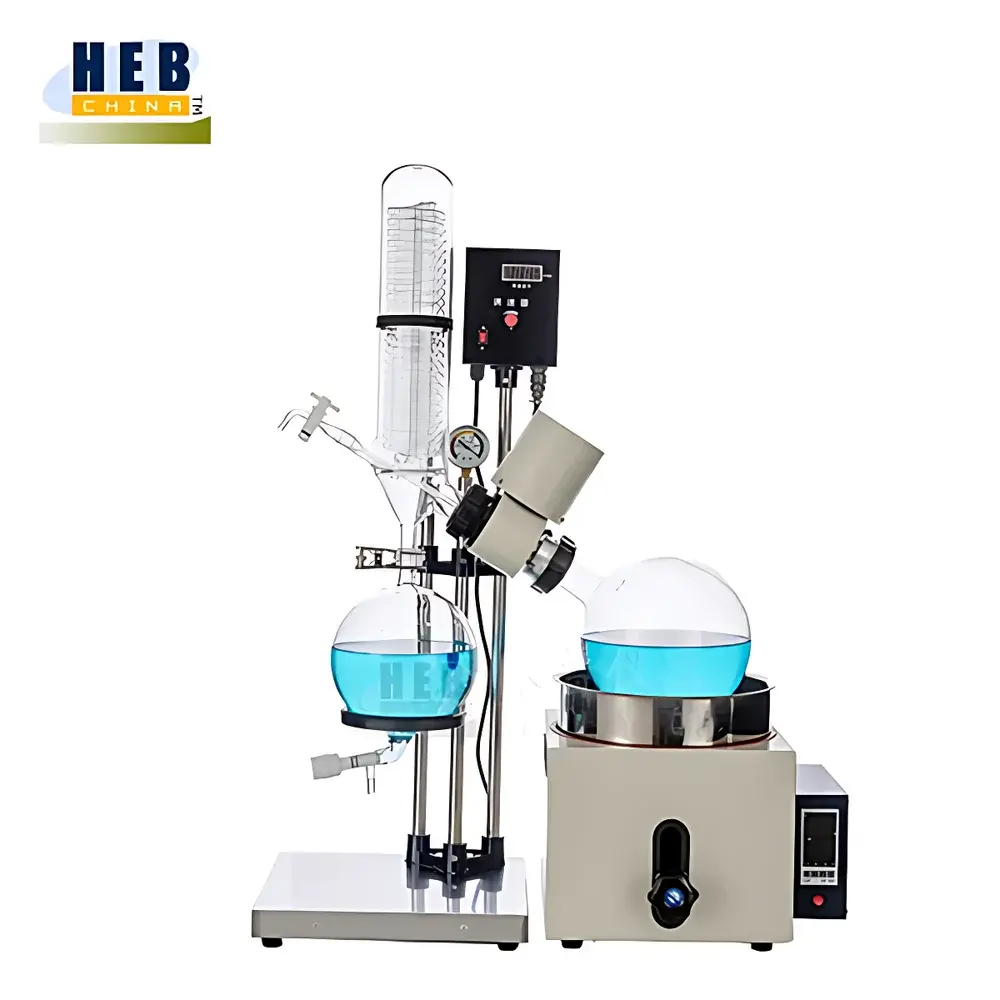
HePu RE-501 Rotary Evaporator
| Brand | HePu (Jinan Hepu Instrument Co., Ltd.) |
|---|---|
| Capacity | 5 L |
| Ultimate Vacuum | 0.098 MPa |
| Rotational Speed | 0–120 rpm |
| Heating Bath Temperature Range | Ambient to 180 °C |
| Temperature Control Accuracy | ±1 °C |
| Condenser Cooling Area | 0.11 m² |
| Power Supply | 220 V / 50 Hz (optional 110 V / 60 Hz) |
| Heating Power | 2 kW |
| Motor Power | 40 W |
| Bath Volume | ~8.6 L |
| Overall Dimensions (L×W×H) | 700 × 335 × 1009 mm |
| Net Weight | 41 kg |
Overview
The HePu RE-501 Rotary Evaporator is an engineered solution for solvent removal, concentration, crystallization, and distillate recovery under reduced pressure—commonly deployed in pharmaceutical development, fine chemical synthesis, natural product isolation, and biotechnology laboratories. It operates on the principle of thin-film evaporation: a motor-driven rotation of the evaporation flask spreads sample material into a uniform, high-surface-area film along the inner wall; simultaneous heating via a thermostatically controlled water or oil bath accelerates vaporization, while vacuum conditions lower the boiling point of solvents. Vaporized solvent passes through a vertically oriented double-layer coiled condenser with enhanced surface area (0.11 m²), where it undergoes rapid phase transition and is collected in a dedicated receiving flask. All wetted components—including evaporating flask, condenser, adapter, and collection vessel—are fabricated from GG-17 borosilicate glass (ISO 3585 compliant), ensuring thermal stability up to 400 °C, resistance to thermal shock, and inertness toward acidic, alkaline, and organic media. Sealing integrity is maintained by dual-material seals combining polytetrafluoroethylene (PTFE) and fluorocarbon elastomer (FKM), enabling stable operation at ≤0.098 MPa absolute pressure.
Key Features
- Stainless steel and aluminum alloy main support frame—rigid, corrosion-resistant, and designed for long-term mechanical stability.
- Digital microprocessor-based temperature controller with K-type thermocouple feedback; setpoint resolution of 0.1 °C and steady-state accuracy of ±1 °C across 0–180 °C range.
- Stepless electronic speed control (0–120 rpm) with real-time digital RPM display and intuitive rotary knob interface.
- Vertically mounted dual-coil serpentine condenser (Φ100 × 590 mm) optimized for high condensate recovery efficiency—particularly critical when handling low-boiling or heat-sensitive solvents such as dichloromethane, ethyl acetate, or ethanol.
- Manually adjustable lifting mechanism for heating bath (0–150 mm travel), enabling precise alignment between rotating flask and condenser axis—minimizing mechanical stress and vapor path resistance.
- Integrated PTFE-lined discharge valve (Φ50 mm flange) on collection flask for quantitative transfer of concentrated extracts without disassembly.
- Front-panel vacuum gauge with direct analog readout for continuous monitoring of system pressure during operation.
- Thermal cut-off fuse and overtemperature protection circuitry comply with IEC 61010-1 safety standards for laboratory electrical equipment.
- Standardized ground-glass joints (19/22, 24/29, 35/20 ball-and-socket, and Φ230 mm/Φ50 mm flanges) ensure compatibility with third-party accessories including chiller units, vacuum controllers, and feed funnels.
Sample Compatibility & Compliance
The RE-501 accommodates a broad spectrum of sample matrices—including aqueous solutions, polar and non-polar organic mixtures, viscous extracts, and thermolabile biomolecules—provided volatility and thermal stability permit thin-film formation. Its all-glass fluid path eliminates metal ion leaching risks, making it suitable for GMP-aligned small-scale API purification and GLP-regulated botanical extract concentration. The instrument meets general requirements of ISO/IEC 17025 for equipment suitability in testing laboratories. While not intrinsically 21 CFR Part 11 compliant (as it lacks audit-trail-capable software), its analog controls and physical interlocks support traceable manual operation within validated workflows when paired with procedural documentation and calibration records per ASTM E2500 and USP .
Software & Data Management
The RE-501 is a standalone benchtop instrument with no embedded firmware or network connectivity. Temperature setpoints, rotation speed, and vacuum status are monitored and adjusted manually via front-panel controls. For integration into automated or regulated environments, optional external data loggers (e.g., Omega OM-DAQPRO-5300) may be connected to the K-type sensor output and tachometer signal port to record time-stamped process parameters. Calibration certificates for temperature and rotational speed sensors can be generated per ISO/IEC 17025-accredited protocols upon request.
Applications
- Concentration of peptide fractions post-solid-phase synthesis prior to lyophilization.
- Removal of reaction solvents (e.g., THF, DMF, toluene) after catalytic hydrogenation or cross-coupling reactions.
- Isolation of essential oils from steam-distilled plant extracts via fractional solvent stripping.
- Recovery and reuse of high-purity chlorinated solvents in QC laboratories to reduce hazardous waste generation.
- Preparative-scale dehydration of hygroscopic intermediates under nitrogen-purged vacuum conditions.
- Simultaneous evaporation of multiple samples using optional parallel evaporation manifolds (not included).
FAQ
What vacuum level is required for optimal performance?
A stable vacuum of ≤0.098 MPa (≤2 mbar absolute) is recommended for efficient low-temperature evaporation of common organic solvents. Performance may degrade above 0.090 MPa due to increased boiling points and reduced condensation efficiency.
Can the RE-501 be used with corrosive solvents like concentrated HCl or bromine?
No. Although GG-17 glass resists mild acids and bases, prolonged exposure to strong oxidizers, halogens, or hydrofluoric acid will etch the surface and compromise structural integrity. Use only with solvents compatible with borosilicate glass and PTFE seals.
Is the heating bath compatible with silicone oil or only water?
Yes—the stainless steel bath is rated for continuous operation up to 180 °C and supports both water and silicone oil as heat-transfer media. Oil use extends the upper temperature limit beyond water’s boiling point but requires additional viscosity and flash-point considerations.
Does the unit include a vacuum pump or cooling circulator?
No. The RE-501 is supplied as a core evaporator assembly only. External vacuum sources (e.g., diaphragm or scroll pumps) and recirculating chillers must be selected and connected separately per application requirements.
How often should the PTFE/FKM seals be replaced?
Under normal usage (≤8 hrs/day, ambient humidity <60%), seals typically retain functional integrity for 12–18 months. Visual inspection for cracking, hardening, or compression set is advised prior to each high-vacuum run.



