
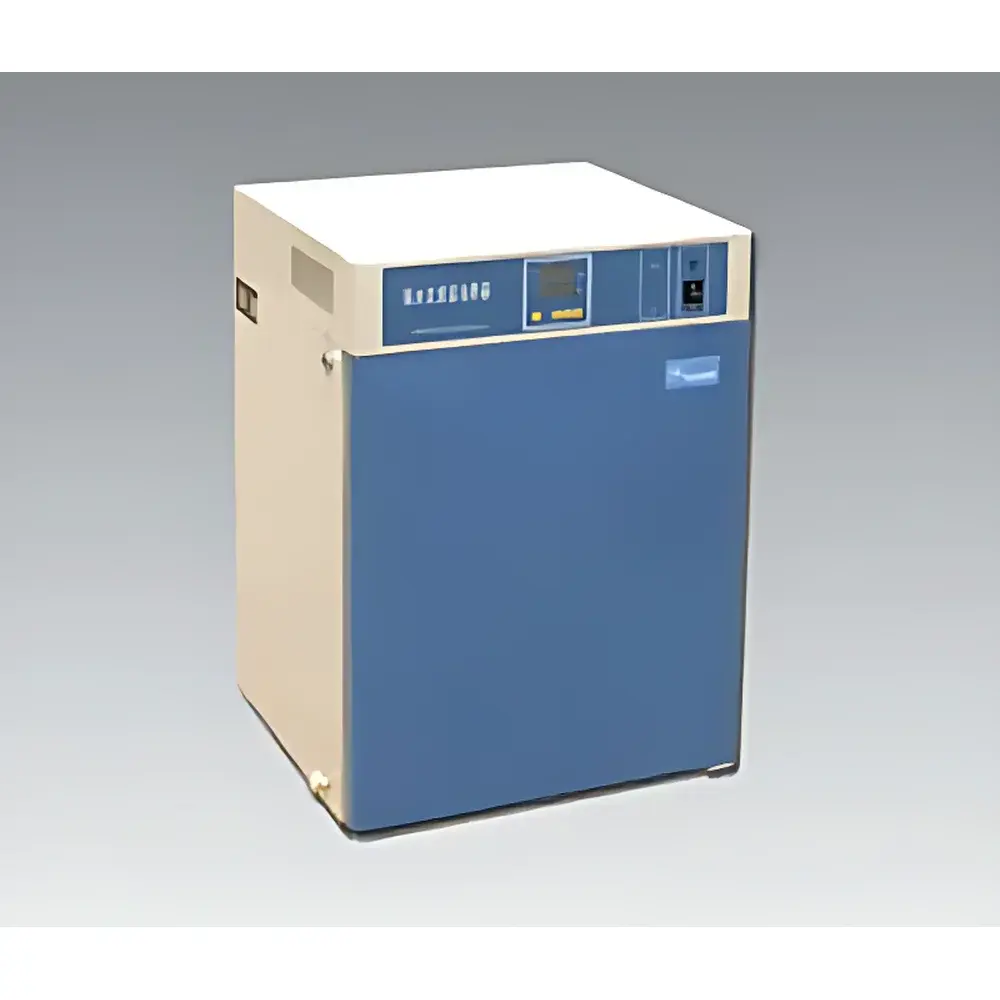
GHP-9050 Water-Jacketed Constant Temperature Incubator
| Brand | Jihepu (Jinan Hepu) |
|---|---|
| Origin | Shandong, China |
| Model | GHP-9050 |
| Temperature Range | RT+5°C to 65°C |
| Temperature Resolution | 0.1°C |
| Temperature Uniformity | ±0.5°C |
| Heating Method | Water Jacket |
| Input Power | 460 W |
| Interior Dimensions (W×D×H) | 350 × 350 × 410 mm |
| Exterior Dimensions (W×D×H) | 510 × 500 × 700 mm |
| Standard Shelving | 2 stainless steel trays |
| Timer Range | 1–9999 minutes |
| Operating Ambient | 5–35°C |
| Voltage/Frequency | 220 V / 50 Hz |
Overview
The GHP-9050 Water-Jacketed Constant Temperature Incubator is a precision-engineered environmental chamber designed for stable, uniform thermal control in microbiological culture, cell propagation, enzyme activity assays, and long-term biological storage applications. Unlike forced-air incubators, the GHP-9050 employs a water-jacketed heating architecture—where temperature-regulated water circulates around the inner chamber walls—delivering superior thermal inertia, reduced temperature fluctuation, and enhanced recovery after door openings. This design ensures minimal thermal gradient across the working volume, critical for sensitive cultures requiring uninterrupted physiological conditions. The unit operates within a controlled range of RT+5°C to 65°C, with a resolution of 0.1°C and verified uniformity of ±0.5°C under no-load conditions at 20°C ambient. Its robust stainless steel interior chamber resists corrosion from repeated sterilization cycles and humid environments, supporting compliance with standard laboratory hygiene protocols.
Key Features
- Microprocessor-based digital controller with integrated timer (1–9999 minutes), enabling precise programmatic incubation cycles and unattended operation.
- Dual-door structure: outer insulated door and inner tempered glass door for real-time visual monitoring without compromising chamber integrity or thermal stability.
- Water-level monitoring system with automatic audible/visual alarm and heater cutoff upon low-water detection—preventing dry-heating damage and ensuring operational safety.
- Independent over-temperature safety cut-off circuit (optional configuration), compliant with IEC 61000-4 electromagnetic compatibility standards and aligned with GLP laboratory risk mitigation requirements.
- High-efficiency water-jacket heating system with optimized thermal mass, maintaining stable internal temperature for up to 60–90 minutes post-power interruption—critical for continuity during brief outages.
- Front-accessible water fill port and drain valve for routine maintenance; sealed jacket minimizes evaporation and simplifies refilling intervals.
Sample Compatibility & Compliance
The GHP-9050 accommodates standard Petri dishes, multi-well plates (6–96-well), culture flasks (T25–T175), and test tubes—configured on two adjustable, autoclavable stainless steel shelves. Its water-jacketed design inherently suppresses convective air currents, minimizing desiccation of agar-based media and reducing condensation on lid surfaces. While not certified to ISO 13485 or FDA 21 CFR Part 11 out-of-the-box, the incubator’s hardware architecture supports integration into validated workflows under ISO/IEC 17025-accredited laboratories when paired with external calibration logs and documented preventive maintenance records. It meets general electrical safety requirements per GB 4793.1 (equivalent to IEC 61010-1) and is suitable for use in Class II biosafety cabinets’ peripheral support zones.
Software & Data Management
The GHP-9050 operates via embedded firmware without proprietary software dependency—ensuring long-term serviceability and eliminating licensing constraints. All setpoints, timer values, and alarm status are retained in non-volatile memory during power loss. For traceability-driven environments, users may connect an external calibrated data logger (e.g., HOBO UX100 series) to the rear-mounted analog output port (0–5 V DC proportional to chamber temperature) to generate audit-ready temperature profiles compliant with FDA 21 CFR Part 11 Annex 11 documentation standards. Optional RS-485 interface (available on upgraded firmware versions) enables integration with LabVantage or STARLIMS LIMS platforms for centralized equipment monitoring.
Applications
- Maintenance of bacterial and fungal stock cultures (e.g., E. coli, S. cerevisiae, A. niger) at defined sub-optimal temperatures for viability preservation.
- Incubation of diagnostic media such as MacConkey Agar, Blood Agar, and Sabouraud Dextrose Agar in clinical microbiology labs adhering to CLSI M02-A12 guidelines.
- Enzyme kinetics studies requiring stable thermal baselines over extended durations (e.g., 4–72 h assays).
- Seed germination trials and plant tissue culture pre-incubation steps where humidity-sensitive explants benefit from low-airflow thermal environments.
- Pre-warming of reagents, buffers, and consumables prior to ELISA, PCR setup, or flow cytometry sample preparation.
FAQ
What is the difference between water-jacketed and air-jacketed incubators?
Water-jacketed units provide greater thermal stability and slower heat loss due to the high specific heat capacity of water—making them preferable for applications demanding minimal drift and resilience to ambient fluctuations.
Can the GHP-9050 be used for CO₂-independent cell culture?
Yes—it is suitable for short-term mammalian cell maintenance (e.g., HEK293, CHO-K1) when paired with buffered media (e.g., HEPES), though it lacks CO₂ regulation and humidity control features required for prolonged monolayer growth.
Is calibration documentation provided with the unit?
Factory calibration certificates are available upon request; users must perform periodic verification using NIST-traceable thermistors per ISO/IEC 17025 Clause 6.4.
How often should the water jacket be refilled or replaced?
Under typical lab conditions (20–25°C ambient), distilled water replenishment is required every 4–6 weeks; annual full drainage, cleaning, and refill are recommended to prevent mineral deposition.
Does the GHP-9050 support remote monitoring or network connectivity?
Not natively—but third-party IoT adapters (e.g., Sensirion SHT4x + ESP32 gateway) can be deployed externally to relay temperature telemetry via MQTT or Modbus TCP to cloud dashboards.
Related Products




