
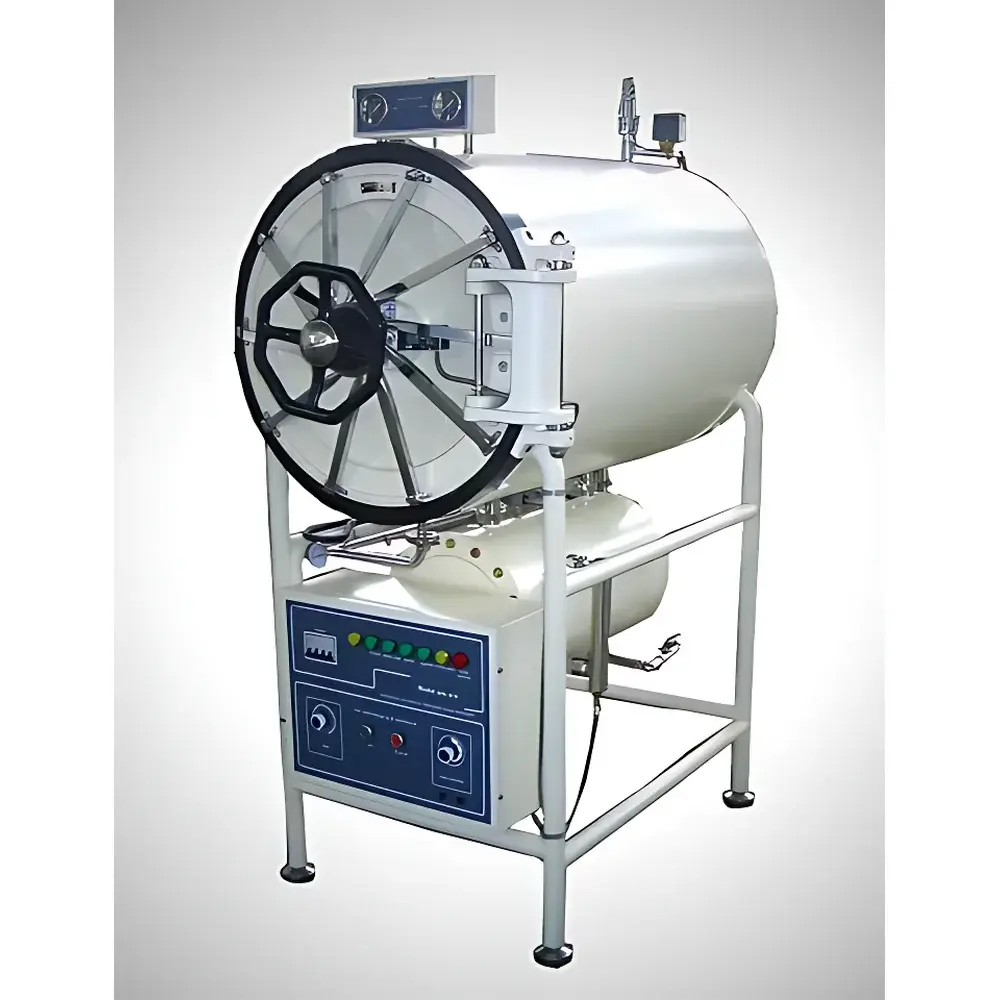
HePu WS-400YDA Horizontal Autoclave
| Brand | HePu (Jihepu) |
|---|---|
| Origin | Shandong, China |
| Model | WS-400YDA |
| Sterilization Chamber Volume | 0.4 m³ (Φ700 × 1100 mm) |
| Maximum Operating Temperature | 134 °C ± 1 °C |
| Maximum Working Pressure | 0.22 MPa |
| External Dimensions | 1430 × 880 × 1830 mm |
| Power Supply | 18 kW / 380 V AC, 50 Hz |
| Temperature Range | 40–134 °C |
| Sterilization Time Range | 0–60 min |
| Drying Time Range | 0–60 min |
| Thermal Uniformity | ≤ ±2 °C |
| Safety Interlocks | Door-locking at >0.027 MPa, automatic steam shutoff on door opening, low-water cutoff, overpressure relief valve (0.24 MPa), earth-leakage and overload protection |
Overview
The HePu WS-400YDA Horizontal Autoclave is a fully automated, Class B vacuum-assisted steam sterilizer engineered for high-reliability terminal sterilization in laboratory, pharmaceutical, clinical, and industrial settings. It operates on the principle of saturated steam under pressure—leveraging the latent heat released during steam condensation to achieve rapid, uniform thermal inactivation of microorganisms, including bacterial spores, viruses, and prions. Designed in strict accordance with ISO 17665-1 (Sterilization of health care products — Moist heat) and aligned with EN 285 (Large steam sterilizers) requirements, the unit delivers validated, repeatable sterilization cycles across diverse load types. Its horizontal cylindrical chamber accommodates large-volume or elongated instrumentation—including surgical trays, glassware, culture media bottles, and porous textile packs—while maintaining precise control over temperature, pressure, time, and drying parameters. The dual-chamber architecture—comprising an inner sterilization chamber and an outer steam jacket—ensures rapid heat-up, minimized thermal gradients, and energy-efficient operation via integrated glass-fiber insulation.
Key Features
- Double-walled, horizontal stainless-steel chamber (SUS304) with steam jacket heating for enhanced thermal stability and corrosion resistance.
- Automated air removal system with programmable pre-vacuum pulses and gravity displacement cycles to ensure complete air evacuation—critical for achieving sterility assurance level (SAL) of 10⁻⁶ per ISO 11134.
- Intelligent PLC-based controller with real-time graphical interface displaying cycle phase, chamber temperature, pressure, elapsed time, and fault diagnostics.
- Multi-stage safety interlock system: door remains mechanically locked until chamber pressure drops below 0.027 MPa; automatic steam isolation upon unintended door actuation; redundant overpressure relief at 0.24 MPa.
- Self-monitoring water level management: automatic fill to 20 L high-water mark prior to heating; continuous low-water detection with audible alarm, power cutoff, and venting activation.
- Integrated drying function with adjustable temperature (up to 134 °C) and duration (0–60 min), enabling residual moisture removal from wrapped instruments and porous materials.
- Comprehensive electrical protection: earth-leakage circuit breaker, thermal overload cutoff, and short-circuit safeguard compliant with IEC 61000-4 EMC standards.
Sample Compatibility & Compliance
The WS-400YDA supports sterilization of a broad spectrum of load categories defined in EN 13060 and ISO 15883: unwrapped solid instruments, wrapped porous loads (e.g., gauze, drapes), hollow devices (with appropriate air removal), liquids (in vented containers), and microbiological culture media. Its validated cycle profiles meet regulatory expectations for GLP and GMP environments, including traceable audit trails for temperature, pressure, and time—facilitating compliance with FDA 21 CFR Part 11 when paired with optional data logging software. All safety mechanisms conform to PED 2014/68/EU (Pressure Equipment Directive) and CE marking requirements. Routine validation can be performed using biological indicators (e.g., Geobacillus stearothermophilus spore strips) and thermocouple mapping per ANSI/AAMI ST79 guidelines.
Software & Data Management
The onboard control system records full-cycle data—including setpoints, actual values, alarms, and operator actions—with timestamped storage for ≥10,000 cycles. Optional USB export enables transfer to external PCs for statistical process analysis (SPC), deviation investigation, and electronic archiving. When integrated with HePu’s optional Ethernet module, remote monitoring, email alerts for cycle completion or faults, and centralized fleet management become available. All data logs support ALCOA+ principles (Attributable, Legible, Contemporaneous, Original, Accurate, Complete, Consistent, Enduring, Available), fulfilling documentation requirements for ISO 9001, ISO 13485, and hospital accreditation audits.
Applications
This autoclave serves as a primary sterilization platform in hospital central sterile supply departments (CSSD), university research laboratories, biotech pilot plants, food safety testing facilities, and pharmaceutical QC labs. Typical use cases include: terminal sterilization of surgical kits and laparoscopic instruments; depyrogenation of glass vials and stoppers; preparation of agar plates and liquid growth media; decontamination of biohazard waste prior to disposal; and validation of sterilization processes for medical device manufacturers under ISO 11135 and ISO 11137 frameworks.
FAQ
What is the maximum allowable load weight for the WS-400YDA chamber?
The chamber is rated for standard loading density up to 180 kg per cycle, assuming uniform distribution and adequate steam penetration pathways.
Does the unit support vacuum-assisted drying cycles?
Yes—programmable post-sterilization vacuum drying enhances moisture removal from wrapped and porous items, reducing post-cycle handling time and minimizing recontamination risk.
Can the autoclave be validated for routine use in regulated environments?
Absolutely—the design includes calibrated PT100 sensors (traceable to NIST standards), cycle reproducibility ≤±0.5 °C, and built-in test modes for Bowie-Dick and Helix tests per EN 285 Annex C.
Is third-party IQ/OQ/PQ documentation available?
HePu provides standardized qualification templates and supports on-site protocol execution by certified validation engineers upon request.
What maintenance intervals are recommended for optimal performance?
Daily: chamber drain inspection and door gasket cleaning. Quarterly: safety valve calibration and vacuum pump oil replacement. Annually: full thermocouple verification and pressure transducer recalibration.



