
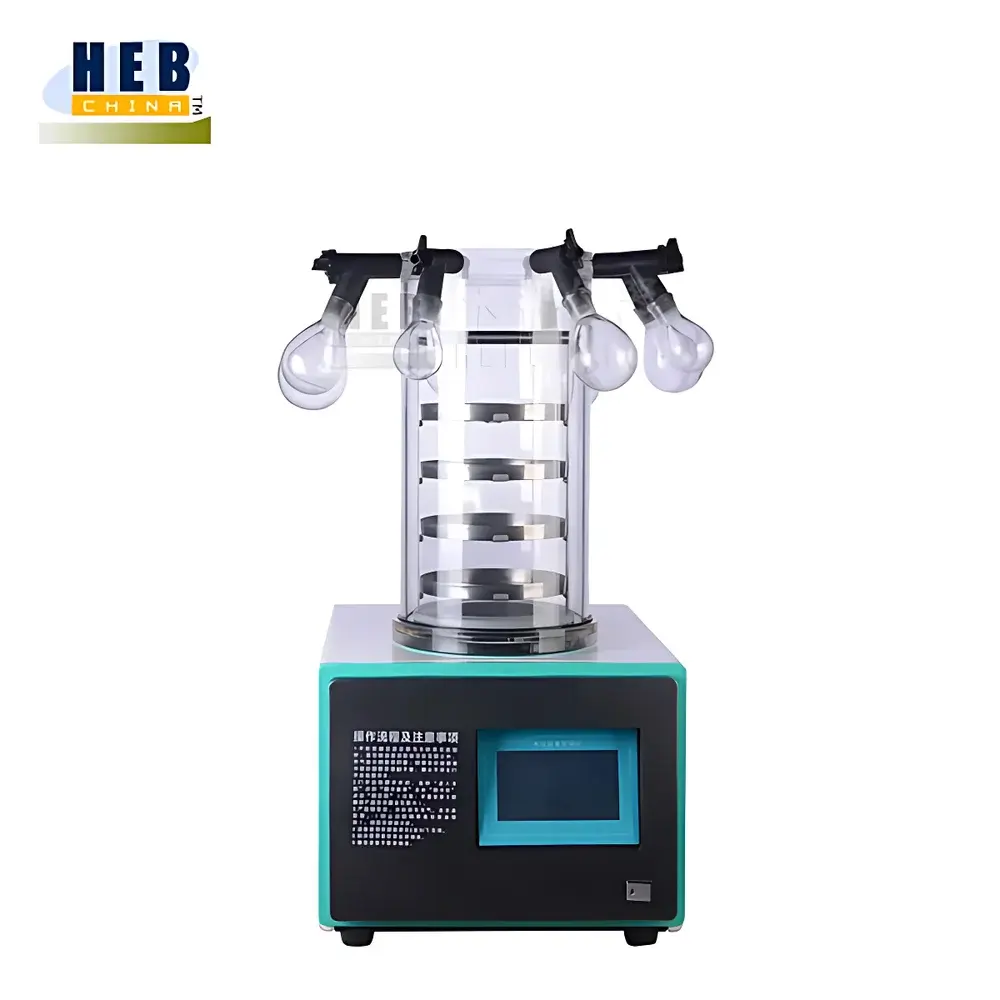
Hebei Jihepu ZLGJ-10 Manifold-Type Laboratory Freeze Dryer
| Brand | Jihepu |
|---|---|
| Origin | Shandong, China |
| Model | ZLGJ-10 |
| Instrument Type | Manifold-Type Freeze Dryer |
| Application | Laboratory-Scale Lyophilization |
| Shelf Area | 0.1 m² |
| Ultimate Vacuum | ≤5 Pa (empty chamber) |
| Condenser Temperature | −55 °C (standard), optional −80 °C |
| Water Capture Capacity | 3–4 kg/24 h |
| Condenser Surface | Stainless Steel, No Internal Coils |
| Cooling Method | Air-Cooled |
| Pumping Speed | 2 L/s |
| Power Supply | 220 V ±10%, 50 Hz, 950 W |
| Dimensions (W×D×H) | 520 × 600 × 400 mm |
| Net Weight | 48 kg |
| Sample Holders | 4 × φ180 mm stainless steel trays (70 mm spacing) |
| Vial capacity | 920 × φ12 mm, 480 × φ16 mm, or 260 × φ22 mm |
| Control System | 7-inch color industrial touchscreen + SH-HPSC-II modular controller |
| Data Logging | Real-time curves for condenser temperature, sample temperature, and vacuum pressure |
| User Management | Multi-level access control with password protection |
| Calibration | Onboard sensor calibration support |
| Operating Environment | 10–30 °C, ≤70% RH, non-corrosive/non-explosive atmosphere |
| Storage Range | −40 to 50 °C |
Overview
The Hebei Jihepu ZLGJ-10 Manifold-Type Laboratory Freeze Dryer is engineered for reliable, small-batch lyophilization of heat-sensitive biological, pharmaceutical, and analytical samples under controlled vacuum and sub-zero conditions. It operates on the principle of sublimation—removing water from frozen samples by direct phase transition from ice to vapor under reduced pressure—enabling preservation of structural integrity, bioactivity, and chemical stability without thermal degradation. Designed for benchtop use in research laboratories, QC facilities, and academic settings, the ZLGJ-10 integrates a high-efficiency air-cooled condenser, manifold port architecture for parallel flask-based drying, and a modular control system compliant with fundamental GLP documentation requirements. Its compact footprint (520 × 600 × 400 mm) and integrated pre-freezing capability eliminate dependency on external ultra-low temperature freezers, streamlining workflow for routine sample preparation.
Key Features
- Monolithic stainless steel construction: Condenser chamber and drying manifold are fabricated from electropolished 304 stainless steel—chemically inert, corrosion-resistant, and compatible with cleaning validation protocols.
- Manifold configuration with eight standardized ports: Supports simultaneous lyophilization of up to eight glass flasks (100–500 mL) or four stainless steel trays (φ180 mm, 70 mm vertical spacing), enabling comparative drying trials or multi-formulation processing.
- Patented gas flow distribution design: Ensures uniform vapor migration from all ports to the condenser surface, minimizing localized ice buildup and maximizing capture efficiency across the full −55 °C condenser surface (optional −80 °C upgrade available).
- Intelligent vacuum management: Vacuum pump activation is temperature-gated—delayed until condenser reaches setpoint—to prevent oil backstreaming and extend pump service life; ultimate vacuum ≤5 Pa achievable under empty-chamber conditions.
- Industrial-grade control architecture: 7-inch resistive touchscreen interface paired with the SH-HPSC-II embedded controller delivers deterministic PID regulation of shelf temperature (indirectly via condenser cooling), vacuum setpoints, and cycle timing with <±0.5 °C thermal stability.
- Comprehensive data traceability: Real-time logging of condenser temperature, estimated product temperature (via thermocouple input), and absolute pressure; timestamped CSV exports support audit-ready record retention per internal SOPs.
- User-access hierarchy: Three-tier permission system (Operator, Technician, Administrator) with password enforcement ensures procedural compliance and prevents unauthorized parameter modification.
Sample Compatibility & Compliance
The ZLGJ-10 accommodates diverse sample formats—including aqueous solutions in glass vials (φ12–22 mm), serum bottles, scintillation vials, and standard taper-neck flasks—without requiring custom adapters. All wetted surfaces contact only USP Class VI-certified elastomers and 304 stainless steel, satisfying baseline material compatibility expectations for GMP-adjacent lab environments. While not FDA 21 CFR Part 11–validated out-of-the-box, its audit-trail-capable data logger, user authentication, and parameter lockout functions provide foundational infrastructure for laboratories implementing internal electronic record controls aligned with ISO/IEC 17025 and WHO TRS 961 Annex 6 guidelines. The unit meets IEC 61000-6-3 (EMC emissions) and IEC 61000-6-2 (immunity) standards for laboratory equipment.
Software & Data Management
Data acquisition occurs at 1-second intervals during active cycles, with persistent storage on internal flash memory (≥10,000-cycle history). Exported .CSV files contain columns for elapsed time, condenser temperature (°C), system vacuum (Pa), and optional external probe readings—fully compatible with Excel, MATLAB, and LabChart for post-run analysis. No proprietary software installation is required; raw files open natively in spreadsheet applications. Firmware updates are delivered via USB drive with SHA-256 checksum verification. Sensor calibration offsets (for temperature and pressure transducers) can be adjusted locally using reference-grade metrology tools, maintaining measurement fidelity over extended operational lifetimes.
Applications
- Stabilization of monoclonal antibodies, enzymes, vaccines, and diagnostic reagents prior to long-term storage or transport.
- Preparation of reference standards and certified reference materials (CRMs) for chromatographic and spectroscopic analysis.
- Drying of microbial cultures, tissue homogenates, and botanical extracts while preserving volatile metabolites and secondary compounds.
- Processing of forensic evidence samples where morphological integrity and DNA/RNA recovery are critical.
- Method development for scale-up to pilot- or production-scale freeze dryers—ZLGJ-10’s process parameters (e.g., shelf-equivalent cooling rate, primary drying endpoint detection via pressure rise test) correlate directly with larger systems.
FAQ
Does the ZLGJ-10 include a built-in refrigeration compressor?
Yes—it features a sealed, air-cooled scroll-type compressor from an internationally recognized manufacturer, rated for continuous operation at −55 °C condenser temperature.
Can the system accommodate custom flask sizes beyond the supplied set?
Yes, provided appropriate PTFE-coated stopcocks and O-ring seals are used; port dimensions conform to ISO 2858 standard flange interfaces.
Is remote monitoring supported via Ethernet or Wi-Fi?
No—communication is limited to USB mass-storage export and local touchscreen interaction. Network connectivity is not implemented to minimize cybersecurity attack surface in regulated labs.
What maintenance intervals are recommended for the vacuum pump?
Oil changes every 500 operating hours; inlet filter inspection every 100 hours; full pump rebuild recommended at 5,000 hours or per manufacturer specifications.
How is condenser defrosting performed?
Via natural ambient-air thawing only—no active heating elements are installed, preserving thermal shock resistance of the stainless steel condenser surface.



