
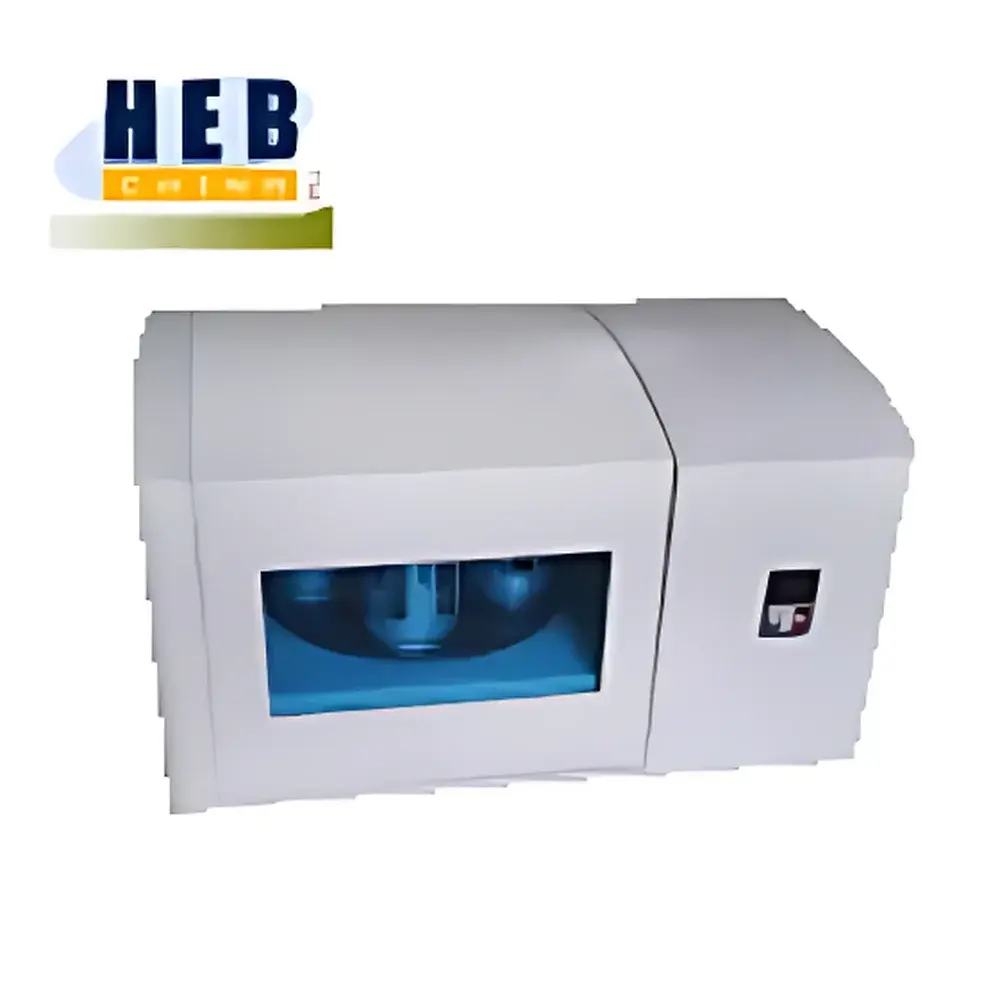
JH-B4 Soil Grinder
| Brand | Jihepu (Jinan Hepu) |
|---|---|
| Origin | Shandong, China |
| Model | JH-B4 |
| Grinding Mode | Dry & Wet |
| Max Feed Size | ≤10 mm |
| Final Particle Size | ≤0.1 µm |
| Batch Capacity | 50–250 mL |
| Speed Range | 0–1499 rpm |
| Grinding Mechanism | Impact & Friction Force |
| Display | Digital LED |
| Max Continuous Operation | 72 h |
| Noise Level | ≤50 dB(A) |
| Dimensions | 80 × 50 × 50 cm |
| Weight | 150 kg |
| Grinding Vessel Options | Agate, Stainless Steel, Tungsten Carbide, PTFE, Nylon, Zirconia, Polycarbonate |
Overview
The Jihepu JH-B4 Soil Grinder is a high-performance planetary ball mill engineered for reproducible, contamination-controlled size reduction of soil and other heterogeneous solid matrices in environmental, agricultural, and geochemical laboratories. Operating on the principle of high-energy planetary motion—where grinding jars rotate eccentrically around a sun wheel while simultaneously revolving on their own axes—the instrument generates intense impact and shear forces between grinding media (e.g., balls) and sample material. This dual-motion mechanism ensures rapid, uniform comminution of hard, brittle, or fibrous samples to sub-micron particle sizes without thermal degradation. Designed specifically for environmental sample preparation workflows, the JH-B4 meets the mechanical homogenization requirements outlined in EPA Method 3050B, ISO 11464:2021 (soil pretreatment), and ASTM D4292 (particle size analysis of soils). Its robust cast-iron frame, precision-balanced drive system, and sealed grinding chamber minimize vibration transmission and ambient noise—critical for shared laboratory environments.
Key Features
- Programmable digital control interface with real-time rpm, time, and direction display; supports single-step or multi-segment timing (up to 50 gradient steps per program on JH-B4A variant)
- Non-volatile memory retains user-defined parameters—including start delay, total runtime, forward/reverse cycling intervals, and pause duration—even after power interruption
- Dual-mode operation: dry grinding for volatile or moisture-sensitive matrices; wet grinding with solvent or dispersant for heat-sensitive or agglomerated soils
- Modular jar configuration: accommodates 1, 2, or 4 grinding vessels (50 mL, 100 mL, or 250 mL capacity) made from chemically inert materials including agate, zirconia, stainless steel, tungsten carbide, PTFE, nylon, and polycarbonate
- Low-noise design (≤50 dB[A] at 1 m distance) achieved via acoustic damping enclosure, rubber-isolated base, and optimized gear train dynamics
- 72-hour maximum continuous duty cycle under full load—validated per IEC 61000-4-30 for sustained operational reliability
Sample Compatibility & Compliance
The JH-B4 is validated for processing soil samples containing clay, silt, sand, organic matter, and trace metal contaminants—including Cr, Pb, Cd, As, and Hg—prior to acid digestion (EPA 3050B/3051A) or XRF analysis. It accepts feed particles up to 10 mm (soil) or 3 mm (metal ores), reducing them consistently to ≤0.1 µm median particle size (D50) as verified by laser diffraction (ISO 13320). Jar material selection follows ISO 17025:2017 clause 6.4.2—preventing cross-contamination during heavy-metal analysis. The instrument complies with CE machinery directive 2006/42/EC, RoHS 2011/65/EU, and EMC directive 2014/30/EU. Optional audit-trail-enabled software (sold separately) supports 21 CFR Part 11-compliant electronic records when integrated with validated LIMS platforms.
Software & Data Management
While the base JH-B4 operates via standalone digital controls, the JH-B4A variant integrates an LCD touch panel supporting local storage of up to 10 multi-stage grinding protocols. Firmware updates are performed via USB port. For centralized lab management, optional PC-based control software enables remote monitoring and synchronized operation of multiple units—each with independent parameter logging (timestamped rpm, duration, direction, jar ID). Data export is supported in CSV and XML formats compatible with ELN systems. All software modules undergo IQ/OQ validation documentation support per GxP guidelines, including calibration traceability to NIST-traceable torque and rotational speed standards.
Applications
- Environmental labs: Homogenization of field-collected soil cores prior to heavy metal extraction, organic pollutant screening (e.g., PAHs, PCBs), and nutrient profiling (NPK, CEC)
- Agricultural research: Particle-size distribution analysis for soil texture classification (USDA textural triangle), clay mineralogy studies, and pesticide residue recovery optimization
- Geochemical surveying: Preparation of rock-soil composites for ICP-MS/OES quantification and stable isotope ratio analysis (δ13C, δ15N)
- Regulatory compliance: Sample prep for ISO 14001-certified environmental monitoring programs and national soil quality assessment frameworks (e.g., China’s GB 15618-2018)
- Material science: Pre-treatment of ceramic precursors, catalyst supports, and composite fillers requiring controlled crystallite size reduction
FAQ
What jar materials are recommended for trace-metal soil analysis?
Agate and zirconia jars are preferred for low-background heavy metal analysis due to negligible leaching of Al, Fe, or Zr under acidic conditions.
Can the JH-B4 be used for cryogenic grinding?
No—this model lacks liquid nitrogen jacketing or temperature-controlled chambers; it is rated for ambient operation only (10–35°C).
Is the grinding time programmable in minutes or seconds?
Yes—time resolution is 1 second, with total duration configurable from 10 seconds to 72 hours.
Does the instrument include grinding media (balls)?
No—balls must be selected and purchased separately based on jar volume, material compatibility, and desired energy input (e.g., 5–20 mm diameter zirconia balls for 100 mL agate jars).
How is maintenance performed on the planetary drive system?
The sealed gearbox requires no routine lubrication; annual inspection of belt tension and motor coupling alignment is recommended per the maintenance log in the operator manual.



