
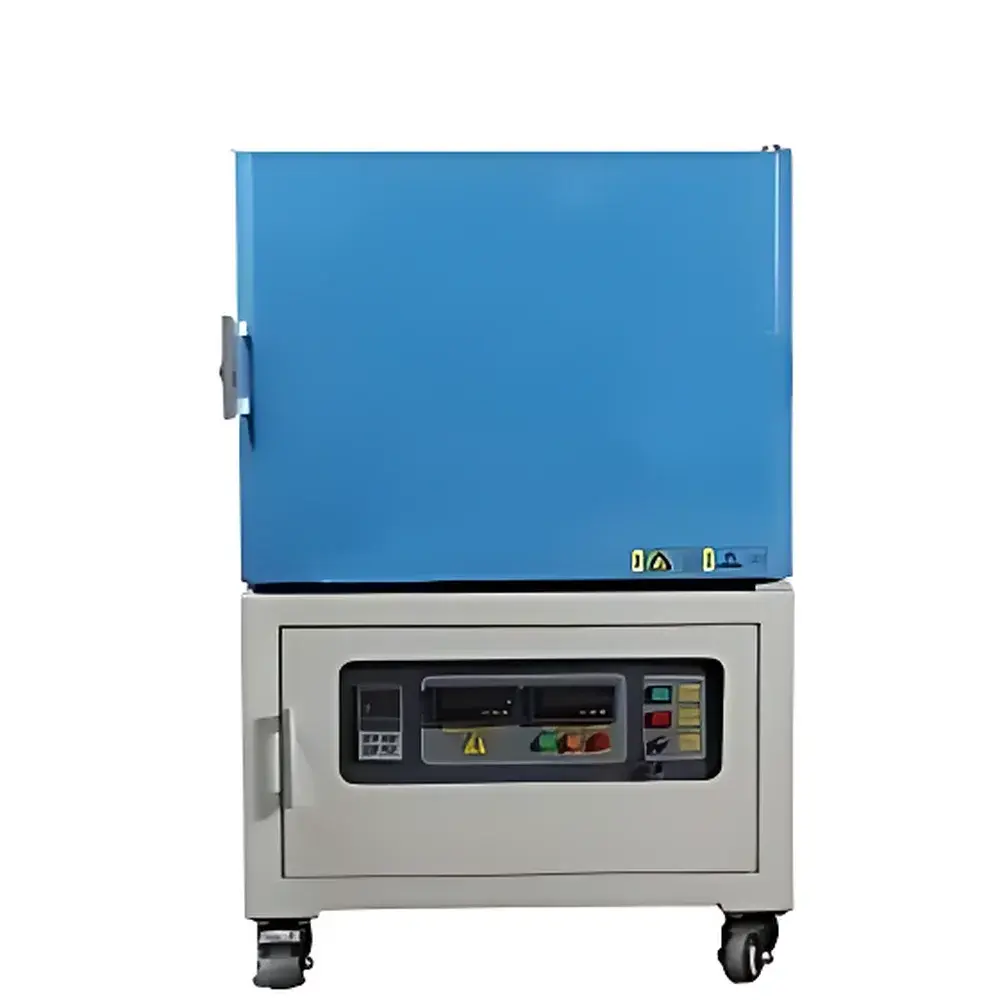
Jihepu SXL-1700C High-Temperature Box-Type Laboratory Muffle Furnace
| Brand | Jihepu |
|---|---|
| Origin | Shandong, China |
| Model | SXL-1700C |
| Maximum Temperature | 1650 °C (continuous operation ≤1600 °C) |
| Control Accuracy | ±1 °C |
| Power Supply | AC 220 V / 50–60 Hz, 6 kW (also available in 380 V / 14 kW variant) |
| Heating Element | High-Purity Silicon Molybdenum (MoSi₂) Rods |
| Internal Chamber Dimensions | 300 × 250 × 200 mm (D × W × H) |
| Heating Rate | ≤10 °C/min recommended |
| Cooling Rate | ≤10 °C/min above 700 °C |
| Insulation Material | Vacuum-adsorbed Al₂O₃ polycrystalline fiber board (1700-grade), coated with high-emissivity/low-conductivity ceramic coating |
| Thermocouple Type | B-type (PtRh30/PtRh6), rear-mounted for representative chamber temperature measurement |
| Compliance | CE certified (GB/1067/4189/12 Issue 1), conforms to GB/T 10066.1–2004 and GB/T 10067.4–2005 |
Overview
The Jihepu SXL-1700C is a high-temperature box-type muffle furnace engineered for precision thermal processing in academic research laboratories, materials science institutes, and industrial R&D environments. Designed around a robust dual-shell architecture with forced-air cooling, it delivers stable, repeatable operation at temperatures up to 1650 °C—optimized for continuous use at ≤1600 °C. Its core thermal system employs silicon molybdenum (MoSi₂) heating elements, known for excellent oxidation resistance and long service life in oxidizing atmospheres up to 1800 °C. The furnace utilizes a vacuum-adsorbed, high-purity alumina polycrystalline fiber insulation system—developed using Japanese manufacturing technology—which provides superior thermal retention, low thermal conductivity (<0.15 W/m·K at 1000 °C), and exceptional dimensional stability under repeated thermal cycling. Unlike conventional ceramic fiber boards, this material exhibits negligible shrinkage and no binder-derived volatiles, ensuring consistent cavity geometry and minimal contamination risk during high-purity sintering or annealing.
Key Features
- Intelligent temperature control system featuring PID algorithm with auto-tuning capability and programmable 50-segment ramp-soak profiles for precise thermal protocol execution.
- Left-hinged door with safety interlock: power is automatically cut upon opening, eliminating exposure to radiant heat during sample loading/unloading.
- Dual-layer furnace shell with integrated air-cooling ducts maintains external surface temperature below 50 °C at full operating temperature—reducing lab ambient heat load and improving operator safety.
- Modular, interlocking polycrystalline fiber chamber design includes strategically placed expansion relief vents to accommodate thermal contraction/expansion, preventing cracking or delamination over extended service life.
- Rear-mounted B-type thermocouple ensures accurate measurement of true chamber temperature—not wall or element temperature—enabling reliable process validation and reproducibility.
- Standard RS485 communication interface supports integration with third-party SCADA systems or Jihepu’s optional PC-based control software for remote monitoring, real-time data logging, audit-trail generation, and batch report export (CSV/PDF).
- Comprehensive safety suite includes over-temperature cutoff, ground-fault circuit interruption (GFCI), and audible/visual alarm activation on fault detection.
Sample Compatibility & Compliance
The SXL-1700C accommodates standard high-purity crucibles—including alumina, zirconia, and graphite—as well as custom fixtures up to 300 mm depth × 250 mm width × 200 mm height. Its inert muffle chamber eliminates direct flame contact and minimizes atmospheric interaction, making it suitable for oxidation-controlled processes such as ceramic sintering (e.g., YSZ, AlN), powder metallurgy pre-sintering, catalyst calcination, ash content determination (ASTM D3174), and thermal gravimetric pre-conditioning per ISO 11358. The furnace complies with GB/T 10066.1–2004 (general safety requirements for industrial electrothermal equipment) and GB/T 10067.4–2005 (safety specifications for laboratory furnaces). CE marking confirms conformity with EU Machinery Directive 2006/42/EC and Electromagnetic Compatibility Directive 2014/30/EU. While not inherently classified for Class I Div 1 hazardous locations, optional purge fittings enable nitrogen or argon atmosphere adaptation for controlled-atmosphere applications.
Software & Data Management
The optional Jihepu FurnaceControl Suite (v3.2+) enables centralized supervision of single or networked SXL-series units. It records timestamped temperature, power draw, and program stage data at user-defined intervals (1–60 s), stores historical runs with metadata tagging (operator ID, batch number, material type), and exports fully traceable reports compliant with GLP and internal QA documentation standards. Audit trails meet FDA 21 CFR Part 11 requirements when deployed with Windows domain authentication and electronic signature modules. All data files are saved in non-proprietary formats (UTF-8 CSV, PDF/A-1a), facilitating integration into LIMS platforms or statistical process control (SPC) workflows without vendor lock-in.
Applications
- Ceramic and refractory development: densification studies, phase transition analysis, and firing schedule optimization for oxide and non-oxide systems.
- Advanced battery materials: cathode precursor calcination (e.g., NMC, LFP), solid electrolyte sintering, and electrode coating thermal treatment.
- Metallurgical research: alloy homogenization, grain growth kinetics, and intermetallic compound synthesis.
- Geochemical and environmental testing: loss-on-ignition (LOI) assays, soil mineral decomposition, and fly ash characterization per ASTM C114.
- Quality assurance labs: reference material stabilization, calibration standard annealing, and inter-laboratory round-robin test preparation.
FAQ
What is the maximum continuous operating temperature?
The SXL-1700C is rated for continuous operation at ≤1600 °C. Peak temperature capability is 1650 °C, intended for short-duration thermal excursions only.
Can this furnace be used under inert or reducing atmospheres?
Yes—optional quartz or stainless-steel gas inlet/outlet ports allow connection to N₂, Ar, or forming gas lines. Note that MoSi₂ elements require oxidizing conditions for protective silica layer formation; prolonged use below 800 °C in reducing atmospheres may accelerate degradation.
Is the temperature uniformity specified across the chamber?
Typical radial and axial uniformity is ±5 °C within the central 70% volume at 1500 °C, verified per ASTM E220 methodology using multi-point thermocouple mapping.
Does the unit include calibration documentation?
Each furnace ships with a factory calibration certificate referencing NIST-traceable standards, covering thermocouple output, controller linearity, and setpoint accuracy at three points (800 °C, 1200 °C, 1600 °C).
What maintenance is required for long-term reliability?
Annual inspection of MoSi₂ rod resistance (±10% deviation indicates replacement), visual check of fiber integrity, and cleaning of cooling fan filters are recommended. No lubrication or consumable parts are required beyond thermocouple replacement every 12–18 months under continuous use.



