
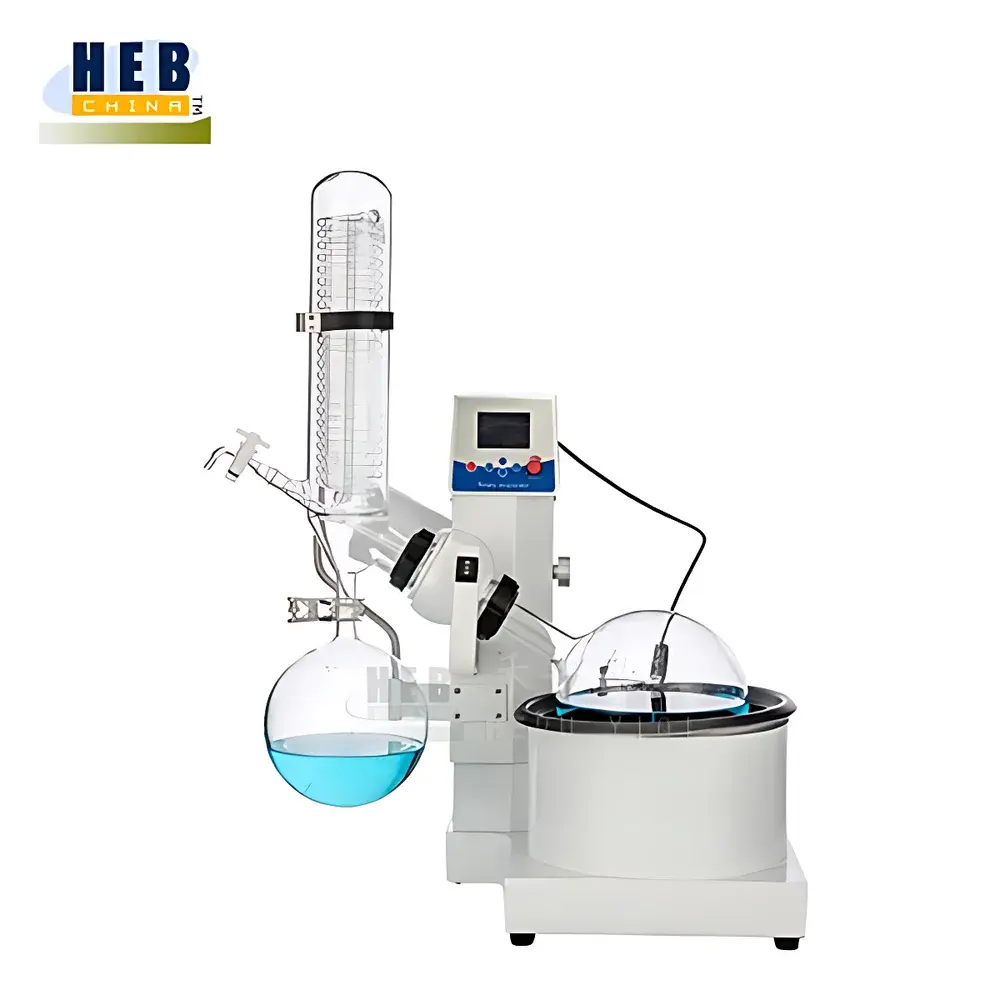
Rotary Evaporator RE-5000 by Jihepu
| Key | Capacity: 5 L |
|---|---|
| Ultimate Vacuum | 0.098 MPa |
| Rotation Speed | 0–200 rpm |
| Temperature Control Range | 0–400 °C |
| Temperature Accuracy | ±1 °C |
| Condenser Cooling Area | 0.11 cm² |
| Power Supply | 220 V / 50 Hz (optional 110 V / 60 Hz) |
| Heating Power | 2 kW |
| Motor Power | 40 W |
| Lift Stroke | 0–150 mm |
| Dimensions (L×W×H) | 700 × 410 × 880 mm |
| Net Weight | 43 kg |
Overview
The Jihepu RE-5000 Rotary Evaporator is a precision-engineered vacuum distillation system designed for efficient solvent removal, concentration, crystallization, and recovery under controlled thermal and pressure conditions. Operating on the principle of thin-film evaporation under reduced pressure, it enables rapid and gentle volatilization of heat-sensitive compounds—particularly critical in pharmaceutical development, fine chemical synthesis, natural product isolation, and biotechnology applications. The instrument integrates a motor-driven rotating evaporation flask, digitally regulated heating bath, high-efficiency vertical double-layer coil condenser, and robust vacuum-compatible sealing architecture. All wetted surfaces contacting samples or vapors are constructed from borosilicate glass (GG-17), rated for continuous use from –80 °C to +250 °C, and fluoropolymer components (PTFE and imported FKM elastomers), ensuring chemical inertness and long-term vacuum integrity.
Key Features
- Aluminum alloy mainframe with optimized mechanical rigidity and ergonomic layout for stable operation and extended service life.
- Dual-material sealing system combining PTFE and high-grade fluoroelastomer (FKM) for bidirectional vacuum integrity—maintains ultimate vacuum ≤0.098 MPa during prolonged operation.
- GG-17 borosilicate glass assembly—including 5 L evaporation flask (Φ230 mm, standard 50# ground joint), 2 L collection flask (166 mm diameter, 35# spherical joint), and Φ100 × 590 mm vertical double-helix condenser—guarantees thermal shock resistance and optical clarity for process monitoring.
- Digital PT100 temperature sensor integrated into stainless steel–lined, PTFE-coated heating bath (Φ280 × 170 mm, ~10.5 L capacity), delivering precise thermal control across water- or oil-based media within 0–400 °C range at ±1 °C accuracy.
- Micro-motor-driven automatic lift mechanism (0–150 mm travel) with overload protection, enabling safe flask immersion and removal without manual adjustment.
- Stepless electronic speed control (0–200 rpm) with real-time digital RPM display; rotation stabilized via precision gearmotor to ensure uniform thin-film formation on flask interior walls.
- Integrated safety circuitry including thermal cut-off fuse and dry-run prevention logic that deactivates heating if bath fluid level falls below operational threshold.
- Standardized modular interface design: 19# ground joint feed valve, 10 mm push-fit vacuum inlet (compatible with diaphragm, scroll, or oil-sealed pumps), and dual 10 mm coolant ports (12 × 8 mm tubing) for connection to recirculating chillers or cold water sources.
Sample Compatibility & Compliance
The RE-5000 accommodates a broad spectrum of organic solvents (e.g., ethanol, acetone, dichloromethane, ethyl acetate), aqueous solutions, and thermally labile extracts—including proteins, peptides, and plant-derived terpenoids—without degradation. Its all-glass/fluoropolymer fluid path complies with general laboratory good manufacturing practice (GMP) expectations for non-contaminating material contact surfaces. While not certified to ISO 9001 or FDA 21 CFR Part 11 out-of-the-box, its architecture supports audit-ready documentation workflows when paired with validated external data loggers and electronic lab notebooks (ELNs). The system meets fundamental requirements referenced in ASTM E2654 (Standard Guide for Validation of Aqueous Solvent Recovery Systems) and aligns with ISO 27025 clause 5.5.2 regarding equipment suitability for intended analytical use.
Software & Data Management
The RE-5000 operates as a standalone analog-digital hybrid instrument with local control only—no embedded firmware, network connectivity, or proprietary software suite. All operational parameters (rotation speed, bath temperature, lift position) are monitored and adjusted via front-panel LED displays and tactile controls. For traceable process recording, users may integrate third-party USB or RS-485 data loggers compatible with PT100 output and 0–10 V speed feedback signals. When deployed in regulated environments, documented calibration procedures (per ISO/IEC 17025 Section 6.4) and maintenance logs—including seal replacement intervals and vacuum leak testing records—are recommended to support GLP/GMP compliance audits.
Applications
- Solvent recovery and reuse in API synthesis and intermediate purification workflows.
- Concentration of crude botanical extracts prior to HPLC fractionation or lyophilization.
- Removal of low-boiling solvents post-Suzuki coupling or Grignard reactions.
- Dehydration of hygroscopic catalysts and metal-organic frameworks (MOFs) under mild thermal conditions.
- Preparative-scale removal of tetrahydrofuran (THF) or dimethylformamide (DMF) from polymer solutions.
- Distillative separation of volatile flavor compounds from fermented broths in food science R&D.
FAQ
What is the maximum recommended operating temperature for the GG-17 glass components?
The evaporation and condenser flasks are rated for continuous exposure up to +250 °C; however, sustained operation above 180 °C requires verification of seal integrity and vacuum pump compatibility with elevated vapor temperatures.
Can the RE-5000 be used with corrosive solvents such as concentrated HCl or bromine-containing reagents?
No. While PTFE and FKM provide broad chemical resistance, halogenated acids and oxidizing agents (e.g., fuming nitric acid, chlorine gas) exceed their compatibility limits and may compromise seal longevity and vacuum performance.
Is the heating bath compatible with silicone oil and ethylene glycol–water mixtures?
Yes—the stainless steel–PTFE composite bath is chemically resistant to common heat-transfer fluids used across the 0–400 °C range; viscosity and flash point of the selected medium must be verified per manufacturer specifications.
Does the unit include a vacuum controller or pressure sensor?
No. Vacuum regulation must be managed externally via a compatible vacuum pump with inline gauge or a separate digital vacuum controller connected to the 10 mm inlet port.
What maintenance intervals are recommended for optimal long-term vacuum performance?
Fluoroelastomer seals should be inspected quarterly and replaced annually or after 500 operational hours; glass joints require periodic cleaning with acetone and light greasing with high-vacuum silicone grease (Dow Corning HV 100).



