
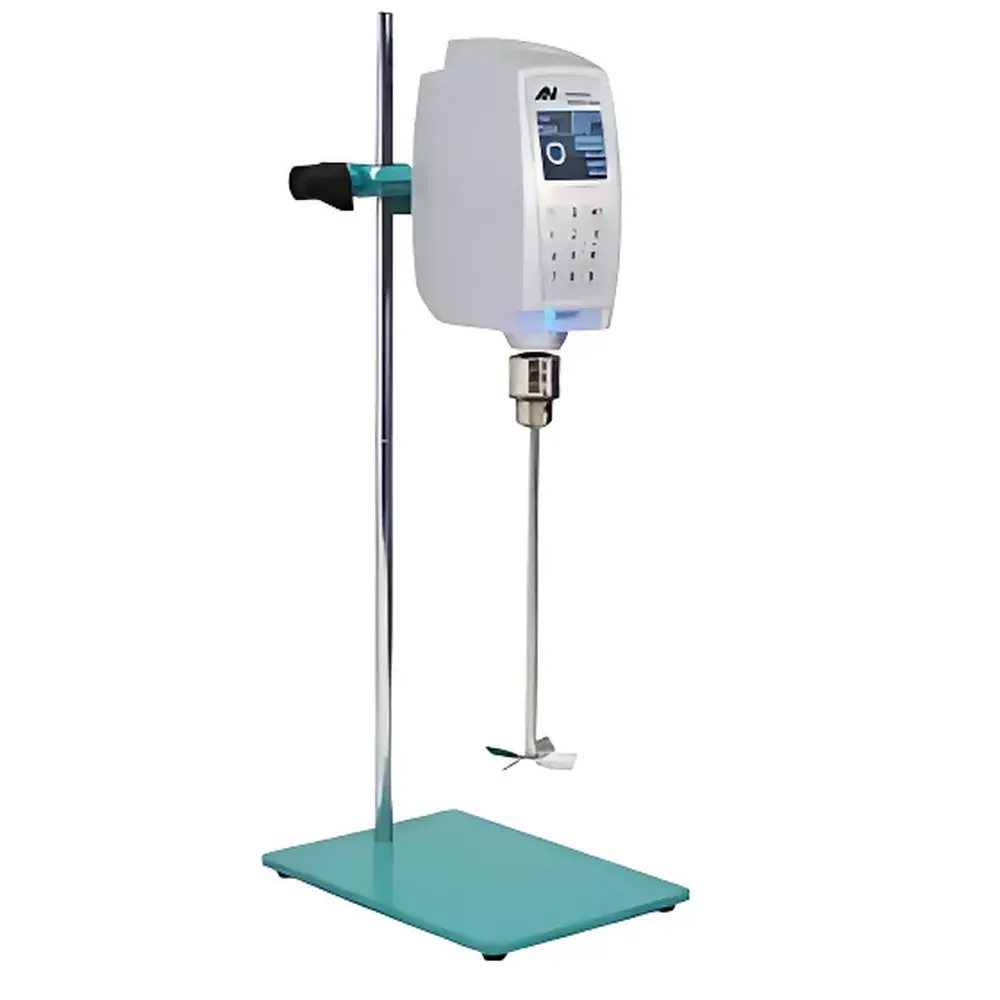
Jihepu AM250W-T Advanced Digital Laboratory Stirrer with Brushless DC Motor and TFT Display
| Brand | Jihepu |
|---|---|
| Model | AM250W-T |
| Max. Mixing Volume | 30 L (water-equivalent) |
| Speed Range | 30–2000 rpm, continuously adjustable |
| Torque Output | 49.7 N·cm (rated), 150.0 N·cm (peak) |
| Input Power | 368 W |
| Output Power | 250 W |
| Motor Type | Brushless DC |
| Control Interface | Capacitive Touch Keyboard |
| Display | TFT Color Screen |
| Speed Regulation | Microprocessor-controlled, load- and voltage-compensated |
| Timer Range | 1–6000 min |
| Overload Protection | Integrated thermal & current-limiting circuit |
| Clamp Type | Quick-release chuck |
| Chuck Capacity | Φ2–13 mm |
| Max. Viscosity Handling | 100,000 mPa·s |
| IP Rating | IP40 |
| Dimensions (W×D×H) | 250 × 350 × 835 mm |
| Net Weight | 14.5 kg |
| Operating Ambient | ≤40 °C, ≤80 % RH |
Overview
The Jihepu AM250W-T is a high-performance digital laboratory stirrer engineered for precision mixing and dispersion of low- to high-viscosity fluids across research, quality control, and pilot-scale development environments. It operates on the principle of rotational mechanical agitation—transferring torque from a brushless DC motor through a rigid shaft to a mounted impeller, inducing laminar to transitional flow regimes in the sample. Unlike induction-driven or geared AC stirrers, its brushless architecture eliminates carbon wear, ensures consistent torque delivery across the full speed range, and supports extended continuous-duty operation (S1 rating) without thermal derating. The system’s microprocessor-based speed regulation dynamically compensates for load-induced deceleration and input voltage fluctuations—maintaining setpoint accuracy within ±1.5% of nominal rpm under variable viscosity conditions. This level of speed stability is critical when preparing homogeneous suspensions, dissolving polymers, or conducting kinetic studies where shear history directly influences colloidal structure or reaction yield.
Key Features
- Brushless DC motor delivering 250 W continuous output power and 150.0 N·cm peak torque—optimized for viscous media up to 100,000 mPa·s
- TFT color display showing real-time rpm, torque trend (simulated), elapsed time, and setpoint confirmation—enabling traceable parameter monitoring
- Capacitive touch keyboard with haptic feedback for intuitive, glove-compatible operation and reduced mechanical failure risk
- Intelligent speed control algorithm with automatic load compensation—maintains target rpm during viscosity spikes or volume changes
- Integrated electronic overload protection with thermal cutoff and current limiting—prevents motor stall damage during high-torque startup or gel formation
- Quick-release chuck (Φ2–13 mm) compatible with standard ISO 8687–1 shaft diameters; includes four-blade helical impeller optimized for axial flow and bulk circulation
- Programmable timer (1–6000 min) with auto-shutdown and memory retention for repeatable protocol execution
Sample Compatibility & Compliance
The AM250W-T is validated for use with aqueous, organic, and semi-polar solvents; polymer solutions; ceramic slurries; pharmaceutical suspensions; and food-grade emulsions. Its sealed motor housing (IP40) and non-corrosive aluminum alloy chassis meet general laboratory environmental requirements per IEC 61010-1 for electrical safety. While not certified for explosive atmospheres (ATEX/IECEx), it complies with CE marking directives for EMC (2014/30/EU) and Low Voltage (2014/35/EU). For GLP/GMP-aligned workflows, the device supports audit-ready documentation via screen-captured rpm/torque logs (when interfaced with external data acquisition systems) and adheres to fundamental principles outlined in USP for analytical instrument qualification—particularly in Operational Qualification (OQ) for speed accuracy and repeatability testing.
Software & Data Management
The AM250W-T operates as a standalone instrument with no embedded firmware update capability or native USB/RS-232 connectivity. However, its TFT interface provides visual traceability of all operational parameters—including real-time torque simulation (derived from current draw and motor back-EMF modeling) and rpm deviation trends—supporting manual data recording per SOP requirements. For laboratories requiring electronic records, the unit may be integrated into broader lab automation frameworks via external optical tachometer coupling or analog 0–10 V torque signal output (available upon request with optional interface module). All user settings—including speed presets, timer values, and torque thresholds—are retained after power cycling, satisfying basic ALCOA+ data integrity expectations for parameter persistence.
Applications
This stirrer serves core functions in method development and routine analysis across multiple regulated sectors: dissolution testing of solid dosage forms (aligned with USP agitation specifications); preparation of calibration standards for viscometry and particle sizing; homogenization of nanoparticle dispersions prior to DLS or TEM analysis; blending of catalyst slurries in fine chemical synthesis; and rheological conditioning of hydrogels used in biomaterial characterization. Its wide speed range and high torque enable both gentle suspension maintenance (e.g., cell cultures at 50–100 rpm) and aggressive dispersion of agglomerates (e.g., carbon black in elastomer masterbatches at 1800+ rpm). In academic teaching labs, it supports hands-on instruction in fluid dynamics, mass transfer, and process scale-up fundamentals.
FAQ
Does the AM250W-T support external computer control or data export?
No—the unit lacks built-in serial, USB, or Ethernet interfaces. Data must be recorded manually from the TFT display or captured externally using third-party sensors.
What impeller types are compatible beyond the included four-blade helix?
Any ISO-standard shaft (Φ2–13 mm) impeller—such as paddle, anchor, propeller, or Rushton turbine—can be mounted using the quick-release chuck.
Is the device suitable for use inside a fume hood or cold room?
Yes, provided ambient temperature remains between 5–40 °C and relative humidity does not exceed 80 %. Condensation must be prevented on the TFT surface and touch panel.
Can it operate continuously for 24 hours?
Yes—its S1 continuous duty rating and thermal management system permit unattended operation over extended periods, subject to proper ventilation and load limits.
What maintenance is required for long-term reliability?
None beyond periodic cleaning of the chuck and shaft interface; the brushless motor contains no consumable parts and requires no lubrication or brush replacement.



