
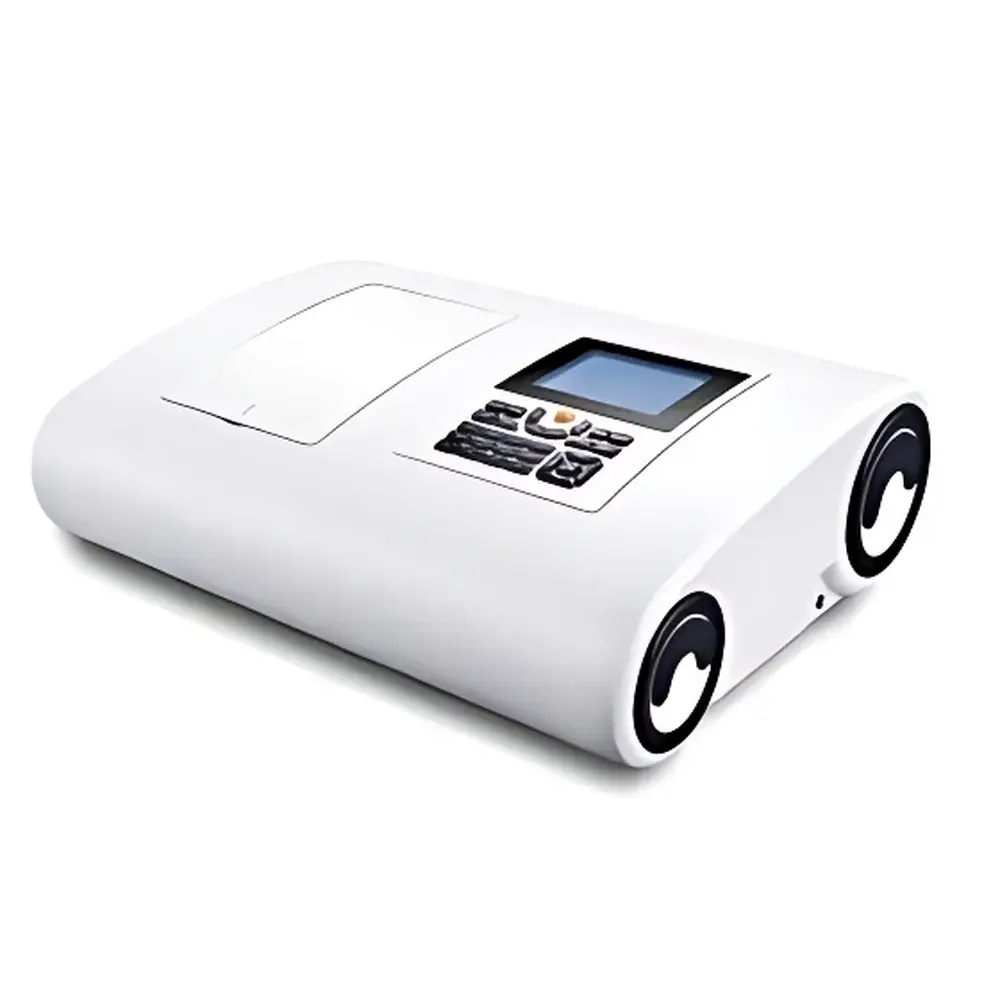
Hebei HOP UV-9000S Dual-Beam Ultraviolet-Visible Spectrophotometer
| Brand | Hebei HOP |
|---|---|
| Origin | Shandong, China |
| Manufacturer Type | Authorized Distributor |
| Model | UV-9000S |
| Optical System | Dual-Beam |
| Detector | Photomultiplier Tube (PMT) |
| Wavelength Range | 185–900 nm |
| Wavelength Accuracy | ±0.1 nm @ 656.1 nm (D₂ line), ±0.3 nm across full range |
| Spectral Bandwidth | 0.1 / 0.2 / 0.5 / 1.0 / 2.0 / 4.0 nm (6-step adjustable) |
| Stray Light | ≤0.01% T @ 220 nm and 360 nm |
| Wavelength Repeatability | ≤0.1 nm |
| Photometric Accuracy | ±0.2% T (0–100% T), ±0.002 A (0–0.5 A), ±0.004 A (0.5–1.0 A) |
| Photometric Repeatability | ≤0.1% T, ±0.001 A (0–0.5 A), ±0.002 A (0.5–1.0 A) |
| Baseline Flatness | ±0.0004 A |
| Drift | ±0.0004 A/h @ 500 nm |
| Noise | ±0.0003 A |
| Photometric Range | 0–200% T, –4.0 to +4.0 A, 0–9999 C |
| Display | 320 × 240 pixel, 6-inch LED-backlit color LCD |
| Interface | USB, Parallel Port |
| Dimensions | 625 × 430 × 210 mm |
| Weight | 30 kg |
| Power Supply | AC 220 V / 50 Hz or 110 V / 60 Hz |
Overview
The Hebei HOP UV-9000S Dual-Beam Ultraviolet-Visible Spectrophotometer is engineered for high-precision quantitative and qualitative analysis across research laboratories, quality control environments, and regulatory-compliant production facilities. Based on the fundamental principle of Beer–Lambert absorption spectroscopy, the instrument employs a true dual-beam optical architecture—splitting the light path into reference and sample channels simultaneously—to eliminate source intensity drift and thermal instability effects in real time. This design ensures superior photometric stability and long-term measurement reproducibility, critical for applications requiring trace-level detection, kinetic monitoring, or multi-point calibration workflows. The system operates across an extended spectral range from deep UV (185 nm) to near-infrared (900 nm), enabling characterization of diverse analytes including nucleic acids, proteins, transition metal complexes, organic dyes, and pharmaceutical intermediates.
Key Features
- Dual-beam, dual-detector optical configuration with independent PMT detection for reference and sample beams—minimizing baseline drift and enhancing signal-to-noise ratio
- Six-step adjustable spectral bandwidth (0.1–4.0 nm) optimized for resolution–sensitivity trade-off: narrow bandwidths for high-resolution peak deconvolution; wider settings for improved throughput in routine assays
- Imported high-efficiency holographic grating and precision-aligned optical train deliver ultra-low stray light (≤0.01% T at 220 nm and 360 nm), essential for accurate absorbance measurements below 0.1 A
- Rigid 16-mm thick machined aluminum optical baseplate with suspended optical assembly—mechanically isolates the spectrometer core from external vibration and thermal expansion-induced misalignment
- High-brightness 6-inch color LCD (320 × 240 pixels) with intuitive icon-driven interface—supports standalone operation without PC connection for basic photometric, quantitative, and spectral scanning tasks
- Pre-aligned, imported deuterium and tungsten-halogen lamps ensure stable output across UV and visible ranges; lamp lifetime and spectral output consistency are validated per ICH Q5C and ISO 17025 calibration protocols
Sample Compatibility & Compliance
The UV-9000S accommodates standard 10-mm rectangular quartz cuvettes (UV-grade), semi-micro cells (50–500 µL), and optional accessories including Peltier-controlled temperature cells, fiber-optic probes, and microvolume platforms. Its optical performance meets key international specifications: wavelength accuracy conforms to ASTM E275 and ISO 6223; photometric linearity aligns with USP and EP 2.2.25; stray light levels satisfy requirements for Class A instrumentation per JIS K 0115. The instrument supports GLP/GMP workflows through audit-trail-ready software logging (when used with optional HOP SpectraScan Suite), and its firmware architecture permits configuration locking and user access level management in accordance with FDA 21 CFR Part 11 principles.
Software & Data Management
Bundled with the HOP SpectraScan software (Windows-compatible, USB-connected), the UV-9000S enables advanced spectral processing—including derivative spectroscopy, peak search/area integration, multi-component quantitation via simultaneous equation solving, and time-resolved kinetics with up to 10,000 data points per scan. Raw absorbance, transmittance, and concentration data export to CSV, TXT, or XML formats; reports include instrument ID, operator name, timestamp, method parameters, and calibration history. All spectral scans and quantitative results are timestamped and stored with metadata—facilitating retrospective review during internal audits or regulatory inspections. Software validation documentation (IQ/OQ templates) and electronic signature support are available upon request for regulated environments.
Applications
- Pharmaceutical QC: Assay of active pharmaceutical ingredients (APIs), excipient identification, dissolution testing per USP , and stability-indicating methods
- Life sciences: DNA/RNA quantification (A₂₆₀/A₂₈₀ ratios), protein concentration (Bradford/Lowry/BCA), enzyme kinetics (NADH/NADPH monitoring at 340 nm)
- Environmental analysis: Nitrate/nitrite determination (via diazotization), phosphate (molybdenum blue), and heavy metal chelates (e.g., Fe²⁺–phenanthroline)
- Materials science: Bandgap estimation of semiconductors, thin-film thickness calculation via interference fringes, and UV-curable resin curing kinetics
- Food & beverage: Colorimetric assays for antioxidants (DPPH scavenging), anthocyanin profiling, and sulfite detection
FAQ
What is the difference between single-beam and dual-beam operation in UV-Vis spectrophotometry?
Dual-beam mode continuously compares sample and reference signals in real time, compensating for lamp intensity fluctuations and detector sensitivity drift—resulting in higher photometric stability over extended measurement periods.
Can the UV-9000S perform kinetic measurements?
Yes—the instrument supports time-scan mode with user-defined interval times (0.01–600 s) and up to 10,000 data points per run, suitable for monitoring enzymatic reactions, polymerization, or photochemical processes.
Is the system compliant with FDA 21 CFR Part 11 requirements?
While the hardware itself does not enforce electronic signatures, the optional SpectraScan software provides configurable user roles, audit trails, and secure data storage—enabling implementation of Part 11 controls when deployed within validated IT infrastructure.
What maintenance is required for optimal performance?
Routine checks include lamp alignment verification every 6 months, quartz cuvette cleaning with ethanol followed by DI water rinse, and annual wavelength and photometric calibration using NIST-traceable standards (e.g., Holmium oxide filter, potassium dichromate solution).
Does the UV-9000S support custom method development?
Yes—users can define and save complete measurement protocols (wavelength, bandwidth, scan speed, data points, calculation formulas) directly on the instrument or via SpectraScan software, with password-protected method libraries for departmental standardization.




