
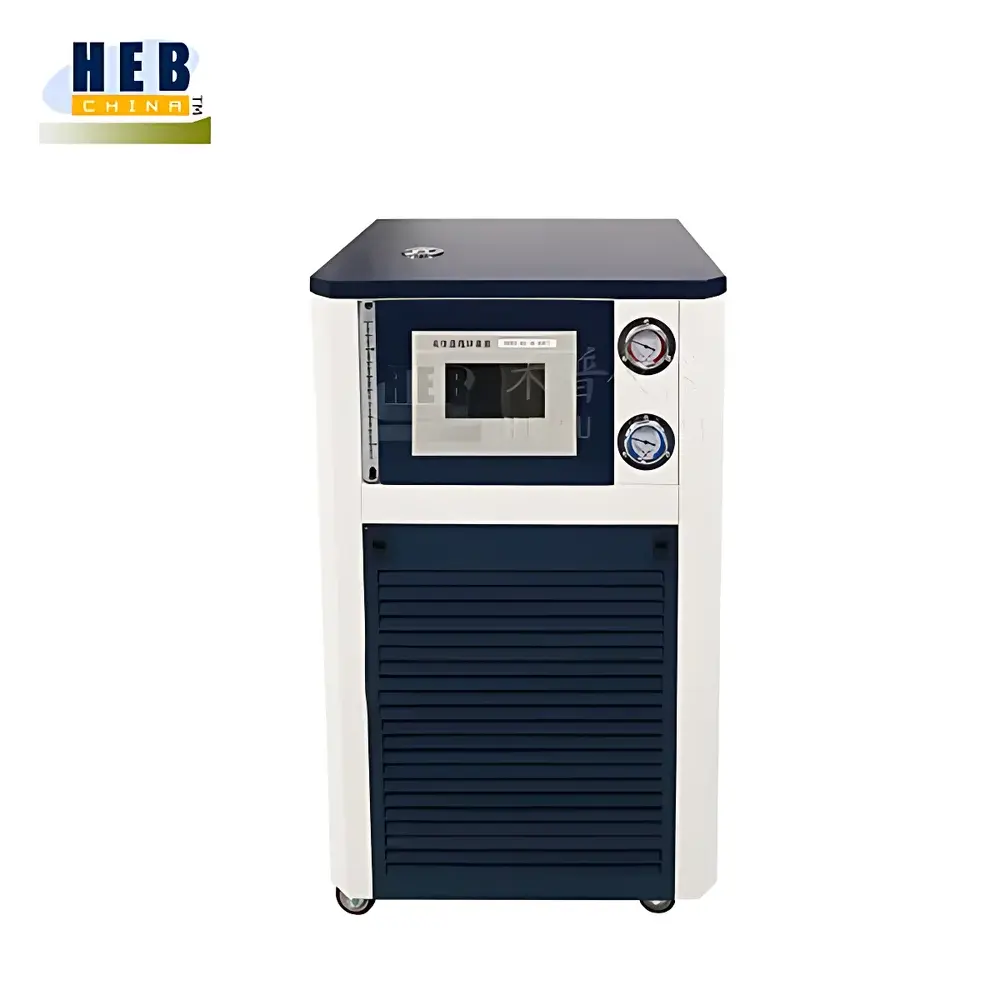
Hebei Jihepu GDSZ-20/-40 High-Low Temperature Circulating Chiller
| Brand | Jihepu (Jinan Hebei Jihepu) |
|---|---|
| Origin | Shandong, China |
| Model | GDSZ-20/-40+200 |
| Temperature Range | -40 °C to +200 °C |
| Ambient Operating Conditions | 5–35 °C, ≤70% RH |
| Power Supply | 3-phase 380 V / 50 Hz |
| Control Accuracy | ±0.1 °C |
| Sensor Type | PT100 |
| Total Power Consumption | 5305 W |
| Heating Power | 3000 W |
| Compressor | 3 HP, R22 refrigerant, 2205 W |
| Refrigeration Capacity | 6972 W at -40 °C |
| Circulation Pump | 100 W, 4–6 m head, 20–40 L/min flow rate, max pressure 0.4 MPa |
| Heat Exchanger | Plate-type, 0.53 m² effective area |
| External Port | 3/4″ BSP female threads (2 ports) with two 2 m stainless steel braided hoses |
| Fluid Compatibility | Premium-grade silicone oil (Class H) |
| Cabinet Material | Powder-coated cold-rolled steel |
| Dimensions (W×D×H) | 710 × 780 × 1055 mm |
| Net Weight | 127 kg |
| Shipping Volume | 0.56 m³ (wooden crate), Gross Weight: 142 kg |
Overview
The Hebei Jihepu GDSZ-20/-40 High-Low Temperature Circulating Chiller is an engineered thermal management system designed for precise, bidirectional temperature control of external process equipment—primarily jacketed reactors, calorimeters, and analytical instrumentation requiring stable thermal environments across a broad operational range. Its dual-mode architecture integrates vapor-compression refrigeration and resistive electric heating into a single closed-loop circulation platform, enabling seamless transition between cooling and heating without manual intervention or fluid exchange. The unit operates on the principle of forced convection heat transfer: a thermally stable silicone oil medium is circulated via an internal high-head pump through external process jackets, absorbing or delivering thermal energy based on real-time PID-regulated setpoint demand. Critical thermal components—including the hermetic scroll compressor, air-cooled condenser, plate heat exchanger, thermostatic expansion valve, and high-accuracy PT100 sensor array—are selected and calibrated for long-term stability under continuous duty cycles in laboratory and pilot-scale settings.
Key Features
- Wide operational temperature span: –40 °C to +200 °C, with ±0.1 °C steady-state control accuracy verified per ISO 17025 traceable calibration protocols
- Integrated safety architecture featuring six independent protection layers: compressor discharge temperature cutoff, high/low pressure switches, phase sequence monitoring, phase loss detection, overcurrent relay, and programmable overtemperature lockout
- Robust circulation subsystem: stainless steel-braided 3/4″ BSP hose kit (2 × 2 m), 0.4 MPa pressure-rated manifold, and a low-pulsation centrifugal pump delivering 20–40 L/min across 4–6 m static head
- Thermally optimized heat exchange: brazed plate heat exchanger (0.53 m² active surface) ensures minimal thermal lag and high coefficient of performance (COP) across the full temperature range
- Intuitive local HMI: backlit LCD display with membrane keypad interface supporting ramp-soak programming, real-time parameter logging, and alarm history review
- Industrial-grade enclosure: powder-coated cold-rolled steel chassis with corrosion-resistant internal coating, compliant with IP20 ingress protection for indoor laboratory use
Sample Compatibility & Compliance
The GDSZ-20/-40 is validated for use with Class H silicone oils meeting ASTM D4652 specifications—fluids exhibiting thermal stability up to 200 °C, low volatility, and negligible degradation products under extended cycling. It is not intended for water-based or glycol solutions due to freezing risk below 0 °C and viscosity limitations above 150 °C. While the unit itself carries no CE, UL, or UKCA certification, its electrical design adheres to IEC 61000-6-2 (immunity) and IEC 61000-6-4 (emissions) standards for laboratory environments. All safety interlocks meet EN 61000-1-2 requirements for functional safety in non-hazardous areas. For GLP/GMP-regulated workflows, the system supports manual audit trails via timestamped screen logs; however, it does not include FDA 21 CFR Part 11-compliant electronic signature or automated data archiving capabilities.
Software & Data Management
This model operates exclusively via embedded firmware with no external PC connectivity (RS232, USB, or Ethernet). All operational parameters—including setpoint, actual bath temperature, compressor status, pump speed, and alarm codes—are accessible and adjustable directly from the front-panel interface. Real-time values are displayed continuously; historical data (last 100 events) can be reviewed in chronological order but are not exportable or persistent beyond power cycle. For integration into centralized lab automation systems, third-party analog (4–20 mA) or digital (Modbus RTU over RS485) interface modules may be added externally—subject to user-configured isolation and signal conditioning per ISA-84.00.01 guidelines.
Applications
- Temperature-controlled synthesis in glass or stainless-steel jacketed reactors (1–50 L volume)
- Calibration and verification of differential scanning calorimeters (DSC), thermogravimetric analyzers (TGA), and dynamic mechanical analyzers (DMA)
- Stabilization of laser sources, photodetectors, and optical benches requiring sub-degree thermal drift suppression
- Pre-conditioning of polymer samples prior to rheological testing or tensile analysis per ASTM D638 and ISO 527
- Support of accelerated stability studies (ICH Q1A) where controlled thermal cycling between –40 °C and +40 °C is required
- Cooling of high-power electronics during environmental stress screening (ESS) per MIL-STD-810G Method 502.6
FAQ
What fluids are compatible with the GDSZ-20/-40?
Only high-purity, low-volatility silicone oils rated for continuous operation between –40 °C and +200 °C (e.g., Dow Corning 200 Fluid Series, Wacker BR200) are approved. Water, ethylene glycol, or ethanol mixtures must not be used.
Can this unit maintain temperature stability during rapid ramping?
Yes—the integrated PID algorithm with adaptive gain scheduling achieves <±0.3 °C deviation during 10 °C/min ramps within the –20 °C to +150 °C range, as verified by internal step-response testing.
Is remote monitoring or control possible?
No native connectivity is provided. Integration requires optional external signal converters and custom SCADA configuration.
What maintenance intervals are recommended?
Compressor oil and refrigerant charge require verification every 24 months; plate heat exchanger inspection and silicone oil replacement every 36 months or after 5000 operating hours—whichever occurs first.
Does the unit comply with ISO/IEC 17025 for accredited labs?
The hardware meets metrological prerequisites for temperature uniformity and stability, but formal accreditation requires user-performed validation (IQ/OQ/PQ) per ISO/IEC 17025 Clause 6.4.2 and documented traceability to NIST or equivalent national standards.



