
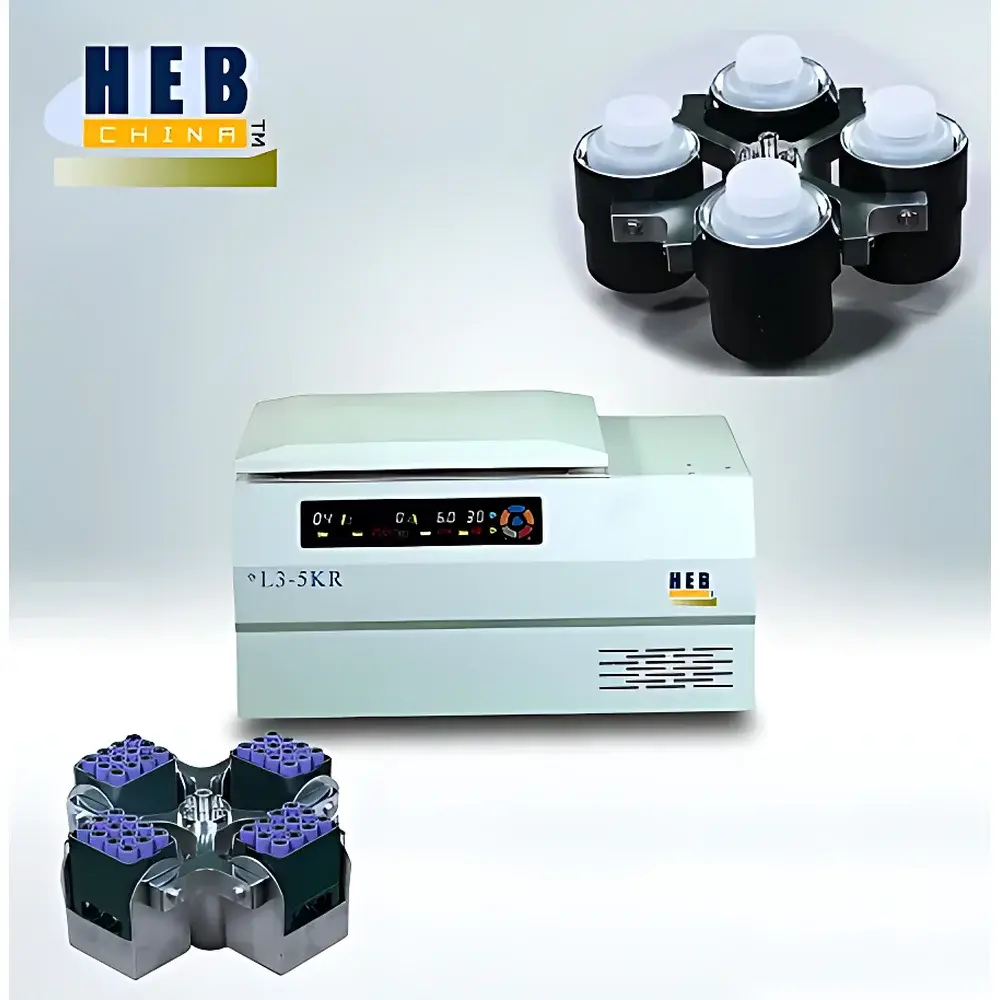
HePu L3-5KR Automatic Cap-Removal Centrifuge
| [Brand | HePu (Jinan Hepu) |
|---|---|
| Origin | Shandong, China |
| Model | L3-5KR |
| Type | Benchtop Low-Speed Centrifuge |
| Max. Speed | 4000 rpm |
| Max. RCF | 3580 × g |
| Max. Capacity | 96 or 100 vacuum blood collection tubes |
| Tube Compatibility | 3 mL, 5 mL, and 7 mL standard vacuum tubes (no adapter required) |
| Temperature Range | –20 °C to +40 °C |
| Temp. Accuracy | ±2.0 °C |
| Timer Range | 1 min – 99 min (displayed in seconds when <60 s) |
| Acceleration/Deceleration | 10 selectable profiles (Profile 9: free deceleration time ≥540 s) |
| Display | Multi-color LED showing speed, RCF, temperature, and time |
| Safety | Electronic door lock, full stainless-steel inner chamber liner |
| Noise Level | ≤65 dB(A) |
| Dimensions (W×D×H) | 550 × 650 × 365 mm |
| Net Weight | 70 kg |
| Power Supply | AC 220 V ±22 V, 50 Hz, 10 A |
| Total Power | 800 W] |
Overview
The HePu L3-5KR Automatic Cap-Removal Centrifuge is a purpose-engineered benchtop centrifuge designed for high-throughput, automated processing of clinical vacuum blood collection tubes in diagnostic laboratories, blood banks, nuclear medicine departments, and immunoassay facilities. Unlike conventional centrifuges requiring manual cap removal prior to separation, the L3-5KR integrates precise mechanical cap ejection with controlled low-speed centrifugation—enabling complete tube de-capping and serum/plasma separation in a single, unattended run. Its operation relies on synchronized rotational dynamics and programmable pneumatic-mechanical actuation to lift caps without tube tilting or sample disturbance, minimizing hemolysis risk and preventing re-mixing of separated phases. Engineered for clinical workflow integrity, it supports routine processing of up to 100 tubes per cycle under validated temperature-controlled conditions (–20 °C to +40 °C), meeting foundational requirements for pre-analytical standardization in ISO 15189-accredited laboratories.
Key Features
- Automated cap removal with >95% success rate across 3 mL, 5 mL, and 7 mL vacuum tubes—no adapters or manual intervention required
- Dual-parameter display and real-time switching between rotational speed (rpm) and relative centrifugal force (RCF) for method flexibility and protocol compliance
- 10-step acceleration/deceleration control, including ultra-slow free-stop profile (≥540 s) to preserve delicate cell layers and minimize sediment resuspension
- Multi-color LED interface showing live rpm, RCF, set temperature, elapsed time, and remaining time—with second-resolution timing for sub-minute protocols
- Electronically interlocked safety door with reinforced stainless-steel inner chamber liner and acoustic damping design (≤65 dB[A]) for continuous operation in shared lab environments
- Programmable temperature control (±2.0 °C accuracy) enabling cold centrifugation for coagulation studies or ambient/frozen storage compatibility
Sample Compatibility & Compliance
The L3-5KR accommodates standard evacuated blood collection tubes compliant with CLSI H20-A3 and ISO 6710 specifications—including EDTA, heparin, citrate, serum separator (SST), and lithium heparin formulations. Its universal basket design eliminates cross-calibration needs between tube volumes, supporting seamless integration into LIS-driven workflows. The instrument meets IEC 61010-1:2010 safety standards for laboratory electrical equipment and incorporates fail-safe mechanisms aligned with GLP and CAP checklist item ANP.3.1.2 (sample integrity during pre-analytical handling). While not FDA 510(k)-cleared, its functional design aligns with USP centrifugation guidance for biopharmaceutical stability testing and CLIA-waived assay preparation.
Software & Data Management
The L3-5KR operates via embedded firmware with non-volatile memory storing up to 99 user-defined protocols. Each run logs timestamp, rotor ID (if equipped with RFID-capable accessories), set parameters, actual RCF, final temperature, and door status—exportable via USB to CSV for audit trail generation. Though lacking network connectivity or remote monitoring, its local data retention supports internal QA documentation and satisfies basic 21 CFR Part 11 traceability requirements when paired with institutional electronic logbook systems. All parameter changes during active runs are recorded with operator ID (via optional PIN authentication module) and time stamp, ensuring reproducibility in regulated environments.
Applications
- Routine serum and plasma separation from whole blood in hospital core labs and regional blood centers
- Preparation of samples for ELISA, RIA, chemiluminescence immunoassays (CLIA), and thyroid function panels
- Stabilization of coagulation factors (e.g., Factor VIII, fibrinogen) under refrigerated centrifugation
- Processing of pediatric microtubes and geriatric low-volume draws where cap-handling ergonomics impact staff fatigue
- Supporting ISO 15189 clause 5.4.2 (pre-examination phase control) by eliminating manual decapping variability and associated contamination risks
FAQ
What tube sizes does the L3-5KR support without adapters?
It natively accepts 3 mL, 5 mL, and 7 mL vacuum blood collection tubes conforming to ISO 6710 dimensions.
Can the L3-5KR operate at sub-zero temperatures?
Yes—it maintains stable operation from –20 °C to +40 °C with ±2.0 °C thermal accuracy, suitable for cold-chain-compatible assays.
Is the cap-removal mechanism compatible with gel-separator tubes?
Yes; the controlled vertical lift action preserves the gel barrier integrity and prevents layer disruption during de-capping.
Does the instrument meet electromagnetic compatibility (EMC) standards for clinical use?
It complies with IEC 61326-1:2013 Class B emission limits and IEC 61000-4 series immunity requirements for laboratory instrumentation.
How is rotor imbalance detected and managed?
Vibration sensing triggers automatic shutdown if imbalance exceeds 5 g tolerance; all rotors undergo dynamic balancing certification per ISO 19438.
Related Products



