
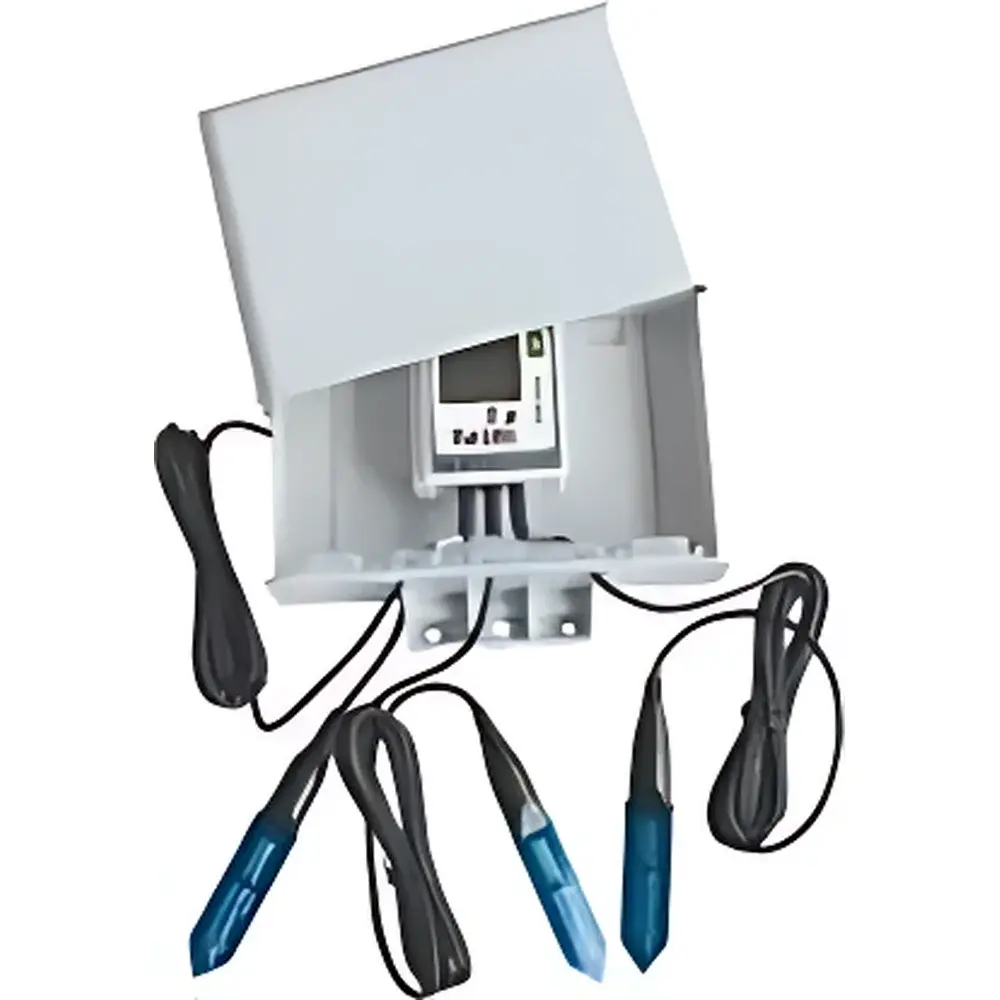
Spectrum WatchDog 1200 Soil Moisture and Temperature Monitoring Station
| Origin | USA |
|---|---|
| Manufacturer Type | Authorized Distributor |
| Origin Category | Imported |
| Model | WatchDog 1200 |
| Instrument Type | Soil Moisture / Water Potential Analyzer |
| Sensor Capacity | 2 channels |
| Data Storage | 10,080 readings |
| Sampling Interval | 1–60 min (user-configurable) |
| Display | Built-in LCD for real-time data viewing |
| Battery Life | Up to 12 months (typical operation) |
| Soil Moisture Sensor Range | 0–100% Volumetric Water Content (VWC), fully saturated |
| Output Signal | Analog voltage 0.5–1.5 V (excitation voltage: 3 V |
| Oscillation Frequency | 80 MHz |
| Resolution | 0.1% VWC |
| Accuracy | ±3% VWC (for soil electrical conductivity < 8 mS/cm) |
| Sensing Volume Dimensions | 6 cm (L) × 2 cm (W) × 0.3 cm (T) |
| Standard Cable Length | 1.8 m (optional: 6 m |
| max extension | 15 m) |
Overview
The Spectrum WatchDog 1200 is a field-deployable, battery-powered soil moisture and temperature monitoring station engineered for long-term, unattended environmental observation in agricultural research, ecological studies, irrigation management, and hydrological modeling. It operates on the principle of frequency-domain reflectometry (FDR), utilizing an 80 MHz oscillator to measure the dielectric permittivity of soil—directly correlated with volumetric water content (VWC). Unlike time-domain reflectometry (TDR) systems requiring complex signal analysis, the WatchDog 1200 employs a calibrated analog output (0.5–1.5 V) referenced to a stable 3 V excitation source, enabling robust, low-power operation ideal for remote or off-grid sites. Its dual-channel architecture supports simultaneous measurement from two independent FDR sensors, allowing comparative profiling across depth or spatial gradients without external data loggers or multiplexers.
Key Features
- Dual-sensor capability with independent analog input channels for concurrent soil moisture and temperature acquisition
- Integrated LCD display for on-site verification of real-time readings, eliminating reliance on external devices during field checks
- Non-volatile internal memory storing up to 10,080 timestamped records—sufficient for >200 days at 30-minute sampling intervals
- Configurable sampling interval (1–60 minutes) via PC-based configuration utility, supporting adaptive monitoring strategies
- Low-power design optimized for 12-month battery life under typical deployment conditions (25°C, 30-min sampling)
- FDR sensor geometry (6 cm × 2 cm × 0.3 cm active sensing volume) ensures minimal soil disturbance and representative bulk measurement
- Cable options include standard 1.8 m length with factory-terminated connectors; extended configurations up to 15 m maintain signal integrity via shielded twisted-pair construction
Sample Compatibility & Compliance
The WatchDog 1200 is validated for use in mineral soils with electrical conductivity ≤ 8 mS/cm. At higher EC levels—common in saline or fertilized soils—calibration adjustments or site-specific empirical correction may be required to maintain ±3% VWC accuracy. The system complies with ASTM D5745-15 (Standard Test Method for Determination of Volumetric Water Content Using Electromagnetic Methods) for FDR-based soil moisture assessment. While not certified for GLP or GMP environments, its deterministic analog signal path, fixed calibration coefficients, and audit-ready data export format support traceability in field research adhering to ISO 11274:2022 (Soil quality — Determination of water retention characteristics). No firmware updates or cloud connectivity are embedded—ensuring data sovereignty and compatibility with institutional IT security policies.
Software & Data Management
Data retrieval is performed via USB connection using Spectrum’s proprietary WatchDog Software (Windows-compatible), which provides raw value export in CSV format with UTC timestamps, sensor ID tagging, and metadata logging (sampling interval, battery voltage, error flags). The software does not require internet access or account registration. All calibration parameters—including slope and offset per channel—are stored within the device firmware and preserved across power cycles. Exported datasets are compatible with third-party analysis platforms including R (via readr), Python (Pandas), MATLAB, and common GIS tools (QGIS, ArcGIS Pro) for spatiotemporal interpolation and integration with evapotranspiration models (e.g., FAO-56 Penman-Monteith).
Applications
- Long-term soil moisture trend analysis in climate change impact studies
- Validation of satellite-derived soil moisture products (e.g., SMAP, Sentinel-1)
- Irrigation scheduling and deficit irrigation trials in viticulture, orchards, and row crops
- Root-zone monitoring for lysimeter and mesocosm experiments
- Calibration reference for wireless sensor networks (WSNs) deployed in precision agriculture
- Hydrological boundary condition definition in watershed-scale numerical models (e.g., SWAT, HYDRUS-1D)
FAQ
What is the recommended calibration protocol for the WatchDog 1200 sensors?
Factory calibration is provided for mineral soils; users should perform gravimetric validation at field capacity and permanent wilting point for site-specific soils—particularly those with high organic matter (>10%) or clay content (>40%).
Can the WatchDog 1200 operate in frozen soil conditions?
No. FDR measurement ceases to be reliable below 0°C due to phase transition effects on dielectric response; the device will record but not interpret frozen-state readings.
Is sensor cable extension beyond 15 meters supported?
Extension beyond 15 m introduces signal attenuation and noise susceptibility; custom solutions require impedance-matched cabling and may necessitate recalibration.
Does the system support external power or solar charging?
The WatchDog 1200 accepts optional 6–12 V DC external power input, enabling indefinite operation when paired with regulated solar charge controllers meeting IEC 62133 safety standards.
How is data integrity verified during transfer?
Each data packet includes CRC-16 checksums; the software performs end-to-end validation and logs transmission errors in the session report file.







