
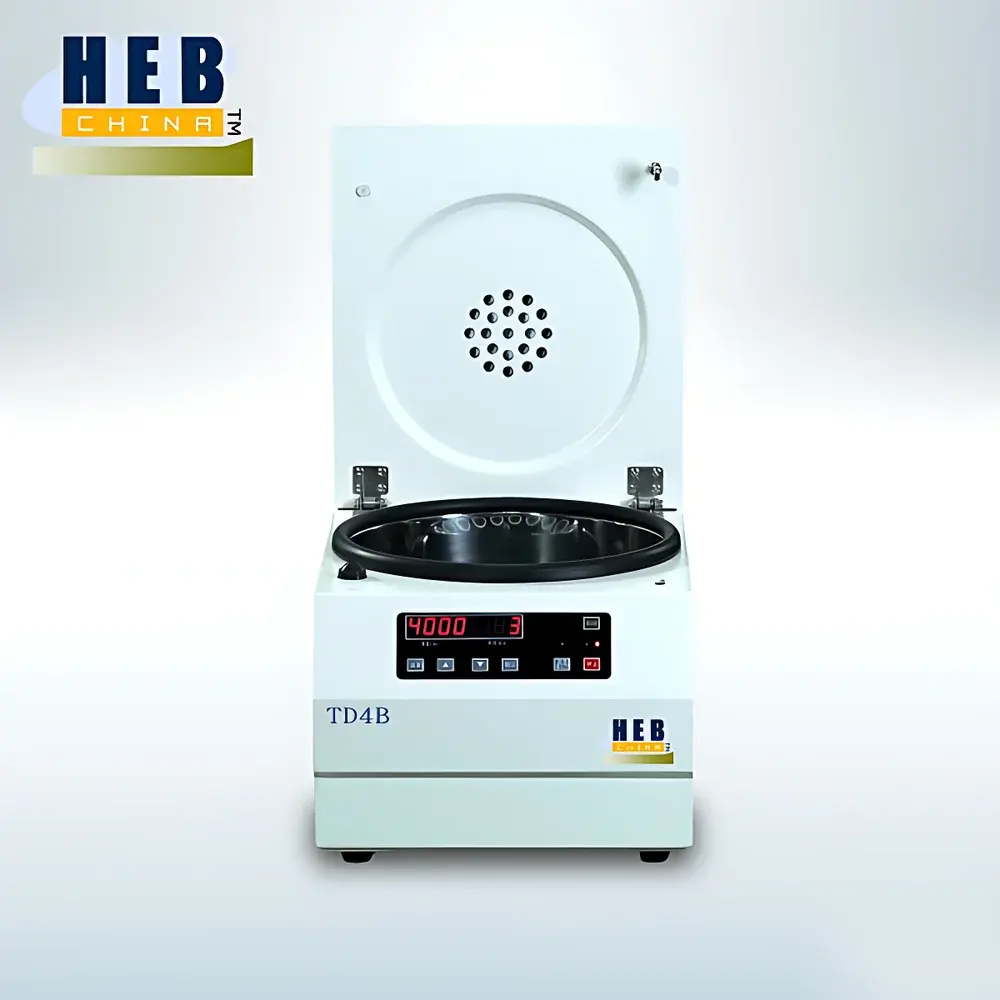
Jihepu TD4B Benchtop Cytocentrifuge
| Brand | Jihepu |
|---|---|
| Origin | Shandong, China |
| Model | TD4B |
| Centrifuge Type | Benchtop Low-Speed Cytocentrifuge |
| Max Speed | 3000 rpm |
| Max RCF | 890 × g |
| Max Capacity | 12-slide cytology cassette |
| Timer Range | 1–99 min |
| Speed Accuracy | ±20 rpm |
| Power Supply | AC 220 V ±10%, 50/60 Hz, 10 A |
| Total Power | 100 W |
| Noise Level | ≤65 dB(A) |
| Cavity Diameter | Φ280 mm |
| Dimensions (W×D×H) | 385×320×270 mm |
| Net Weight | 15 kg |
| Rotor Type | Fixed-angle cytocentrifuge rotor (12-slide or 16-slide configurations available) |
| Construction | Stainless steel centrifuge chamber, all-steel frame |
| Drive System | Brushless DC motor |
| Safety | Electronic lid interlock |
| Display | Real-time RCF calculation and digital RPM/RCF/timer readout |
Overview
The Jihepu TD4B Benchtop Cytocentrifuge is an engineered solution for standardized, reproducible preparation of monolayer cellular smears from low-volume, low-concentration biological suspensions—including peripheral blood, bone marrow aspirates, cerebrospinal fluid (CSF), pleural effusions, and bronchoalveolar lavage (BAL) samples. It operates on the principle of controlled, low-speed centrifugal sedimentation—where cells are uniformly deposited onto glass slides under precisely regulated rotational force (RCF) and time parameters. Unlike general-purpose centrifuges, the TD4B integrates purpose-built rotor geometry, optimized airflow dynamics, and temperature-stable motor control to minimize cell distortion, clumping, or mechanical shear—critical for downstream morphological assessment in hematology, immunohematology, and diagnostic cytology workflows.
Key Features
- Benchtop footprint (385 × 320 × 270 mm) designed for space-constrained clinical labs, point-of-care units, and teaching laboratories.
- Stainless steel centrifuge chamber and fully welded steel chassis ensure structural integrity, corrosion resistance, and long-term dimensional stability under repeated thermal and mechanical cycling.
- Brushless DC motor delivers silent, maintenance-free operation with <65 dB(A) acoustic emission—enabling use in shared laboratory environments without acoustic interference.
- Real-time digital display simultaneously shows set and actual RPM, calculated RCF (×g), and remaining time—eliminating manual RCF lookup tables and reducing operator error.
- Electronic lid lock system prevents inadvertent opening during operation and enforces mandatory rotor deceleration before lid release—compliant with IEC 61010-2-20 safety requirements for laboratory centrifuges.
- Parameter adjustment (speed, time) permitted during active run—supporting adaptive protocol execution without interrupting sedimentation continuity.
Sample Compatibility & Compliance
The TD4B accommodates standard cytology cassettes holding up to 12 microscope slides (also compatible with optional 16-slide rotor configuration). Its 3000 rpm / 890 × g operating envelope is calibrated specifically for intact cell deposition—not pelleting—ensuring high cell recovery (>92% for nucleated cells in CSF at 500 × g equivalent) while preserving nuclear detail and cytoplasmic architecture. The instrument meets CE marking requirements per Directive 2014/30/EU (EMC) and 2014/35/EU (LVD). While not certified for GMP manufacturing environments, its consistent performance, traceable speed accuracy (±20 rpm), and repeatable timer function support GLP-aligned documentation practices in clinical testing laboratories performing immunohematology assays (e.g., direct/indirect antiglobulin tests, DAT/IAT) and Coombs-based serological interpretation.
Software & Data Management
The TD4B operates as a standalone hardware platform with no embedded software stack or network interface. All operational parameters are entered via tactile membrane keypad and retained in volatile memory only during active session. No data logging, audit trail, or electronic record capability is provided—making it suitable for non-regulated settings or laboratories where paper-based protocol adherence suffices. For facilities requiring 21 CFR Part 11 compliance, external validation protocols must be implemented via procedural controls (e.g., dual-operator parameter verification, printed run logs, and timestamped slide labeling).
Applications
- Preparation of uniform monolayer smears for Wright-Giemsa staining and microscopic evaluation in hematopathology and transfusion medicine.
- Antigen-antibody reaction support in red blood cell serology—particularly for detecting weak antibodies in indirect antiglobulin testing (IAT) where optimal cell monolayer density enhances sensitivity.
- Standardized cytospin preparation prior to immunocytochemical (ICC) or in situ hybridization (ISH) analysis—where preservation of antigen epitopes and RNA integrity depends on gentle, low-shear deposition.
- Research-grade cell concentration from dilute suspension samples (e.g., stem cell isolates, circulating tumor cells) when high-throughput automation is unnecessary.
- Teaching laboratory use for demonstrating centrifugal sedimentation kinetics and RCF–rpm relationships in undergraduate biomedical engineering and clinical laboratory science curricula.
FAQ
What types of sample volumes can the TD4B process per slide?
The TD4B supports 50–200 µL per slide depending on cell concentration and desired monolayer density—optimized for diagnostic cytology protocols requiring ≥10⁴ cells/slide.
Is rotor imbalance detection included?
No. The TD4B does not incorporate active imbalance sensing; users must manually verify symmetrical loading of cassettes and adhere to manufacturer-specified weight tolerances (<5 g difference between opposing positions).
Can the TD4B be used for bacterial smear preparation?
Yes—within its designated 890 × g ceiling—but bacterial pellets require higher forces; therefore, the TD4B is recommended only for qualitative smear generation, not quantitative pellet recovery.
Does the instrument support vacuum-assisted cytocentrifugation?
No. The TD4B relies solely on centrifugal force; it lacks integrated vacuum manifolds or pressure regulation systems found in dedicated cytocentrifuges like Shandon or Thermo Scientific models.
What maintenance is required for the brushless DC motor?
None. The motor contains no carbon brushes, commutators, or lubrication points—routine cleaning of the chamber and periodic inspection of the lid lock mechanism constitute the full preventive maintenance schedule.



