
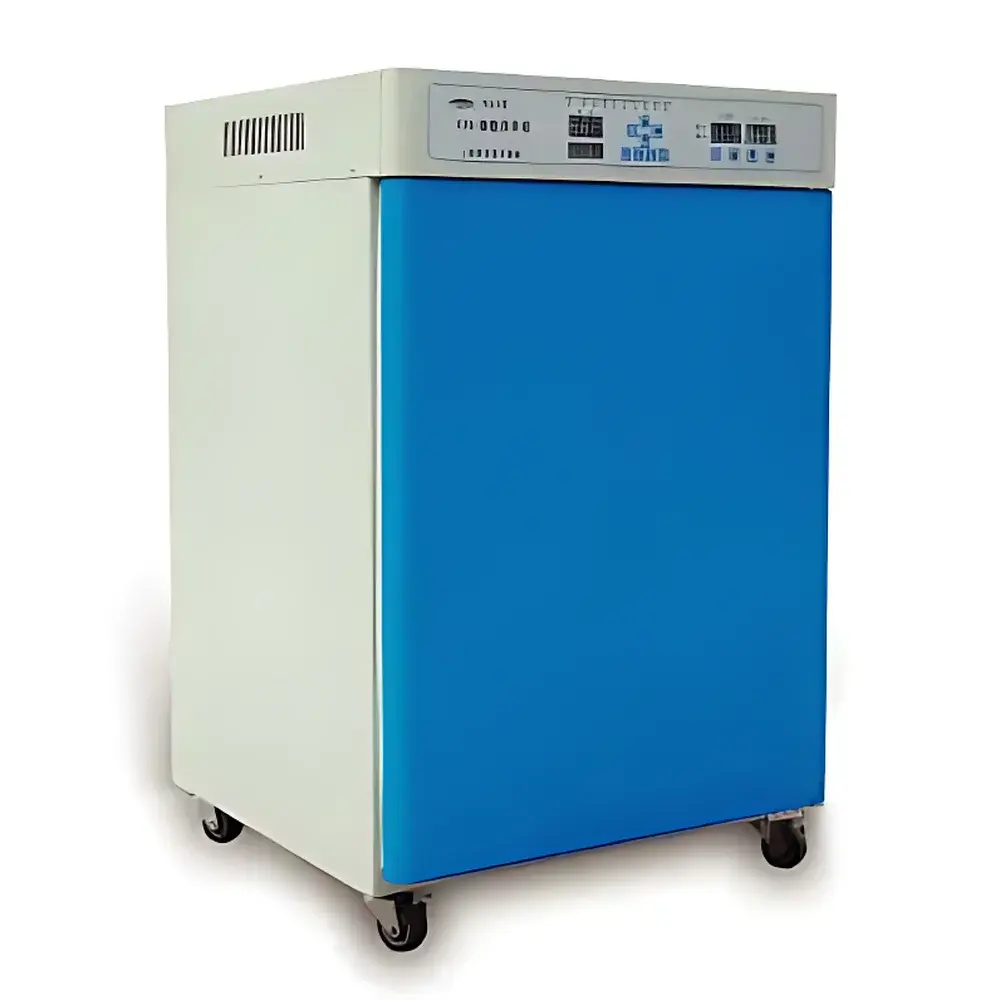
HePu WJ-2 Carbon Dioxide Incubator
| Brand | HePu |
|---|---|
| Origin | Shandong, China |
| Model | WJ-2 |
| Temperature Range | Ambient +3°C to 60°C |
| Temperature Uniformity | ≤ ±0.5°C |
| Humidity Range | 20–95% RH |
| Chamber Volume | 80 L or 160 L |
| CO₂ Control Range | 0–20% |
| Heating Method | Water-jacketed or Air-jacketed |
| CO₂ Control Mode | Gas-mixing with flow regulation |
| Humidification | Passive evaporation from stainless steel water pan |
| Sterilization | UV lamp |
| Safety Features | Over-temperature, sensor failure, low-water, and CO₂ outage alarms |
| Power Supply | 1φ 220 V, 50 Hz |
Overview
The HePu WJ-2 Carbon Dioxide Incubator is an engineered environmental control system designed for reliable, long-term cultivation of mammalian cells, primary tissues, and sensitive microbial cultures under physiologically relevant conditions. It maintains precise regulation of CO₂ concentration (0–20%), temperature (ambient +3°C to 60°C), and relative humidity (20–95% RH) — critical parameters for mimicking in vivo extracellular environments. The incubator operates on dual thermal architectures: water-jacketed (for enhanced thermal stability and recovery after door opening) or air-jacketed (for faster temperature equilibration and energy efficiency). Its forced-air circulation system—driven by a low-turbulence axial fan with horizontal arc-flow ducting—ensures uniform distribution of heat and gas throughout the chamber, minimizing stratification and supporting high reproducibility across experiments. All internal surfaces are constructed from electropolished SUS-304 stainless steel, providing corrosion resistance, non-porous integrity, and compatibility with routine decontamination protocols including alcohol wipes, hydrogen peroxide vapor (HPV), and UV irradiation.
Key Features
- Triple-sensor PID temperature control architecture: independent DIN Class A PT100 sensors monitor chamber temperature, water-jacket temperature (water-jacketed model), and door surface temperature — enabling dynamic compensation for thermal lag and ambient fluctuations.
- Dual-mode CO₂ regulation: gas-mixing system with precision mass flow control ensures stable CO₂ setpoints; compatible with medical-grade CO₂ (≥99.9% purity, 0.5 MPa supply pressure).
- Passive humidification via removable stainless steel water pan — eliminates risk of aerosol generation while maintaining ≥85% RH at 37°C/5% CO₂ (typical operating condition).
- UV germicidal lamp integrated into ceiling assembly — programmable exposure cycles support routine decontamination between runs without chemical residues.
- Intelligent safety interlock: automatic shutdown of heating elements and fan upon door opening; low-water detection prevents dry-heating of water jacket; real-time fault logging with LED status indicators for over-temperature, sensor failure, CO₂ depletion, and power anomaly.
- Ergonomic interface: LED-based alphanumeric display with English menu navigation, tactile membrane keypad, and dual operational modes — timed (1–9999 min) or continuous.
Sample Compatibility & Compliance
The WJ-2 supports standard tissue culture formats including T-flasks (up to T225), multi-well plates (6–96-well), Petri dishes, roller bottles, and cryovial racks. Its stainless-steel interior and smooth-radius corners facilitate cleaning validation per ISO 14644-1 (cleanroom classification) and support adherence to GLP-compliant laboratory practices. While not certified to IEC 61010-1 or UL 61010-1 out-of-the-box, the unit’s electrical architecture—including thermal cutouts, grounded chassis, and Class II insulation—meets foundational safety requirements for laboratory equipment. Its passive humidification method avoids condensation-related contamination risks common in active steam systems, aligning with USP recommendations for cell therapy environment control. Documentation includes traceable calibration records for temperature and CO₂ sensors, supporting audit readiness for ISO/IEC 17025-accredited labs.
Software & Data Management
The WJ-2 operates via embedded microcontroller firmware with no external PC dependency. All operational parameters — setpoints, real-time readings, alarm history, and runtime logs — are stored in non-volatile memory with timestamping (YYYY-MM-DD HH:MM format). Event logs retain up to 500 entries, including door-open duration, temperature excursions (>±0.5°C), CO₂ deviation events (>±0.3%), and maintenance alerts (e.g., low water, UV lamp life expiration). Data export is not supported via USB or network interface; however, the controller enables manual log review and reset through the front panel. For laboratories requiring electronic record integrity, the system supports 21 CFR Part 11 compliance when paired with validated third-party data acquisition software that captures serial port output (RS-232 optional upgrade) with user authentication, audit trail, and electronic signature capabilities.
Applications
This incubator is routinely deployed in academic research laboratories for stem cell expansion, organoid development, and co-culture modeling; in biopharmaceutical QC labs for mycoplasma testing and cell line banking; and in clinical diagnostics settings for microbiological isolation and antibiotic susceptibility assays. Its stable CO₂ delivery and minimal temperature drift make it suitable for extended-duration assays such as wound healing migration studies (24–72 h), cytokine secretion profiling, and CRISPR-Cas9 editing validation where metabolic consistency directly impacts phenotypic readouts. The 80 L and 160 L configurations accommodate scalable workflows — the smaller volume optimizes energy use for low-throughput projects, while the larger chamber supports parallel culture of multiple cell lines under identical conditions.
FAQ
What CO₂ gas specifications are required for optimal operation?
Medical-grade CO₂ (≥99.9% purity, oil-free, moisture-free) supplied at 0.4–0.6 MPa is mandatory. Use of industrial-grade gas may cause infrared sensor fouling and inaccurate concentration feedback.
Is the incubator compatible with hydrogen peroxide vapor (HPV) decontamination?
Yes — the SUS-304 chamber, silicone gaskets, and UV-resistant polycarbonate viewing window withstand standard HPV cycles (e.g., 30% w/w H₂O₂, 60–90 min exposure). Remove water pan and UV lamp before treatment.
How often should the CO₂ sensor be calibrated?
Annual calibration against NIST-traceable reference gas (e.g., 5.00 ± 0.05% CO₂ in N₂) is recommended. Field verification using two-point gas challenge (0% and 5% CO₂) should be performed quarterly.
Can the incubator maintain humidity without frequent manual refilling of the water pan?
Under steady-state conditions (37°C, 5% CO₂), the stainless steel pan requires replenishment every 3–5 days. Optional humidity monitoring kit (sold separately) provides early warning at ≤70% RH.
Does the unit meet GMP requirements for cell therapy manufacturing?
While the WJ-2 itself is not GMP-certified, its design — including stainless-steel construction, closed-loop CO₂ control, and alarm-logged event history — satisfies baseline infrastructure criteria outlined in EMA Guideline on Human Cell-Based Medicinal Products (CHMP/BWP/178670/2005). Final qualification requires IQ/OQ/PQ under site-specific SOPs.




