
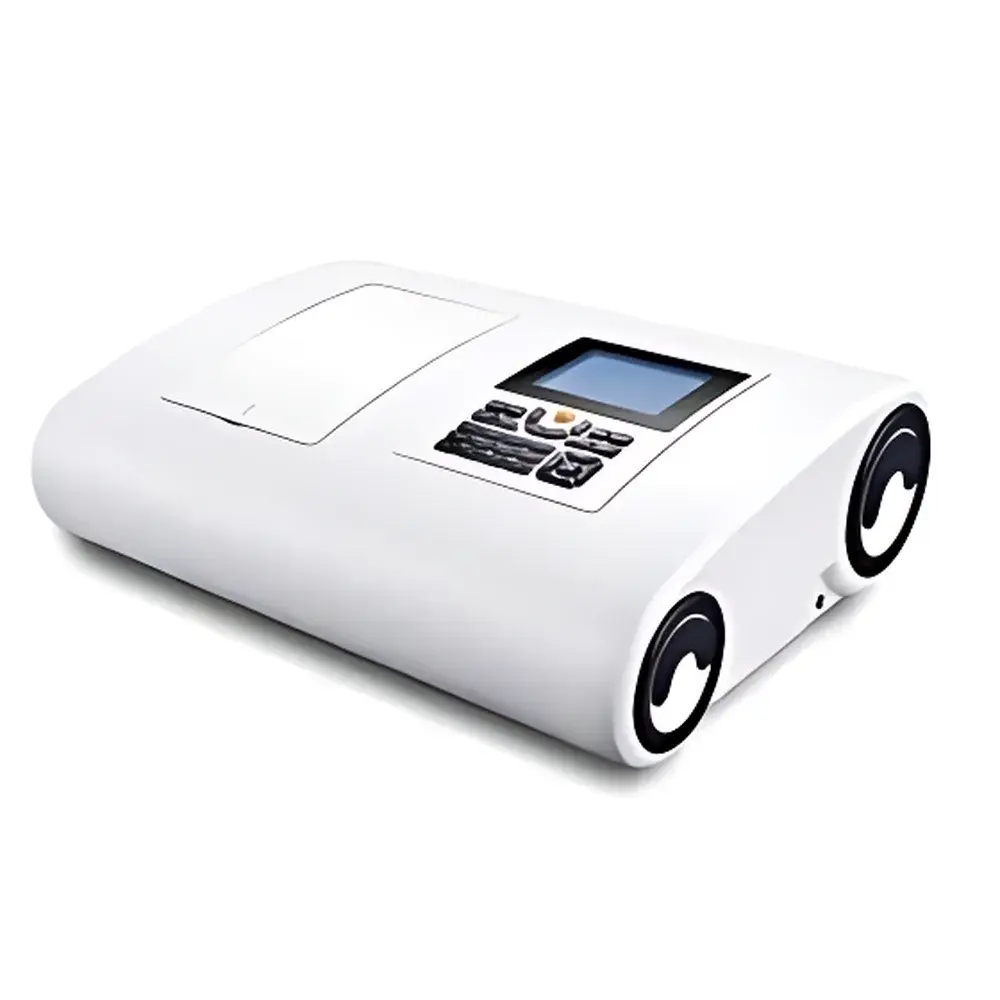
UV-9000 Dual-Beam Ultraviolet-Visible Spectrophotometer
| [Brand | Jihepu (Jinan Hepu) |
|---|---|
| Origin | Shandong, China |
| Model | UV-9000 |
| Optical System | Dual-beam |
| Detector | Photodiode Array (PDA) |
| Wavelength Range | 190–900 nm |
| Wavelength Accuracy | ±0.1 nm (at D₂ 656.1 nm), ±0.3 nm across full range |
| Spectral Bandwidth | 0.1 / 0.2 / 0.5 / 1.0 / 2.0 / 4.0 nm (6 selectable) |
| Stray Light | ≤0.01% T |
| Wavelength Repeatability | ≤0.1 nm |
| Photometric Accuracy | ±0.2% T |
| Photometric Repeatability | ≤0.1% T |
| Baseline Flatness | ±0.001 A |
| Drift | ±0.0004 A/h (at 500 nm) |
| Noise | ±0.0004 A/h |
| Photometric Range | 0–200% T, –4.0 to +4.0 A, 0–9999 C |
| A/D Resolution | 24-bit |
| Display | 320 × 240 pixel, 6-inch high-brightness LCD |
| Light Sources | Imported long-life tungsten and deuterium lamps |
| Grating | Imported precision holographic grating |
| Dimensions | 635 × 440 × 210 mm |
| Weight | 30 kg |
| Power Supply | AC 220 V/50 Hz or 110 V/60 Hz |
| Interface | USB] |
Overview
The Jihepu UV-9000 Dual-Beam Ultraviolet-Visible Spectrophotometer is engineered for high-fidelity absorbance, transmittance, and concentration measurements across the ultraviolet and visible spectral regions (190–900 nm). Its dual-beam optical architecture continuously compares sample and reference beam intensities in real time, effectively compensating for source drift, detector instability, and environmental fluctuations—enabling superior photometric stability and long-term measurement reproducibility. The system employs a precision holographic grating and imported tungsten/deuterium light sources to ensure consistent spectral output and minimal intensity variation over extended operation. Designed with a rigid 16-mm aluminum optical baseplate and suspended optical mount, the instrument isolates the light path from mechanical vibration and chassis deformation—critical for maintaining alignment integrity in shared laboratory environments or on non-dedicated benchtops.
Key Features
- Dual-beam optical design with real-time reference compensation for enhanced baseline stability and reduced photometric drift (±0.0004 A/h at 500 nm).
- Six-step adjustable spectral bandwidth (0.1, 0.2, 0.5, 1.0, 2.0, and 4.0 nm), enabling optimization of resolution versus signal-to-noise ratio per application requirement.
- High-resolution 24-bit analog-to-digital conversion and synchronized sine-drive wavelength mechanism, delivering wavelength repeatability ≤0.1 nm and accuracy of ±0.1 nm at the deuterium line (656.1 nm).
- Photodiode array (PDA) detector with low-noise electronics (±0.0004 A/h) and stray light suppression ≤0.01% T—meeting stringent performance criteria for trace-level quantitative analysis.
- Robust mechanical architecture: all optical components are fixed to a stress-relieved, anodized aluminum base; independent suspension eliminates coupling between chassis motion and optical alignment.
- Integrated ARM-based control system supporting standalone operation—including photometric, quantitative, kinetic, multi-wavelength, DNA/protein, and full-spectrum scanning modes—with onboard data storage and USB export capability.
Sample Compatibility & Compliance
The UV-9000 accommodates standard 10-mm rectangular cuvettes (quartz, glass, or plastic), as well as optional micro-volume adapters and flow cells for specialized workflows. Its optical design supports both transmission and absorbance-based assays compliant with internationally recognized methodologies, including ASTM E275, ISO 6425, and USP for spectrophotometric system suitability. While not pre-certified for FDA 21 CFR Part 11, the instrument’s audit-ready data logging—via timestamped spectra, method parameters, and user ID tagging in exported CSV/ASCII files—supports GLP/GMP-aligned documentation practices when deployed with validated laboratory information management systems (LIMS) or electronic lab notebooks (ELN).
Software & Data Management
The UV-9000 ships with Jihepu SpectraScan™ PC software, providing full remote control, advanced spectral processing (baseline correction, peak integration, derivative spectroscopy), and customizable report generation. Raw data are stored in vendor-neutral formats (CSV, ASCII, .spc) compatible with third-party analytical platforms such as OriginLab, MATLAB, and Python-based scientific stacks (e.g., SciPy, Pandas). All scan and measurement events include embedded metadata: date/time stamp, operator ID, instrument serial number, wavelength calibration status, and active bandwidth setting—facilitating traceability in regulated QC/QA environments. USB 2.0 interface enables direct file transfer without proprietary drivers.
Applications
- Quantitative analysis of pharmaceutical actives and excipients per USP/EP monographs (e.g., assay of paracetamol, aspirin, or riboflavin).
- DNA/RNA quantification and purity assessment (A₂₆₀/A₂₈₀, A₂₆₀/A₂₃₀) using built-in nucleic acid calculation modules.
- Enzyme kinetics monitoring (e.g., NADH oxidation at 340 nm) with programmable time-scan functionality and up to 1000-point kinetic datasets.
- Colorimetric assay validation (e.g., Bradford, Lowry, BCA) requiring high photometric linearity across 0–200% T range.
- Thin-film and nanoparticle characterization via absorbance edge analysis and Tauc plot derivation (with post-acquisition processing).
- Water quality testing (nitrate, phosphate, COD) following APHA Standard Methods protocols.
FAQ
What wavelength calibration standards are recommended for routine verification?
We recommend daily verification using NIST-traceable holmium oxide (Ho₂O₃) and didymium filters, supplemented by deuterium and tungsten lamp intensity checks per ASTM E920.
Is the UV-9000 suitable for GMP-regulated environments?
Yes—when operated with documented SOPs, controlled access, and archived raw data files containing full metadata, it meets core instrumentation requirements for analytical method validation under ICH Q2(R2).
Can the instrument perform simultaneous multi-wavelength measurements?
Yes—the PDA detector captures full spectra in a single acquisition; users may define up to 10 discrete wavelengths for concurrent monitoring during kinetic or concentration series experiments.
What maintenance is required to sustain optical performance?
Annual alignment verification and lamp replacement (deuterium lamp ~1,000 h, tungsten lamp >5,000 h) are advised; no routine grating cleaning is necessary due to sealed optical compartment design.
Does the system support external triggering or automation integration?
The USB interface supports SCPI command set emulation for integration into automated liquid handling platforms or custom LabVIEW/Python control scripts.






