
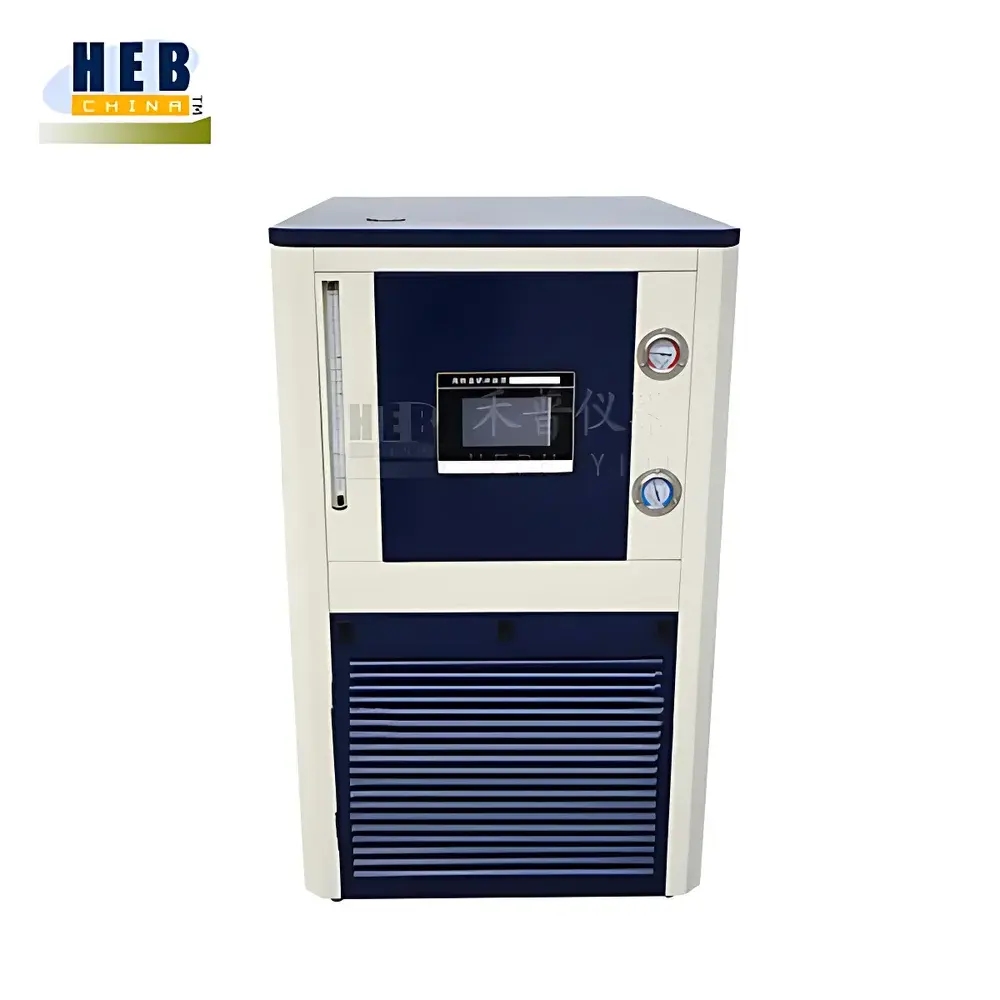
Hebei Jihepu GDSZ-100/40 High-Low Temperature Circulating Chiller
| Brand | Jihepu (Jinan Hebei Jihepu) |
|---|---|
| Origin | Shandong, China |
| Manufacturer Type | Authorized Distributor |
| Country of Origin | China |
| Model | GDSZ-100/40 |
| Temperature Range | −40 °C to +200 °C |
| Ambient Operating Conditions | 5–35 °C, ≤70% RH |
| Power Supply | 3-phase 380 V / 50 Hz |
| Control Accuracy | ±0.1 °C |
| Temperature Sensor | PT100 |
| Total Power Consumption | 17.1 kW |
| Heating Power | 9 kW |
| Compressor | 10 HP hermetic scroll, R22 refrigerant |
| Refrigeration Capacity | 23.24 kW at −40 °C |
| Circulation Pump | 750 W, 135 L/min flow rate, 25 m head, max pressure 0.2 MPa |
| Heat Exchanger | Plate-type, 2.5 m² effective area |
| External Port | 1/2″ BSP (6-point thread), two 3 m stainless steel braided hoses included |
| Fluid Compatibility | Premium-grade silicone oil (Grade A) |
| Dimensions (W×D×H) | 829 × 1071 × 1410 mm |
| Net Weight | 243 kg |
| Packaging | Wooden crate, 1190 × 880 × 1530 mm, 310 kg gross, 1.61 m³ volume |
Overview
The Hebei Jihepu GDSZ-100/40 High-Low Temperature Circulating Chiller is an industrial-grade thermal management system engineered for precise, bidirectional temperature control of external process equipment—including jacketed reactors, calorimeters, distillation columns, and analytical instrumentation. It operates on a dual-mode thermodynamic principle: mechanical compression refrigeration (using R22 refrigerant in a hermetically sealed 10 HP scroll compressor) combined with resistive electric heating via immersed tubular elements. The unit maintains stable thermal transfer through a closed-loop circulation of high-stability silicone oil (Grade A), delivering both rapid cooling from ambient to −40 °C and controlled heating up to +200 °C. Its integrated plate heat exchanger (2.5 m² surface area), low-pressure-drop fluid path, and PID-controlled digital interface ensure high reproducibility across extended operation cycles—critical for reaction optimization, material testing, and stability studies under ISO/IEC 17025-compliant laboratory environments.
Key Features
- Wide operational temperature span: −40 °C to +200 °C with ±0.1 °C setpoint stability, verified per ASTM E2251 calibration protocol
- Dual-stage thermal architecture: Independent refrigeration and heating circuits minimize cross-interference and improve energy efficiency during ramp-and-soak profiles
- Robust circulation system: 750 W magnetically coupled centrifugal pump delivers 135 L/min at 25 m head; pressure-limited to ≤0.2 MPa for compatibility with standard glass and stainless-steel reactor jackets
- Comprehensive safety suite: Dual-stage overtemperature cutoff, phase-sequence monitoring, compressor high-pressure cutout, thermal overload protection, and delayed startup sequencing to prevent inrush current damage
- Human-machine interface: Backlit LCD display with membrane keypad; real-time monitoring of outlet temperature, pump status, compressor load, and fault codes
- Industrial enclosure: Powder-coated cold-rolled steel chassis with corrosion-resistant finish; designed for continuous 24/7 operation in Class 10,000 cleanroom-adjacent labs
Sample Compatibility & Compliance
The GDSZ-100/40 is compatible with externally jacketed vessels ranging from 1 L to 500 L capacity, including borosilicate glass reactors (e.g., Chemglass, Ace Glass), Hastelloy C-276 pilot-scale systems, and modular flow chemistry platforms. It supports fluid media meeting IEC 60747-17 specifications for dielectric silicone oils (viscosity range 10–50 cSt at 25 °C). All electrical components conform to GB/T 14048.1 (equivalent to IEC 60947-1) for low-voltage switchgear. The unit meets CE marking requirements for electromagnetic compatibility (EN 61000-6-3/6-4) and safety (EN 61010-1), and its control logic supports audit-ready event logging for GLP/GMP-regulated workflows when paired with optional RS485 Modbus RTU integration.
Software & Data Management
While the base unit features standalone operation via front-panel controls, optional communication modules enable integration into centralized lab infrastructure. The RS485 port supports Modbus RTU protocol for bidirectional parameter read/write (setpoint, actual temp, pump speed, alarm status) and enables time-stamped data acquisition via third-party SCADA or LIMS platforms. Event logs—including compressor start/stop cycles, temperature deviation alarms (>±0.3 °C for >30 s), and safety interlock triggers—are stored in non-volatile memory with configurable retention (up to 30 days). For FDA 21 CFR Part 11 compliance, external validation packages are available to establish electronic signature workflows, audit trails, and user-access hierarchies.
Applications
- Exothermic/endothermic reaction control in pharmaceutical API synthesis (e.g., Grignard additions, hydrogenations, crystallization seeding)
- Calibration of differential scanning calorimeters (DSC) and thermogravimetric analyzers (TGA) across extended temperature domains
- Thermal cycling stress testing of polymer composites and battery electrolyte formulations per ISO 11357 and UL 1642 protocols
- Temperature-programmed desorption (TPD) and catalyst deactivation studies requiring sub-zero initiation and rapid ramp-to-peak profiles
- Stabilization of optical benches, laser cavities, and interferometric measurement systems sensitive to thermal drift
- Supporting ASTM D341 viscosity-temperature correlation studies using calibrated capillary viscometers
FAQ
What fluids are approved for use with the GDSZ-100/40?
Only high-purity, low-volatility silicone oils meeting ASTM D5272 specifications (e.g., Dow Corning 200 Fluid, Wacker AK20) are recommended. Ethylene glycol/water mixtures, mineral oils, or halogenated solvents are strictly prohibited due to incompatibility with seals and risk of thermal decomposition.
Can this chiller operate continuously at −40 °C?
Yes—the system is rated for continuous duty at full low-temperature capacity provided ambient conditions remain within 5–35 °C and relative humidity does not exceed 70%. Condensation management on external piping must be implemented per ASHRAE Guideline 33.
Is remote monitoring supported out-of-the-box?
No—RS485 Modbus RTU connectivity is optional and requires factory configuration. Ethernet or Wi-Fi interfaces are not available on this model.
What maintenance intervals are specified for the compressor and pump?
Compressor oil analysis and filter replacement are required every 6,000 operating hours or biannually, whichever occurs first. Circulation pump bearings should be inspected annually; seal integrity checks are recommended after each fluid change.
Does the unit comply with noise emission standards for laboratory environments?
At 1 m distance under full-load conditions, sound pressure level is 72 dB(A), compliant with ISO 4871 and suitable for shared lab spaces when installed with vibration-dampening mounts.



