
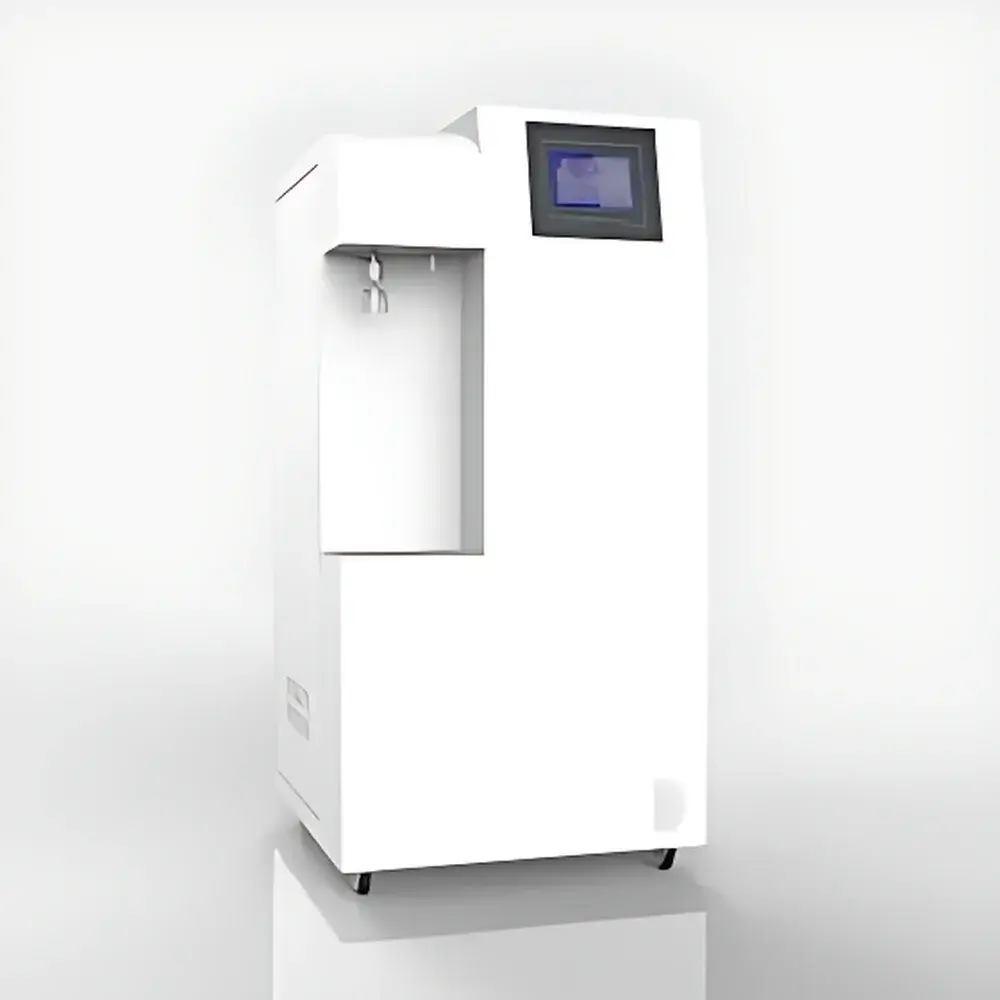
HePu EU-LS-T Floor-Standing Ultra-Pure Water System
| Brand | HePu (Jihepu) |
|---|---|
| Origin | Shandong, China |
| Model | EU-LS-T |
| Resistivity | 18.25 MΩ·cm @ 25°C |
| Heavy Metals & Soluble Silica | <0.1 ppb |
| Total Organic Carbon (TOC) | <3 ppb |
| Microbial Count | <0.1 CFU/mL |
| Endotoxin | <0.001 EU/mL |
| Particles (>0.1 µm) | <1 particle/mL |
| Feed Water | RO/DI/Single-Distilled Water |
| Output Flow Rate | 2–2.5 L/min (tank full) |
| Power Supply | 220 V, 50 Hz, 60–300 W |
| Dimensions (W×D×H) | 550 × 500 × 950 mm |
Overview
The HePu EU-LS-T Floor-Standing Ultra-Pure Water System is an engineered solution for laboratories requiring continuous, on-demand production of Type I ultrapure water compliant with GB/T 6682-2008, ASTM D1193-20, NCCLS EP21-A, and CAP guidelines. It operates as a post-treatment system—accepting reverse osmosis (RO), deionized (DI), or single-distilled feed water—and applies multi-stage purification including dual-wavelength UV oxidation (185 nm + 254 nm), ion exchange, ultrafiltration, and terminal 0.22 µm PES membrane filtration. The system employs Couette-flow-based conductivity/resistivity monitoring in real time, enabling precise detection of ionic contamination at sub-ppb levels. Its architecture integrates electrochemical sensing, programmable logic control (PLC), and fail-safe hydraulic management to ensure consistent delivery of water meeting stringent specifications for molecular biology, trace elemental analysis, and high-sensitivity instrumentation.
Key Features
- Industrial-grade 7-inch LCD touchscreen interface with intuitive PLC-driven navigation and user-defined parameter configuration.
- Real-time online monitoring of feed, pure, and ultrapure water resistivity and conductivity—expandable to include source water quality assessment upon request.
- Automated RO membrane maintenance cycle: programmable pre-rinse duration based on inlet water TDS and pressure profile; anti-scaling flush protocol extends membrane service life by up to 40% under typical municipal feed conditions.
- Comprehensive safety interlocks: low-pressure cutoff, tank-level-triggered shutdown, dry-run protection, overpressure alarm, and thermal overload disconnection.
- Configurable purity alarms—resistivity, TOC, endotoxin, and particle thresholds—with visual/audio alerts and event logging.
- Consumable lifecycle tracking: all cartridges and membranes support customizable replacement intervals; remaining service time displayed dynamically with preemptive notification.
- Flexible dispensing modes: volumetric, timed, or quality-triggered delivery; supports both manual and automated dispensing via footswitch or external signal input.
- Built-in RTC (real-time clock) with calendar function; audit-ready timestamping of all operational events and water dispense records.
- Dual-lamp UV system (185 nm for TOC photolysis, 254 nm for microbial inactivation) with lamp-status diagnostics and automatic fault reporting.
- NSF/ANSI 61-certified fluid path: all tubing, quick-connect fittings, and manifolds comply with material safety standards for potable and laboratory water systems.
- Modular floor-standing chassis with adjustable leveling feet and integrated casters—designed for stability in high-humidity environments and compliance with IEC 61010-1 electrical safety requirements (SELV operation).
Sample Compatibility & Compliance
The EU-LS-T delivers water suitable for critical applications where background interference must be minimized—including HPLC mobile phase preparation, ICP-MS calibration standard dilution, electrophoresis buffer formulation, and cell culture media supplementation. Its output meets or exceeds the purity criteria defined in ISO 3696:1987 (Grade 1), CLSI EP21-A (2022), and USP . All wetted components are chemically inert (PP, PVDF, PES); no leachable metals or organics are introduced during operation. Endotoxin removal efficiency (>3-log reduction) and RNase/DNase-free performance are validated per ISO 13485 manufacturing protocols. System firmware supports GLP/GMP-compliant data integrity through optional 21 CFR Part 11–enabled USB or RS-485 connectivity for secure electronic record retention.
Software & Data Management
The embedded control system logs all operational parameters—including resistivity trends, UV lamp hours, filter saturation indices, dispense volumes, and alarm history—for up to 12 months. Data export is supported via USB flash drive (CSV format) or serial interface; optional PC software enables trend analysis, report generation, and remote diagnostic review. Audit trails capture user login/logout timestamps, parameter changes, and consumable replacements—fully traceable to individual operator accounts with role-based access (administrator, technician, operator). Firmware updates are performed locally without network dependency, preserving cybersecurity integrity in regulated environments.
Applications
- Molecular biology: PCR, qRT-PCR, NGS library prep, CRISPR editing reagent preparation.
- Clinical diagnostics: immunoassay diluents, ELISA plate washing, flow cytometry sheath fluid.
- Analytical chemistry: HPLC/UHPLC solvent preparation, GC-MS carrier gas humidification, ICP-OES/ICP-MS sample introduction.
- Cell culture: stem cell expansion, hybridoma monoclonal antibody production, organoid media formulation.
- Pharmaceutical QA/QC: dissolution testing, extractables/leachables studies, stability-indicating assay development.
- Environmental testing: EPA Method 1631 (mercury analysis), TOC quantification per Standard Methods 5310B.
FAQ
What feed water quality is required for optimal performance?
The system requires pretreated feed water with conductivity ≤5 µS/cm (e.g., from a certified RO unit). Inlet pressure must be maintained between 1.0–5.0 kg/cm²; temperature range: 5–45°C.
Can the system be integrated with a pressurized storage tank?
Yes—it supports connection to NSF-certified stainless steel or polyethylene pressure tanks (up to 100 L) or gravity-fed reservoirs with level-controlled pump activation.
Is the system compatible with regulatory data integrity requirements?
With optional firmware upgrade, it provides electronic signatures, audit trail export, and user permission tiers aligned with FDA 21 CFR Part 11 and EU Annex 11 expectations.
How often do consumables require replacement?
Typical service intervals: RO membrane (24–36 months), UP resin cartridge (6–12 months), UF/UV module (12 months), final 0.22 µm filter (3–6 months)—all configurable and monitored in real time.
Does the system support remote monitoring?
Local RS-485 or USB communication enables integration into lab-wide building management systems (BMS) or centralized water quality dashboards; Ethernet/WiFi modules are available as field-installable upgrades.



