
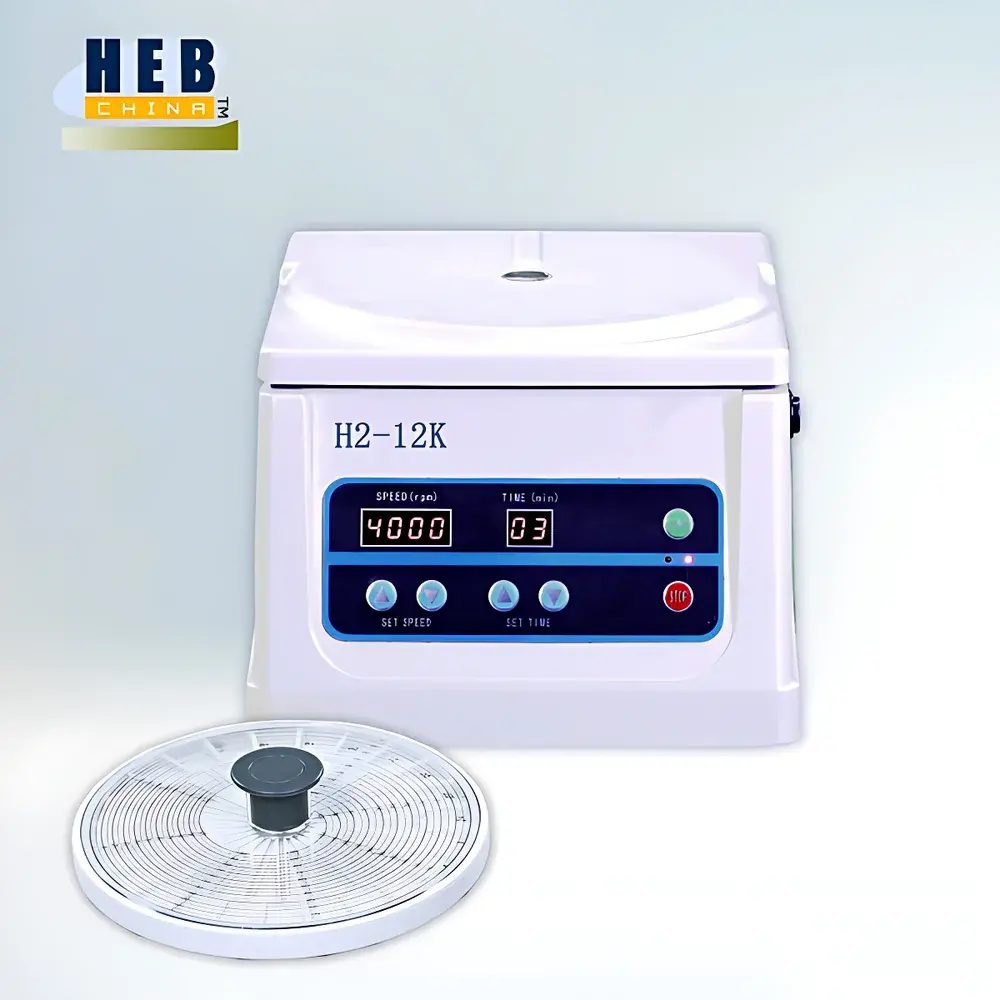
H2-12K Capillary-Specific Benchtop Centrifuge
| Brand | Jihepu (Jinan Hepu) |
|---|---|
| Origin | Shandong, China |
| Model | H2-12K |
| Instrument Type | Benchtop Centrifuge |
| Speed Range | 0–12,000 rpm |
| Max RCF | 14,170 × g |
| Max Capacity | 24 × (0.25–1 mL) capillaries |
| Timer Range | 1–99 min |
| Speed Accuracy | ±20 rpm |
| Power Supply | AC 220 V ±10%, 50/60 Hz, 10 A |
| Total Power | 250 W |
| Noise Level | ≤65 dB(A) |
| Cavity Diameter | Φ200 mm |
| Dimensions (W×D×H) | 315×270×240 mm |
| Net Weight | 11 kg |
| Rotor Type | Fixed-angle capillary rotor (24-position) |
| Application Class | Hematocrit & micro-volume biological sample separation |
Overview
The H2-12K Capillary-Specific Benchtop Centrifuge is an engineered solution for precise hematocrit determination and micro-volume sample separation in clinical laboratories, point-of-care settings, and field-deployable diagnostic workflows. Designed around the principles of fixed-angle centrifugation under controlled rotational dynamics, it applies uniform radial acceleration to capillary tubes containing whole blood or other low-viscosity biological suspensions. Its optimized rotor geometry ensures consistent sedimentation profiles across all 24 positions, enabling reliable, repeatable hematocrit (Hct) measurements per CLSI EP5-A2 and ISO 15189–aligned protocols. The instrument operates within a defined low-speed, high-RCF regime—maximizing separation efficiency for erythrocyte packing while minimizing shear-induced hemolysis or plasma layer distortion. Its compact footprint and structural stability—including integrated vacuum suction base—support operation on uneven surfaces, mobile lab carts, or transport vehicles without compromising mechanical integrity or centrifugal fidelity.
Key Features
- Fixed-angle 24-position capillary rotor engineered for standardized hematocrit tube dimensions (75 mm length, 1.0–1.2 mm internal diameter), ensuring optimal meniscus alignment and sedimentation path consistency.
- Digital LED display with real-time rpm and timer readout; intuitive rotary dial interface for rapid parameter entry without menu navigation latency.
- Brushless DC motor drive system delivering maintenance-free operation, thermal stability over extended runs, and vibration-damped rotational balance at all speeds up to 12,000 rpm.
- Vacuum suction base provides secure adhesion to stainless steel, laminate, or polymer work surfaces—critical for mobile deployment and anti-slip compliance during high-RCF operation.
- Acoustically damped housing and precision-balanced rotor assembly limit operational noise to ≤65 dB(A), meeting WHO-recommended ambient noise thresholds for clinical diagnostic environments.
- Integrated safety interlock prevents lid opening during rotation; automatic rotor recognition logic verifies correct capillary rotor installation prior to run initiation.
Sample Compatibility & Compliance
The H2-12K accepts standard heparinized or EDTA-coated glass or plastic capillary tubes (0.25–1.0 mL volume, 75 mm length). It is validated for use with whole blood specimens per CLSI H26-A3 guidelines for hematocrit measurement and supports QC verification using NIST-traceable hematocrit reference standards. The centrifuge meets IEC 61010-1:2010 safety requirements for laboratory electrical equipment and conforms to electromagnetic compatibility (EMC) standards IEC 61326-1:2021. While not certified for GMP manufacturing environments, its design supports GLP-compliant documentation practices including manual logbook entries for run parameters, operator ID, date/time stamp, and sample identification—enabling audit readiness for CAP, COLA, or ISO 15189-accredited labs.
Software & Data Management
The H2-12K operates as a standalone hardware platform with no embedded firmware-based data logging or network connectivity. All operational parameters are set manually and retained only during active runtime. For regulated environments requiring electronic records, users may integrate external time-stamped video recording or digital lab notebook systems (e.g., LabArchives, Benchling) to capture run metadata. The absence of onboard storage or user-accessible software eliminates 21 CFR Part 11 compliance obligations—making it suitable for non-GxP applications where simplicity, reliability, and minimal validation burden are prioritized.
Applications
- Hematocrit (Hct) quantification in peripheral blood samples for anemia screening, polycythemia evaluation, and perioperative monitoring.
- Micro-volume plasma isolation from fingerstick or heelstick specimens in pediatric and geriatric populations.
- Sedimentation analysis of microhematocrit tubes in resource-limited or field-based malaria or dengue surveillance programs.
- Preparative separation of low-density cellular fractions (e.g., platelet-rich plasma) when combined with calibrated capillary fill volumes and standardized spin durations.
- Quality control testing of capillary tube manufacturing consistency—including wall thickness uniformity and bore concentricity—via comparative RCF-dependent sedimentation kinetics.
FAQ
What capillary tube specifications are compatible with the H2-12K?
Standard 75-mm-length capillaries with outer diameters of 1.2–1.5 mm and internal diameters of 1.0–1.2 mm, holding 0.25–1.0 mL total volume. Both heparinized and EDTA-coated glass or plastic tubes are supported.
Does the H2-12K support variable speed ramping or programmable acceleration/deceleration profiles?
No. It features fixed-rate acceleration and deceleration optimized for capillary integrity and hematocrit reproducibility. Speed transitions occur within ≤15 seconds from standstill to 12,000 rpm.
Is rotor balancing required before each run?
No. The 24-position fixed-angle rotor is factory-balanced and does not require user balancing. Symmetrical loading of capillary tubes is recommended to maintain optimal vibration characteristics.
Can the H2-12K be used for applications beyond hematocrit measurement?
It is validated exclusively for capillary-based micro-volume separations. Use with non-capillary vessels, high-viscosity fluids, or hazardous materials is not supported and voids safety certification.
What maintenance is required for long-term reliability?
No scheduled maintenance is needed. Routine cleaning of the rotor chamber with 70% ethanol and periodic inspection of the suction base seal integrity are sufficient for >5 years of continuous service under normal laboratory conditions.



