
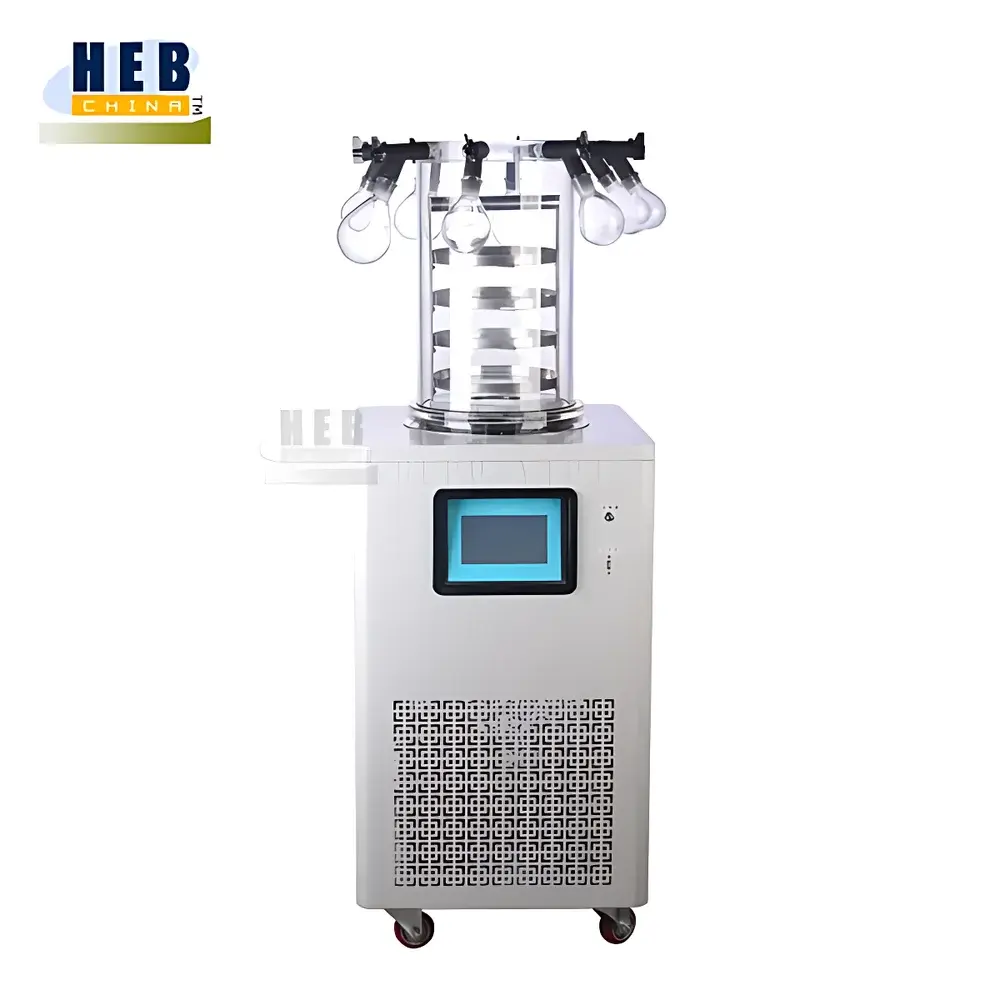
Hebei Jihepu ZLGJ-18 Benchtop Manifold Freeze Dryer
| Brand | Jihepu |
|---|---|
| Origin | Shandong, China |
| Model | ZLGJ-18 |
| Instrument Type | Manifold (Stopcock) Configuration |
| Application | Laboratory-Scale Lyophilization |
| Shelf Area | 0.18 m² |
| Ultimate Vacuum | <5 Pa (empty chamber) |
| Condenser Capacity | 6 kg/24 h |
| Condenser Temperature | ≤−50 °C (standard), optional −80 °C (empty) |
| Pump Speed | 4 L/s |
| Dimensions (W×D×H) | 560 × 560 × 980 mm |
| Weight | 88 kg |
| Cooling Method | Air-cooled |
| Defrost Mode | Natural Thaw |
| Power Supply | 220 V ±10%, 50 Hz, 1100 W |
| Operating Ambient | 10–30 °C, RH ≤70%, non-corrosive/non-explosive environment |
Overview
The Hebei Jihepu ZLGJ-18 Benchtop Manifold Freeze Dryer is a compact, integrated laboratory lyophilization system engineered for precision primary drying of heat-sensitive biological, pharmaceutical, and analytical samples under high-vacuum cryogenic conditions. It operates on the fundamental principle of sublimation—removing water from frozen samples by reducing pressure below the triple point of ice while maintaining low condenser temperatures (≤−50 °C standard, optionally −80 °C). Designed specifically for small-batch R&D, method development, and quality control workflows, the ZLGJ-18 employs a manifold configuration with eight independent stopcock ports, enabling simultaneous freeze-drying of multiple vials, flasks, or ampoules without cross-contamination. Its all-in-one architecture eliminates external refrigeration units or vacuum line assemblies, minimizing footprint (560 × 560 × 980 mm) and installation complexity while ensuring hermetic integrity and long-term operational stability.
Key Features
- Integrated stainless-steel condenser chamber with large-diameter opening and no internal coil—enabling direct pre-freezing of samples inside the cold trap, eliminating dependency on ultra-low temperature freezers.
- Patented gas-flow distribution design ensures uniform ice deposition across the entire condenser surface, maximizing capture efficiency and sustaining stable vacuum during extended cycles.
- High-efficiency air-cooled compressor (international brand) delivers consistent condenser performance at ≤−50 °C (empty), with optional −80 °C configuration available for low-eutectic formulations.
- Dual-stage vacuum system featuring a 4 L/s rotary vane pump with intelligent pump protection logic—automatically delays pump activation until condenser reaches preset safe temperature (e.g., −40 °C), extending pump service life and preventing oil backstreaming.
- 7-inch full-color industrial touchscreen interface paired with the SH-HPSC-II modular controller provides PID-regulated temperature and vacuum control, real-time alarm logging, and programmable multi-step drying protocols.
- Comprehensive data acquisition system records and time-stamps condenser temperature, chamber pressure, and optional shelf/sensor temperature profiles; exportable in CSV format for post-processing and audit compliance.
- User-access level management with password-protected operator/admin accounts supports role-based workflow segregation in regulated environments.
- Traceable sensor calibration utility allows field verification and adjustment of thermocouple and capacitance manometer readings per ISO/IEC 17025 guidelines.
Sample Compatibility & Compliance
The ZLGJ-18 accommodates diverse sample formats via its 8-port manifold: (i) standard glassware including 100 mL, 150 mL, 250 mL, and 500 mL round-bottom flasks (2 each); (ii) four 240 mm diameter stainless-steel trays (total capacity 1800 mL at 10 mm fill depth); (iii) optional six-layer tray configuration (2700 mL capacity); and (iv) direct vial drying using crimp-top or rubber-stoppered serum vials (1320 × Ø12 mm, 740 × Ø16 mm, or 540 × Ø22 mm). All wetted surfaces—including condenser, manifold, and tray supports—are constructed from electropolished 304 stainless steel, compliant with USP material compatibility requirements and suitable for GLP/GMP-aligned processes. The system meets general electrical safety standards (IEC 61010-1) and supports documentation practices aligned with FDA 21 CFR Part 11 when paired with validated data export and electronic signature protocols.
Software & Data Management
Data integrity is maintained through continuous timestamped recording of critical process parameters: condenser temperature (±0.5 °C accuracy), chamber pressure (capacitance manometer, range 0.1–1000 Pa, ±5% full scale), and optional external probe inputs (e.g., product thermocouples). All curves are visualized in real time on the embedded HMI and stored internally with configurable retention (up to 100 cycles). Export functionality supports USB flash drive transfer of raw CSV files compatible with Excel, MATLAB, or LIMS integration. Audit trail metadata—including user ID, event timestamp, parameter setpoints, and deviation flags—is retained with write-protection to prevent post-hoc modification. Firmware updates are performed via secure authenticated USB upload, preserving configuration history.
Applications
The ZLGJ-18 serves core lyophilization needs across academic, biotech, and contract research laboratories: stabilization of monoclonal antibodies, enzymes, vaccines, and diagnostic reagents; preparation of reference standards for chromatography and mass spectrometry; dehydration of microbial cultures and tissue extracts; formulation screening of excipient blends; and small-scale batch production of sterile APIs prior to scale-up. Its manifold architecture is particularly suited for comparative studies—e.g., evaluating collapse temperature across different buffer systems—or parallel drying of clinical trial batches where vial-to-vial consistency must be preserved without shared shelf contact.
FAQ
What is the maximum sample volume supported in manifold mode?
Up to 8 × 500 mL flasks (4 L total), or 1320 × 12 mm serum vials—equivalent to ~1.6 L liquid volume at typical 10 mm fill depth.
Can the system operate unattended overnight?
Yes—programmable cycle logic, automatic pump shutdown on overpressure, and thermal cutoffs enable safe 24-hour operation with remote monitoring via optional Ethernet module.
Is validation support documentation available?
Factory-supplied IQ/OQ templates, calibration certificates for integrated sensors, and material traceability reports are provided upon request for GxP-compliant installations.
What maintenance intervals are recommended?
Vacuum pump oil replacement every 500 operating hours; condenser cleaning after every 10–15 cycles depending on sample load; annual verification of temperature and pressure sensor accuracy.
Does the system comply with energy efficiency standards?
Rated power consumption is 1100 W at peak load; air-cooled design eliminates chiller water demand, aligning with ISO 50001 energy management principles for lab infrastructure.



