
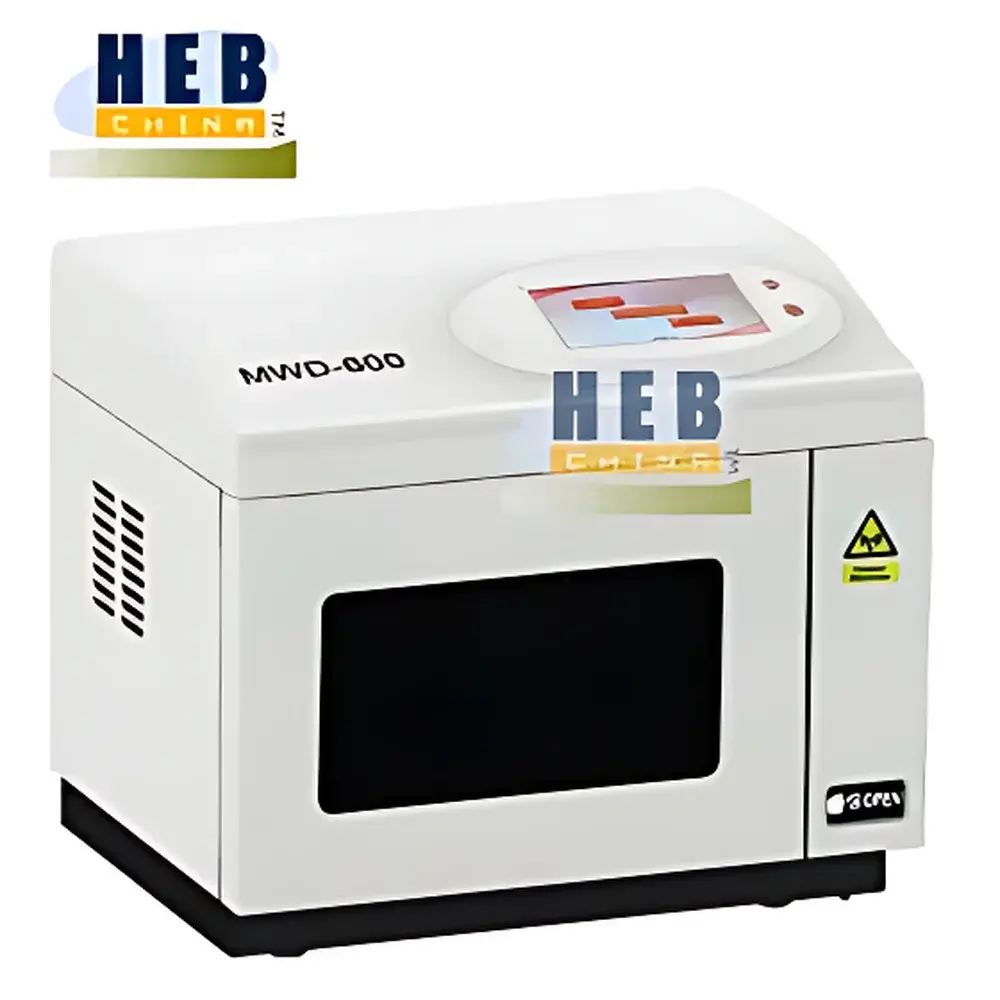
HePu MWD-600 Intelligent Sealed Microwave Digestion System
| [Brand | HePu (Jinan Hepu Instrument Co., Ltd.) |
|---|---|
| Origin | Shandong, China |
| Model | MWD-600 |
| Sample Capacity | 1–10 vessels |
| Microwave Source | Single magnetron |
| Max Temperature | 250 °C |
| Max Operating Pressure | 6 MPa |
| Cavity Volume | 65 L |
| Vessel Material | TFM-lined inner vessel, PEEK + fiberglass reinforced outer vessel |
| Pressure Control | Multi-fiber non-contact scanning pressure monitoring |
| Temperature Control | Mid-infrared non-contact scanning temperature monitoring |
| Power Range | 0–1500 W (2450 MHz) |
| Rotation | 360° continuous rotation |
| Safety Compliance | <5 mW/cm² microwave leakage, dual-safety interlock door, auto-resealing pressure relief, over-pressure/over-temperature cut-off, real-time fault diagnostics |
| Software | 255 programmable methods, 10-step per method, in-process parameter adjustment, audit-ready method logging] |
Overview
The HePu MWD-600 Intelligent Sealed Microwave Digestion System is a laboratory-grade, fully automated sample preparation platform engineered for high-efficiency, reproducible acid digestion of solid and semi-solid matrices under controlled temperature and pressure conditions. It operates on the principle of dielectric heating via 2450 MHz microwave energy, enabling rapid, uniform volumetric heating of samples sealed within chemically inert, high-strength reaction vessels. Unlike conventional hotplate or block digesters—where heat transfer is limited by conduction and convection—the MWD-600 delivers energy directly to polar molecules (e.g., HNO₃, HCl, HF), accelerating decomposition kinetics while minimizing volatile element loss, reagent consumption, and procedural blank contributions. Its sealed-vessel architecture supports digestion at up to 250 °C and 6 MPa, making it suitable for demanding applications including trace metal analysis (ICP-MS, ICP-OES), halogen speciation, and refractory matrix dissolution (e.g., silicates, polymers, biological tissues). Designed for compliance-driven environments, the system supports GLP-aligned workflow documentation and integrates with LIMS via standard RS232/USB interfaces.
Key Features
- Auto-resealing dual-pressure relief mechanism: Each TFM inner vessel features a self-resetting safety valve that vents transient overpressure (>6 MPa) and automatically reseals—preserving digestion integrity without interrupting the cycle or compromising batch consistency.
- Chemically resistant vessel assembly: Inner vessels machined from USP Class VI-certified TFM (modified PTFE); outer containment sleeves fabricated from reinforced PEEK + fiberglass composite—rated to 15 MPa burst pressure and stable in aqua regia, hydrofluoric acid, and organic solvent mixtures.
- True 360° continuous rotation platform: Eliminates “cold spots” and field heterogeneity by rotating the full vessel carousel unidirectionally at constant speed—reducing mechanical stress on drive components versus oscillatory systems and improving inter-vessel temperature uniformity (<±1.2 °C across 10-vessel load).
- Dual-parameter real-time monitoring: Mid-infrared optical sensors measure solution temperature inside each vessel independently; multi-fiber optic probes deliver non-contact pressure readings with ±0.01 MPa resolution—ensuring full isolation between measurement hardware and reactive chemistry.
- Intuitive 8-inch capacitive touchscreen interface: Displays live power, temperature, and pressure curves; provides individual vessel status windows; supports on-the-fly parameter modification during active runs—including ramp rate, hold time, and target setpoints.
- Robust safety architecture: Includes dual-interlocked safety door with force-sensitive latch, emergency stop button (IEC 60204-1 compliant), acoustic anomaly detection, motor stall sensing, and automatic power cutoff upon door opening or thermal runaway.
Sample Compatibility & Compliance
The MWD-600 accommodates diverse sample types—including soils, sediments, food composites, pharmaceutical excipients, polymer additives, catalysts, and clinical biospecimens—within standardized 60 mL TFM vessels. Its pressure-tolerant design enables closed-vessel digestion protocols aligned with ASTM D5511, ISO 11466, USP <231>, and EPA Methods 3050B, 3051A, and 3052. All vessel materials comply with FDA 21 CFR §177.1550 (fluoropolymers) and EU Regulation (EC) No 1935/2004 for food contact. The system’s firmware logs all method executions—including timestamps, operator ID, parameter deviations, and alarm events—supporting 21 CFR Part 11-compliant electronic records when paired with validated third-party data management software.
Software & Data Management
Built-in firmware supports storage of 255 user-defined digestion methods, each configurable with up to 10 sequential steps (ramp/hold segments). Every step permits independent control of temperature (50–300 °C), pressure (0–10 MPa), duration (0–999 min), and microwave power (0–1500 W). Method editing is permitted during runtime, allowing adaptive optimization without aborting cycles. Internal memory retains full execution histories with checksum-verified integrity. USB export enables CSV-formatted reports containing time-stamped temperature/pressure/power traces per vessel. Optional Ethernet module enables remote monitoring and integration into centralized lab informatics platforms via Modbus TCP or HTTP API endpoints.
Applications
- Environmental testing: Heavy metal extraction from sludge, fly ash, and contaminated soils per EPA SW-846 protocols.
- Food safety: Determination of As, Cd, Pb, and Hg in infant formula, seafood, and fortified cereals using ICP-MS quantification.
- Geochemical analysis: Complete dissolution of silicate rocks and mineral ores for REE profiling.
- Pharmaceutical QA/QC: Residual catalyst (Pd, Pt, Rh) recovery from active pharmaceutical ingredients (APIs).
- Battery R&D: LiCoO₂, NMC, and LFP cathode material digestion prior to Ni/Co/Mn ratio verification.
- Clinical research: Total elemental mapping in tissue biopsies and serum matrices for metallomics studies.
FAQ
What is the maximum recommended operating pressure for routine use?
The system is rated for continuous operation at ≤6 MPa; the outer vessel burst rating is 15 MPa.
Can the MWD-600 be used with hydrofluoric acid (HF)?
Yes—TFM inner vessels are HF-resistant; however, HF-containing protocols require dedicated ventilation and post-digestion neutralization per OSHA 1910.1200 guidelines.
Is method validation support available?
HePu provides IQ/OQ documentation templates and reference digestions (NIST SRM 2710a, 1643f) for user-led performance qualification.
Does the system meet electromagnetic compatibility (EMC) standards?
Complies with IEC 61326-1:2013 for industrial electromagnetic environments and CISPR 11 Group 2 Class B emission limits.
How is calibration traceability maintained?
Mid-infrared temperature sensors are factory-calibrated against NIST-traceable blackbody sources; pressure transducers are certified to ISO/IEC 17025-accredited labs.



