
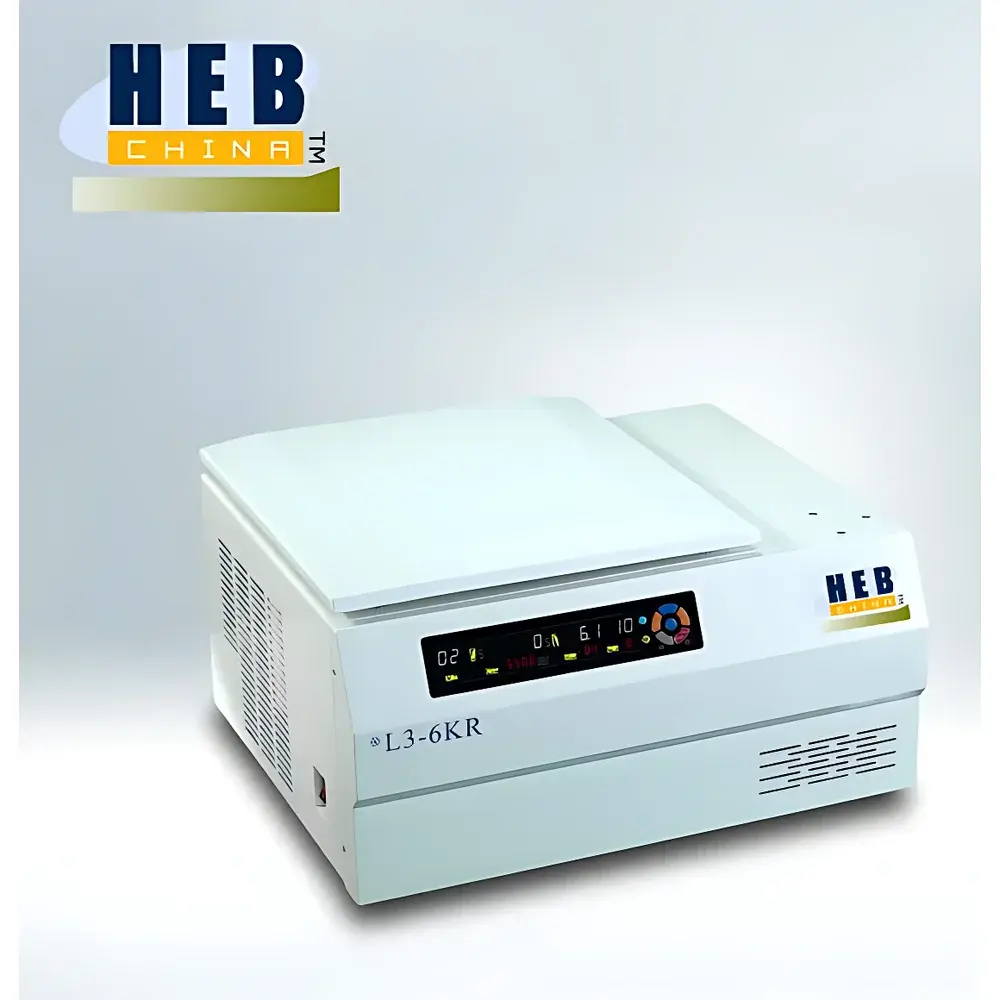
HePu L3-6KR Benchtop Low-Speed Refrigerated Centrifuge
| Brand | HePu |
|---|---|
| Origin | Shandong, China |
| Model | L3-6KR |
| Type | Benchtop Refrigerated Centrifuge |
| Max Speed | 6500 rpm |
| Max RCF | 5190 × g |
| Max Capacity | 4 × 250 mL |
| Temperature Range | −20 °C to 40 °C |
| Temp. Accuracy | ±2.0 °C |
| Timer Range | 1 min – 99 min |
| Acceleration/Deceleration | 10 selectable ramps (Ramp 9: free deceleration >540 s) |
| Noise Level | ≤65 dB(A) |
| Power Supply | AC 220 V ±10%, 50 Hz, 10 A |
| Total Power | 800 W |
| Dimensions (W×D×H) | 550 × 650 × 365 mm |
| Net Weight | 70 kg |
Overview
The HePu L3-6KR is a benchtop low-speed refrigerated centrifuge engineered for routine separation of biological samples requiring temperature control and moderate g-force performance. Designed around a brushless AC frequency-controlled motor and microprocessor-based control system, it delivers stable rotational dynamics with minimal vibration and acoustic emission—critical for maintaining sample integrity during extended runs. Its operational principle relies on sedimentation under controlled gravitational force (RCF), where differential density and particle size drive phase separation in suspensions such as whole blood, cell cultures, crude tissue homogenates, and polymer solutions. Unlike high-speed or ultracentrifuges, the L3-6KR operates within the low-to-mid RCF range (up to 5190 × g), making it particularly suited for applications involving intact cells, organelles, precipitated proteins, and large particulates where excessive shear or thermal stress must be avoided. The integrated high-efficiency eco-refrigeration system maintains chamber temperatures between −20 °C and 40 °C, with rapid pre-cooling capability and sustained cooling at maximum speed (≤−4 °C), ensuring reproducible thermal conditions across repeated batches.
Key Features
- Microprocessor-controlled operation with real-time LED display of speed (rpm), RCF (×g), temperature (°C), and remaining time—parameters editable mid-run without stopping the rotor.
- Simultaneous dual-parameter setting: users may input either rpm or RCF directly, with one-touch conversion between units based on rotor geometry and radius.
- 10-step programmable acceleration and deceleration profiles; Ramp 9 enables extended free-spin-down (>540 s), ideal for fragile pellets or viscous supernatants requiring gentle settling.
- Electronic safety door lock with reinforced stainless-steel inner chamber and corrosion-resistant housing for long-term durability and containment compliance.
- Energy-efficient refrigeration using environmentally compliant refrigerants, certified for continuous operation at full speed while maintaining ≤−4 °C internal temperature.
- One-touch pre-cool function initiates chamber cooling prior to rotor insertion, reducing thermal equilibration time and improving experimental consistency.
- Timer resolution adapts dynamically: displays seconds when set <60 s; switches to minutes for longer durations—enhancing precision in time-sensitive protocols.
Sample Compatibility & Compliance
The L3-6KR supports a broad range of sample containers via interchangeable rotors, including fixed-angle and swing-bucket configurations. Standard angular rotors accommodate up to 16 × 50 mL tubes (6500 rpm / 5190 × g) or 12 × 10–15 mL conical tubes under identical conditions. Optional horizontal rotors enable high-capacity processing: 4 × 250 mL bottles (4200 rpm / 3850 × g) or multi-tube configurations for clinical specimen handling (e.g., 64 × 5 mL vacutainers). All rotors are balanced per ISO 15198 and undergo dynamic balancing verification to ensure mechanical stability. The instrument meets IEC 61010-1:2010 safety standards for laboratory electrical equipment and complies with electromagnetic compatibility requirements per EN 61326-1. While not certified for GMP manufacturing environments, its design supports GLP-aligned workflows—including audit-ready parameter logging when paired with optional data export modules.
Software & Data Management
The L3-6KR operates autonomously via its embedded controller but supports external documentation through USB data export (CSV format) for run logs including start/end timestamps, setpoints, actual RCF, temperature traces, and fault codes. Though no proprietary PC software is bundled, exported files are compatible with common LIMS platforms and spreadsheet-based QA/QC review. The system records up to 100 program presets with user-defined names, facilitating SOP-driven operation in teaching labs or QC departments. All critical operational parameters—including door interlock status, refrigeration status, and overspeed detection—are logged internally and accessible via service mode. For regulated environments, optional firmware upgrades may introduce 21 CFR Part 11–compliant electronic signatures and audit trail generation (subject to validation by end-user).
Applications
This centrifuge serves core separation tasks across academic, clinical, and industrial laboratories: harvesting mammalian or microbial cells from culture media; clarifying serum or plasma prior to ELISA or electrophoresis; isolating nuclei or mitochondria via differential centrifugation steps; preparing platelet-rich plasma (PRP); concentrating viral vectors or exosomes in early-stage bioprocessing; and routine quality control of pharmaceutical suspensions or food emulsions. Its −20 °C to 40 °C range allows both cryopreservation-compatible pelleting and ambient-temperature sedimentation of heat-labile complexes. The 4 × 250 mL capacity supports scalable batch processing for upstream biomanufacturing support, while the 10-ramp deceleration profile accommodates method development for novel biomaterials where pellet resuspension efficiency depends on braking kinetics.
FAQ
What is the minimum temperature achievable at maximum speed?
The refrigeration system maintains ≤−4 °C at 6500 rpm under standard ambient conditions (25 °C, 50% RH). Performance may vary slightly with prolonged runtime or elevated room temperature.
Can this centrifuge be used for blood bank applications?
Yes—the optional horizontal rotor with 64 × 5 mL tube capacity and validated swing-bucket adapters meet CLSI H18-A4 guidelines for whole blood fractionation and PRP preparation.
Is rotor imbalance detection automated?
The system continuously monitors vibration signatures and will automatically halt operation if imbalance exceeds ISO 21500 Class G2.5 thresholds, displaying error code E03.
Does the L3-6KR support remote monitoring or network connectivity?
No native Ethernet or Wi-Fi interface is included; however, USB-exported logs can be integrated into centralized lab informatics systems via middleware scripts.
What maintenance intervals are recommended?
Compressor oil and refrigerant levels should be verified annually by authorized service personnel; rotor inspection (crack testing, corrosion assessment) is advised every 500 hours of cumulative use or per ISO 21500 Annex B.



