
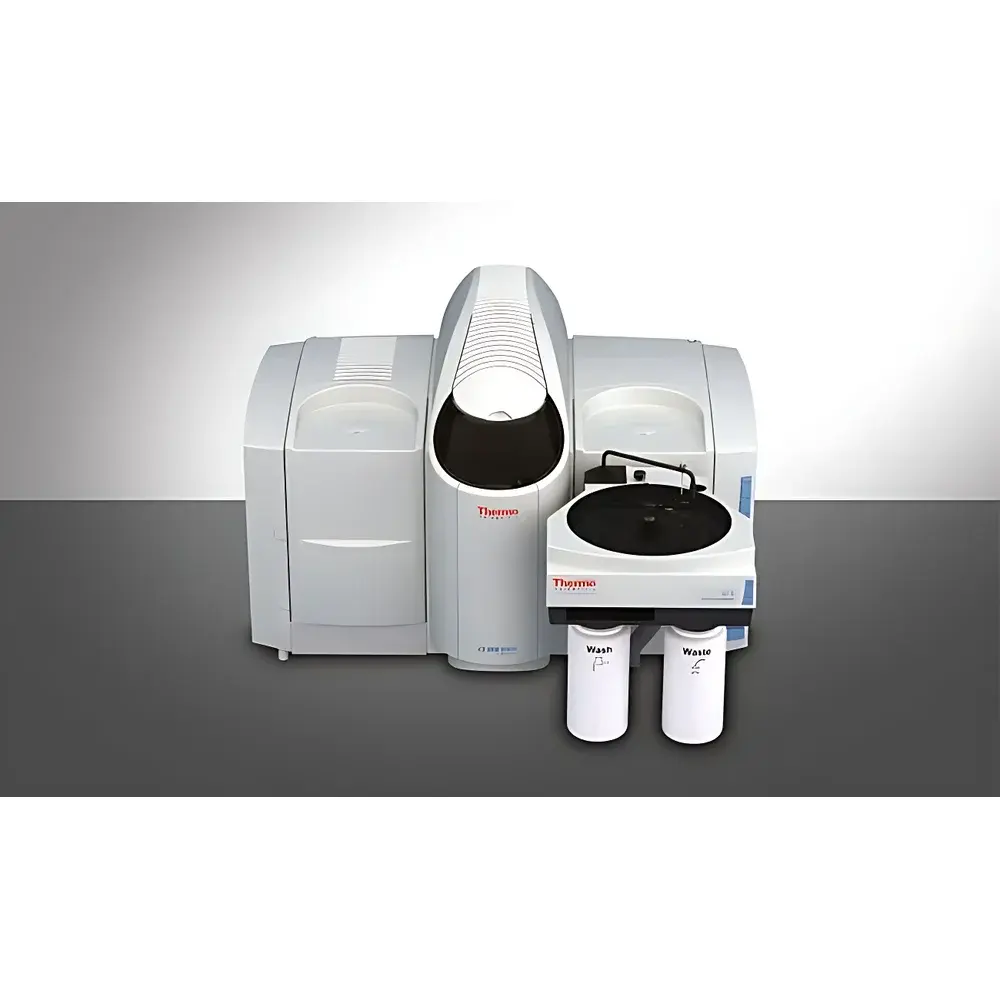
Thermo Scientific iCE 3400 Graphite Furnace Atomic Absorption Spectrometer
| Brand | Thermo Fisher |
|---|---|
| Origin | United Kingdom |
| Manufacturer Type | Original Equipment Manufacturer (OEM) |
| Product Origin | Imported |
| Model | iCE 3400 |
| Instrument Type | Graphite Furnace AAS |
| Monochromator | Echelle Grating |
| Optical System | Double-Beam |
| Detector | Photomultiplier Tube (PMT) |
| Background Correction | D₂ Lamp + Zeeman Electro-Magnetic Field Correction |
Overview
The Thermo Scientific iCE 3400 Graphite Furnace Atomic Absorption Spectrometer is a high-performance, cost-optimized analytical platform engineered for trace elemental quantification in complex matrices. Based on the fundamental principle of atomic absorption spectroscopy—where ground-state free atoms in a graphite furnace absorb characteristic radiation from hollow cathode lamps—the system delivers sub-ppt (parts-per-trillion) detection limits for over 70 elements. Its dual-background correction architecture (simultaneous D₂ lamp and transverse Zeeman field modulation) ensures robust spectral interference removal across diverse sample types, including biological fluids, environmental digests, and high-salt industrial effluents. Designed and manufactured in the UK, the iCE 3400 integrates a rigid double-beam optical path with an echelle grating monochromator to achieve high spectral resolution (≤0.1 nm bandwidth) and exceptional signal-to-noise ratio—critical for reproducible quantitation at ultra-trace levels.
Key Features
- Graphite furnace atomization with programmable, multi-stage temperature control (drying, pyrolysis, atomization, cleaning), enabling precise thermal management and drift-free analysis.
- 6-position automated hollow cathode lamp turret with motorized alignment—ensuring optimal radiant flux and minimizing manual intervention during multi-element workflows.
- Integrated GFTV (Graphite Furnace Temperature Visualization) system providing real-time thermal imaging of the graphite tube surface during heating cycles—supporting method development and troubleshooting of carbon deposition or analyte loss.
- Echelle grating optical system coupled with a high-gain photomultiplier tube detector, delivering high wavelength accuracy (±0.05 nm) and long-term photometric stability (RSD < 0.5% over 4 hours).
- Long-life graphite tubes (ELC – Extended Life Carbon) rated for >2,000 heating cycles, significantly reducing consumables cost per analysis.
- Micro-volume sample introduction (1–50 µL) compatible with autosamplers featuring programmable dilution, standard addition, and matrix-matched calibration protocols.
- Intelligent gas flow regulation (Ar/N₂) synchronized with furnace temperature stages—minimizing carrier gas consumption while maintaining inert atmosphere integrity throughout atomization.
Sample Compatibility & Compliance
The iCE 3400 supports direct analysis of aqueous solutions, acid-digested environmental samples (EPA Method 200.9), biological tissues (following microwave-assisted digestion per ASTM D5683), and food extracts compliant with ISO 11885. It meets key regulatory requirements for laboratory accreditation, including ISO/IEC 17025:2017 analytical validation criteria (linearity, LOD/LOQ, recovery, precision). Background correction performance adheres to ASTM E1311 and EN ISO 11171 for interference-free quantitation in high-background matrices. Optional hydride generation (HG-AAS) and cold vapor (CV-AAS) modules extend capability to As, Se, Sb, Bi, Hg, and Pb—fully compatible with USP and ICH Q2(R2) guidelines for elemental impurities testing.
Software & Data Management
SOLAAR software provides a validated, audit-ready environment supporting 21 CFR Part 11 compliance via electronic signatures, role-based access control, and full audit trail logging (instrument parameters, calibration history, user actions, data modifications). The intuitive wizard-driven interface guides users through lamp selection, wavelength optimization, furnace program setup, and background correction configuration. Automated performance checks—including wavelength accuracy verification, photometric linearity assessment, and background correction efficiency validation—are embedded within routine operation. All raw spectra, peak integration logs, and QC reports are stored in secure, searchable SQL databases with configurable backup policies and export to LIMS-compatible formats (CSV, XML, PDF).
Applications
The iCE 3400 is routinely deployed in environmental monitoring laboratories for trace metal analysis in drinking water (EPA 200.9), soil leachates (TCLP), and wastewater; in pharmaceutical QA/QC labs for elemental impurity screening per ICH Q3D; in clinical research for serum Zn, Cu, Fe, and Pb quantification; and in food safety testing for Cd, Pb, and As in infant formula and seafood. Its compatibility with electrothermal atomization enables accurate determination of volatile elements (e.g., Hg, Cd) without pre-concentration, while the Zeeman-D₂ hybrid correction ensures reliable results in seawater, brines, and digested sludge where molecular absorption and scattering dominate.
FAQ
What background correction methods does the iCE 3400 support?
It employs both deuterium (D₂) lamp and transverse Zeeman-effect background correction—operable simultaneously or independently—to address structured and non-structured background absorption.
Is the instrument compliant with GLP/GMP requirements?
Yes—SOLAAR software includes full 21 CFR Part 11 functionality, electronic audit trails, and IQ/OQ documentation templates aligned with FDA and EMA expectations.
Can the iCE 3400 be upgraded for hydride generation analysis?
Yes—optional HG-AAS accessories integrate seamlessly with the existing graphite furnace module and software workflow.
What is the typical detection limit for cadmium using the graphite furnace mode?
Under optimized conditions (20 µL injection, peak-area measurement), the characteristic mass (m₀) for Cd is ≤0.8 pg, corresponding to a practical LOD of ~0.3 pg absolute or ~0.006 µg/L in solution.
Does the system support automated method transfer between flame and graphite furnace modes?
No—the iCE 3400 is dedicated to graphite furnace AAS; flame AAS functionality requires a separate iCE 3500 configuration.
Related Products





