
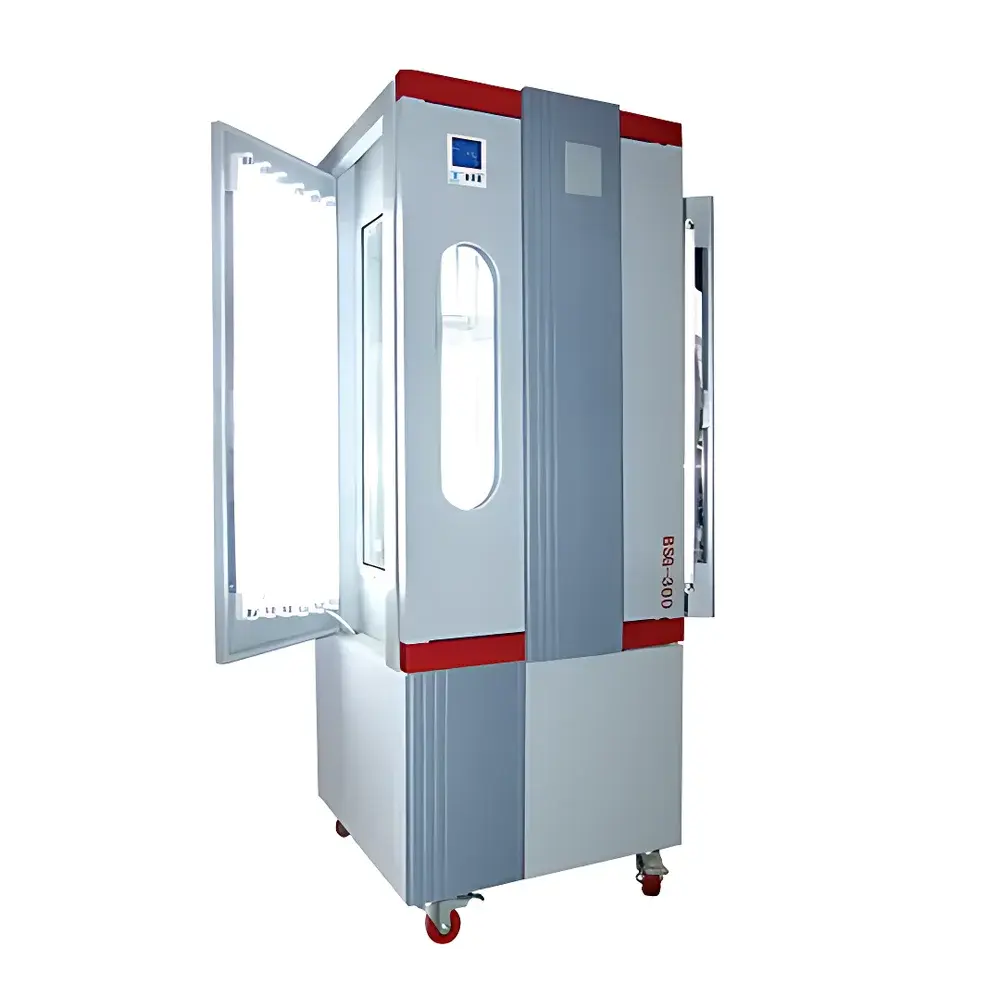
Hebei Jihepu BSG-300 Photostability Chamber for Pharmaceutical Forced Degradation Testing
| Brand | Jihepu (Jihepu Instruments, Shandong) |
|---|---|
| Model | BSG-300 |
| Temperature Range | 0–60°C (dark), 10–60°C (with illumination) |
| Temperature Resolution | 0.1°C |
| Temperature Uniformity | ±1°C |
| Temperature Fluctuation | ±0.5°C |
| Illuminance Range | 0–15,000 lx (6-step adjustable) |
| Input Power | 1500 W |
| Timer Range | 0–9999 min |
| Interior Dimensions (W×D×H) | 540 × 520 × 1100 mm |
| Exterior Dimensions (W×D×H) | 770 × 815 × 1770 mm |
| Shelf Capacity | 4 adjustable stainless steel shelves |
| Refrigerant | Eco-friendly non-CFC/HCFC refrigerant |
| Control Interface | LCD with RS-485 communication port |
| Programmability | Up to 30 segments × 99 cycles |
| Defrost Method | Energy-free automatic defrost |
| Humidity System | Fin-type electric heating humidifier with external 5L water reservoir |
| Safety Features | Over-temperature alarm, power-failure data retention & auto-recovery |
Overview
The Hebei Jihepu BSG-300 Photostability Chamber is a purpose-engineered environmental test system designed to meet ICH Q1B and Q5C guidelines for photostability assessment of pharmaceutical substances and products. It operates on a dual-mode principle: precise temperature-controlled incubation combined with calibrated, spectrally stable visible light irradiation (320–800 nm range, peak intensity centered at 550 nm). Unlike general-purpose plant growth chambers, the BSG-300 integrates pharmaceutical-grade thermal stability, photometric uniformity, and regulatory-compliant data integrity features—making it suitable for forced degradation studies, stability protocol execution, and long-term photostress validation under GLP/GMP-aligned conditions.
Key Features
- Microprocessor-based PID temperature control with 0.1°C resolution and ±0.5°C fluctuation tolerance across full operating range (10–60°C under illumination; 0–60°C in dark mode)
- 6-level adjustable illuminance (0–15,000 lx), delivered via tri-directional LED array ensuring ±5% spatial uniformity across all shelf planes per ICH Q1B Annex 2 requirements
- Integrated refrigeration architecture using high-efficiency hermetic compressor and fluorine-free refrigerant (R134a or equivalent), coupled with passive defrost technology eliminating thermal disturbance during cycle operation
- Stainless steel interior (mirror-finish 304 grade) with four independently height-adjustable shelves; cold-rolled steel exterior with electrostatic epoxy coating for corrosion resistance
- RS-485 serial interface supporting Modbus RTU protocol for integration with LIMS, SCADA, or centralized monitoring systems; supports time-stamped event logging and parameter traceability
- Programmable multi-segment controller (30 segments × 99 cycles) enabling complex stress profiles—e.g., alternating light/dark phases, ramped temperature gradients, or synchronized humidity pulses
- Fail-safe data retention: EEPROM-backed memory preserves setpoints, runtime logs, and alarm history during mains interruption; automatic recovery upon power restoration
Sample Compatibility & Compliance
The BSG-300 accommodates standard pharmaceutical packaging formats including glass vials (2–20 mL), blister cards, HDPE bottles, and aluminum-laminated pouches on its 4-tier shelving system. Internal dimensions (540 × 520 × 1100 mm) allow simultaneous placement of ≥24 ICH-specified sample units per test run. The chamber complies with key regulatory frameworks: ICH Q1B (Photostability Testing of New Drug Substances and Products), ISO 17025:2017 (for accredited laboratories), and ASTM E2053-22 (Standard Practice for Determining Light Exposure Conditions for Photostability Testing). Optional GPRS-enabled SMS alerts satisfy 21 CFR Part 11 audit trail requirements when paired with validated firmware and user access controls.
Software & Data Management
Native firmware provides real-time display of chamber status—including actual vs. setpoint temperature, cumulative illumination dose (lx·h), elapsed timer, and active program segment. All operational parameters are timestamped and stored internally for ≥30 days. Through the RS-485 interface, users may export CSV-formatted logs to third-party platforms such as LabArchives, Empower, or custom Python-based analysis scripts. When equipped with optional printer module, the system generates hard-copy reports containing calibration certificates, daily verification records, and full-cycle irradiance histograms—fully compliant with ALCOA+ data integrity principles (Attributable, Legible, Contemporaneous, Original, Accurate).
Applications
- ICH Q1B-compliant photostability screening of APIs and finished dosage forms
- Forced degradation studies to identify photolytic impurities per ICH Q5C
- Light-accelerated aging of biologics, vaccines, and ophthalmic solutions
- Validation of light-protective packaging efficacy (e.g., amber vials, opaque blisters)
- Long-term stability testing under controlled photic stress (e.g., 1.2 million lx·h exposure)
- Environmental simulation for botanical extract stability and phytochemical degradation kinetics
FAQ
Does the BSG-300 meet ICH Q1B Option 1 and Option 2 irradiance requirements?
Yes—the 0–15,000 lx range covers both options: Option 1 (≥1.2 million lx·h total visible light) and Option 2 (≥200 W/m² UV output), provided users perform annual photometric calibration using NIST-traceable lux meters.
Can humidity be controlled independently of temperature and light?
No—the BSG-300 is optimized for photostability testing where relative humidity is held constant (typically 40–60% RH); it does not feature active dehumidification or vapor pressure control.
Is the RS-485 interface compatible with LabVIEW and MATLAB?
Yes—Modbus RTU implementation allows native integration via standard VISA drivers; example configuration files and register maps are supplied with firmware documentation.
What maintenance intervals are recommended for sustained compliance?
Compressor oil inspection every 24 months; LED array luminance verification annually; temperature sensor calibration semiannually per ISO/IEC 17025 internal audit schedule.
Can the unit operate continuously for >30 days without intervention?
Yes—tested for unattended 720-hour operation with external water reservoir refill interval of 7–10 days depending on ambient humidity and setpoint.




