
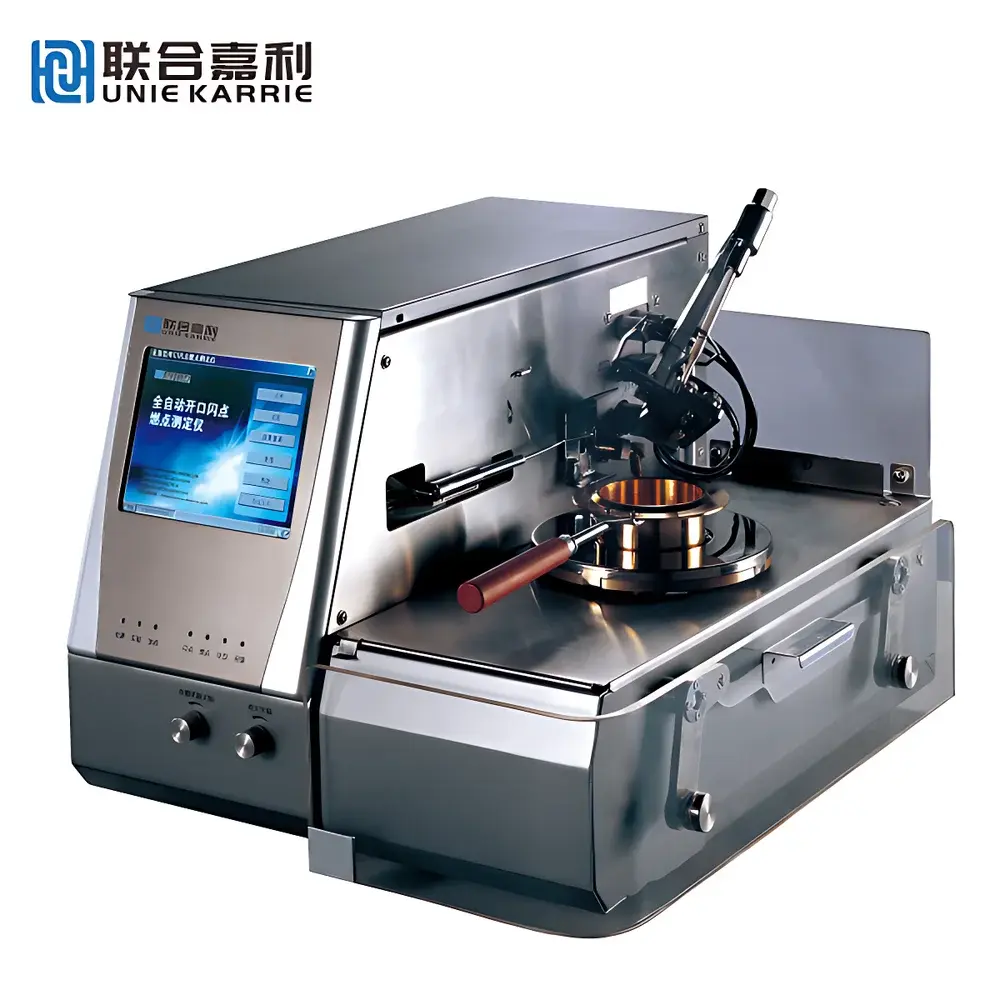
KARRIE EFP 210 Cleveland Open-Cup Flash Point Tester
| Brand | KARRIE |
|---|---|
| Model | EFP 210 |
| Detection Method | Cleveland Open-Cup (COC) |
| Flash Point Range | 79–400 °C |
| Power Supply | AC 220 V, 50 Hz |
| Total Power Consumption | 1500 W |
| Heating Power | 1300 W |
| Operating Temperature | 0–40 °C |
| Storage Temperature | −20–50 °C |
| Safety Cut-off Temperature | 400 °C |
| Pre-Alarm Temperature | EFP + 10 °C |
| Absolute Safety Limit | EFP + 20 °C |
| Ignition System | Dual-mode (electronic spark + gas flame) |
| Display | 6.4″ color TFT LCD, 640 × 480 resolution |
| Dimensions (L×W×H) | 478 × 376 × 322 mm |
| Weight | 32 kg |
| Compliance Standards | GB/T 3536, ISO 2592, ASTM D92 |
Overview
The KARRIE EFP 210 Cleveland Open-Cup Flash Point Tester is an engineered solution for precise determination of flash point and fire point of petroleum products, lubricants, biodiesel blends, and other combustible liquids according to the standardized Cleveland Open-Cup (COC) method. Based on the principle of controlled heating and manual or automated flame application over a slowly heated sample surface, the instrument detects the lowest temperature at which vapors above the specimen ignite momentarily when exposed to a test flame—defining the flash point—and the temperature at which sustained combustion occurs—defining the fire point. Designed for compliance with internationally recognized test protocols—including ASTM D92, ISO 2592, and GB/T 3536—the EFP 210 delivers repeatable, traceable, and auditable results essential for quality control laboratories in refineries, petrochemical plants, third-party testing facilities, and regulatory compliance units.
Key Features
- Dual-control architecture: A dedicated microcontroller manages real-time temperature acquisition and heating regulation, while an industrial-grade embedded PC (256 MB RAM, 2 GB flash storage) handles system coordination, data logging, and user interface—ensuring high temporal resolution and operational robustness.
- Dual ignition system: Integrated electronic spark igniter and auxiliary gas flame provide redundant, self-monitoring ignition; automatic re-ignition occurs if flame extinction is detected during sweep, eliminating operator intervention and minimizing measurement variability.
- Comprehensive self-diagnostic suite: At power-on and during operation, the system verifies integrity of Pt100 oil temperature sensors (German-sourced), flash point detection electrodes, electronic igniter circuitry, thermal fuses, cooling fan activation, and heater reset functionality—with audible alerts and on-screen fault localization (e.g., “Pt100 Sensor Disconnected”).
- Multi-layer thermal safety protocol: Three-tiered overtemperature protection includes pre-alarm at EFP + 10 °C, active alarm and continued testing at EFP + 20 °C, and immediate test termination plus forced-air cooling at 400 °C—fully aligned with IEC 61010-1 requirements for laboratory electrical equipment safety.
- Modular sensor design: Independent mounting of flash point electrode and Pt100 temperature probe enables rapid field replacement without recalibration—supporting GLP-aligned maintenance logs and reducing instrument downtime.
- True-color touchscreen interface: 6.4″ 24-bit TFT display with touch input, optional external mouse/keyboard support, and dual-language firmware (English/Chinese) facilitate intuitive navigation across test setup, real-time curve monitoring, and result review.
Sample Compatibility & Compliance
The EFP 210 accommodates standard Cleveland open-cup specimens (brass-plated copper cup, included) for viscous and non-viscous hydrocarbon-based fluids, including residual fuel oils, transformer oils, hydraulic fluids, and bio-derived fuels. Its mechanical sweep geometry and flame positioning conform strictly to ASTM D92 Annex A1 and ISO 2592 Clause 6. All hardware and firmware implementations are validated against national and international calibration traceability chains. Data integrity meets audit requirements under ISO/IEC 17025:2017 and supports 21 CFR Part 11-compliant electronic records when deployed with optional LIMS integration via RS-232, USB, or Ethernet (RJ-45).
Software & Data Management
Running Windows CE 5.0—an embedded, read-only OS—ensures immunity to malware and system corruption. The software provides full atmospheric pressure correction (manual entry or optional barometric sensor input), customizable test sequences (six preloaded standards plus user-defined methods), and searchable database storage exceeding 10,000 test records. Queries can be filtered by date range, sample ID, operator name, or test condition. Export formats include CSV and PDF; direct printing to networked or locally attached laser printers is supported via LPT port. Firmware updates and data extraction are performed securely over USB without requiring external PCs.
Applications
This instrument serves critical roles in refinery QC labs for crude assay validation, in-service oil analysis programs for turbine and gear oil monitoring, safety data sheet (SDS) generation per GHS classification, and regulatory submissions to agencies including CNCA, API, and regional environmental authorities. It is routinely deployed in accreditation audits under CNAS-CL01 (equivalent to ISO/IEC 17025) and supports fire hazard assessment in accordance with NFPA 30 and EN 60079-10-1 for hazardous area classification.
FAQ
Does the EFP 210 comply with ASTM D92 and ISO 2592?
Yes—hardware geometry, heating rate control, flame dimensions, and sweep timing are rigorously designed to meet all physical and procedural requirements specified in both standards.
Can test data be exported to LIMS or ERP systems?
Yes—via RS-232 serial interface, USB mass storage mode, or TCP/IP Ethernet connection using standard SCPI-like command sets and delimited text protocols.
Is barometric correction mandatory for flash point reporting?
No—but it is strongly recommended for accuracy; the instrument applies automatic correction when ambient pressure is entered or measured externally.
What maintenance is required for long-term reliability?
Annual verification of Pt100 sensor calibration against NIST-traceable reference, routine cleaning of the brass test cup and electrode surfaces, and periodic inspection of gas line integrity (if gas ignition is used).
How does the dual-control architecture improve measurement reproducibility?
The microcontroller ensures millisecond-level heater response fidelity and eliminates PC-induced latency in closed-loop temperature control—critical for maintaining the ±5 °C/min ramp tolerance required by ASTM D92.




