
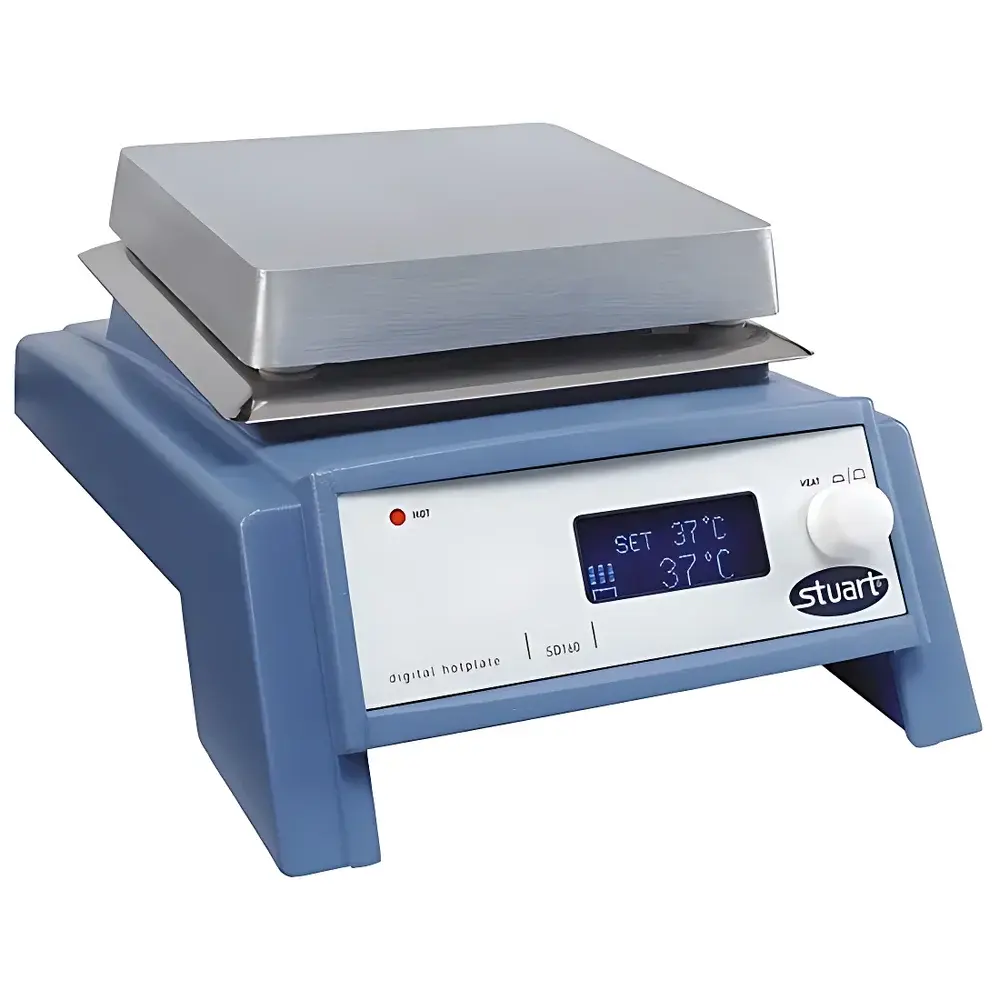
Stuart SD160 Digital Heating Plate
| Brand | Stuart |
|---|---|
| Model | SD160 |
| Heating Plate Material | Aluminium-Silicon Alloy |
| Plate Dimensions | 160 × 160 mm |
| Heating Power | 700 W |
| Max Operating Temperature | 325 °C |
| Temperature Uniformity | ±0.2 °C @ 37 °C, ±1.0 °C @ 150 °C |
| Temperature Stability | ±0.25 °C |
| Temperature Resolution & Display Accuracy | 1 °C |
| Control Method | Digital Microprocessor-Based PID Control |
| Display | LCD Digital Panel |
| Overheat Protection | Independent Safety Circuit |
| Surface Temp Alert | LED Flashing Above 50 °C |
| Housing Dimensions (W×D×H) | 190 × 300 × 110 mm |
| Net Weight | 2.5 kg |
| Power Supply | 230 V, 50–60 Hz, 700 W |
Overview
The Stuart SD160 Digital Heating Plate is a precision-engineered laboratory heating device designed for consistent, repeatable surface temperature control in routine and regulated laboratory workflows. Unlike analog hotplates, the SD160 employs a microprocessor-based PID (Proportional-Integral-Derivative) control system to actively monitor and adjust power delivery in real time—minimizing thermal overshoot and drift. Its 160 × 160 mm aluminium-silicon alloy heating surface offers rapid thermal response and high thermal conductivity, enabling uniform heat distribution across the entire plate. The unit is calibrated to maintain stability within ±0.25 °C under steady-state conditions and achieves temperature uniformity of ±0.2 °C at physiological temperatures (37 °C), making it suitable for applications requiring thermal consistency—such as sample warming prior to analysis, solvent evaporation, enzymatic reactions, and reagent preparation in QC/QA and research labs.
Key Features
- Microprocessor-controlled digital PID regulation ensures precise, responsive temperature management without manual tuning.
- Aluminium-silicon alloy heating plate provides excellent thermal conductivity, mechanical rigidity, and corrosion resistance—critical for long-term reliability in humid or chemically exposed environments.
- LCD digital display shows real-time surface temperature with 1 °C resolution; rotary encoder enables intuitive, tactile temperature setting without menu navigation.
- Dedicated overtemperature protection circuit operates independently from the main controller—cutting power if surface temperature exceeds safe thresholds, complying with IEC 61010-1 safety requirements.
- Visual safety alert: LED indicator flashes when surface temperature exceeds 50 °C—supporting lab safety protocols and personnel awareness in shared workspaces.
- Compact footprint (190 × 300 × 110 mm) and lightweight design (2.5 kg) facilitate integration into fume hoods, biosafety cabinets, or benchtop configurations with space constraints.
Sample Compatibility & Compliance
The SD160 accommodates standard laboratory vessels including glass beakers (up to 1 L), stainless steel trays, ceramic crucibles, and polypropylene containers rated for continuous exposure up to 325 °C. Its non-porous, smooth alloy surface resists chemical adhesion and supports easy decontamination—essential for multi-user labs adhering to GLP (Good Laboratory Practice) guidelines. While not classified as a medical device or GMP-grade instrument, the SD160 conforms to EN 61010-1:2010 (Safety Requirements for Electrical Equipment for Measurement, Control, and Laboratory Use) and carries CE marking for use within the European Economic Area. Its stable thermal performance supports method validation under ISO/IEC 17025-accredited testing laboratories where equipment qualification (IQ/OQ) is required.
Software & Data Management
The SD160 operates as a standalone analog-digital hybrid instrument with no embedded firmware logging, network interface, or PC connectivity. All operational parameters—including setpoint, real-time temperature, and safety status—are conveyed locally via the front-panel LCD and LED indicators. This architecture eliminates cybersecurity vulnerabilities associated with connected devices while ensuring uninterrupted operation during power fluctuations or IT infrastructure downtime. For laboratories requiring audit trails, users may integrate external data loggers (e.g., thermocouple-based USB recorders) compliant with FDA 21 CFR Part 11—provided such systems are validated per internal SOPs. No proprietary software or driver installation is necessary.
Applications
- Pre-warming culture media, buffers, and reagents in microbiology and molecular biology workflows.
- Controlled solvent evaporation in analytical sample preparation (e.g., prior to HPLC or GC injection).
- Temperature conditioning of viscometry samples and rheological standards.
- Supporting ASTM D93 (flash point testing) sample preheating protocols where plate-based uniform heating is specified.
- Heating stages in educational labs for thermodynamics demonstrations and calibration exercises.
- Use in environmental testing labs for soil or water sample equilibration per EPA Method 3510C guidelines.
FAQ
Does the SD160 support external temperature probe feedback for chamber or vessel monitoring?
No—the SD160 regulates only its own surface temperature using an integrated RTD sensor beneath the alloy plate. It does not accept external probe inputs or offer cascade control modes.
Is the heating plate surface resistant to common laboratory acids and bases?
The anodized aluminium-silicon alloy surface exhibits moderate resistance to diluted organic solvents and neutral aqueous solutions. Prolonged exposure to concentrated mineral acids (e.g., HCl, HNO₃) or strong alkalis (e.g., >1 M NaOH) is not recommended and may degrade surface finish over time.
Can the SD160 be used inside a CO₂ incubator or glovebox?
It is not rated for operation in humidified, pressurized, or inert-atmosphere enclosures. Ambient operating conditions must remain within 5–40 °C and ≤80% RH (non-condensing), per IEC 61010-1 specifications.
What accessories are available for mounting or containment?
Stuart offers optional accessories including SB16/4 dust cover (polycarbonate, fitted), SR1 support rod (600 mm × 12 mm Ø), and universal clamping kits compatible with standard lab stands—enabling elevated or suspended configurations for reflux or distillation setups.
How often should the SD160 undergo preventative maintenance or recalibration?
Stuart recommends annual verification of temperature accuracy using a traceable NIST-calibrated surface probe. Visual inspection of the encoder knob, LED indicators, and housing integrity should occur before each shift in high-utilization environments.



