
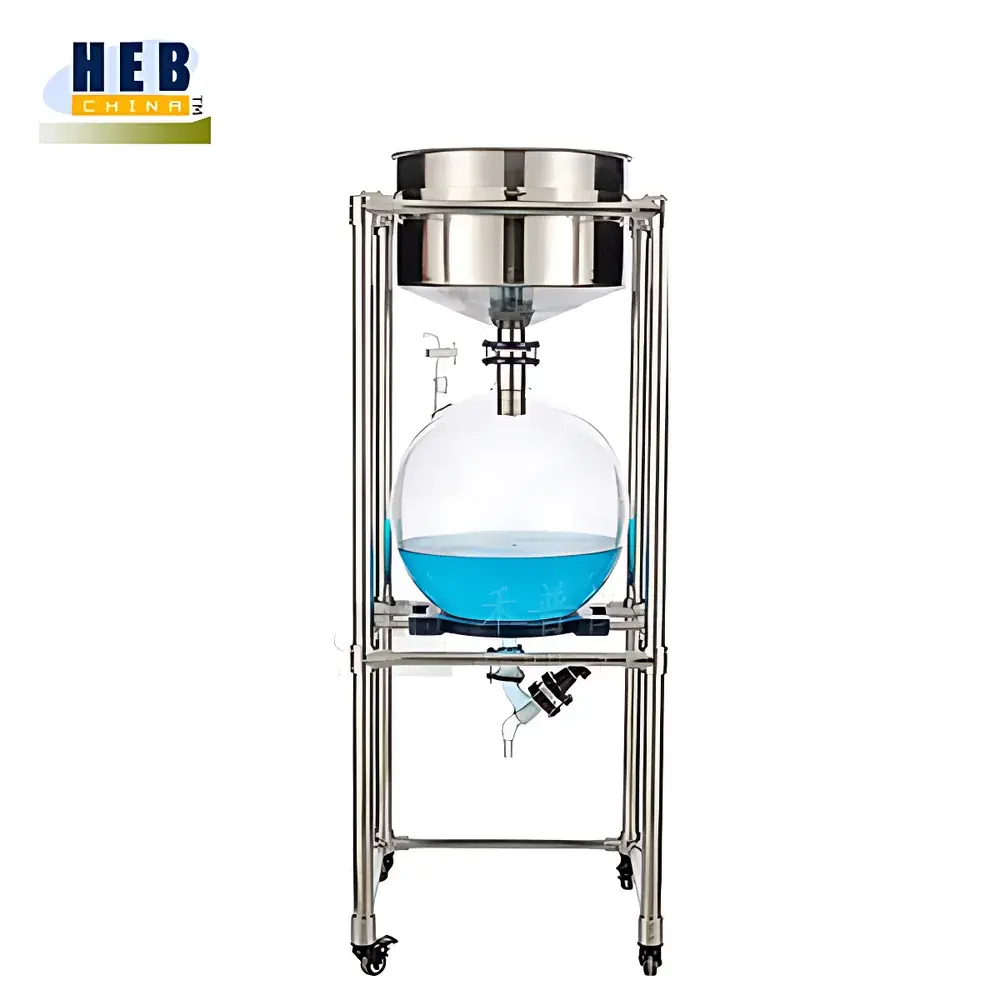
Zhenghua ZF-30L Vacuum Filtration System
| Brand | Jihepu (Jinan Hepu) |
|---|---|
| Origin | Shandong, China |
| Manufacturer Type | Authorized Distributor |
| Origin Category | Domestic (China-made) |
| Model | ZF-30L |
| Price Range | USD 0–2,800 |
| Vessel Capacity | 30 L |
| Construction Material | Borosilicate Glass (3.3 expansion coefficient) & 304 Stainless Steel |
| Operating Pressure | Low Vacuum |
| Ultimate Vacuum Level | 0.098 MPa (≈735 Torr, −0.098 bar gauge) |
| Filtration Area | Φ450 × 250 mm (H) stainless steel funnel |
| Frame | Aluminum alloy + stainless steel |
| Mobility | Four swivel casters with brakes |
| Overall Dimensions (W×D×H) | 580 × 600 × 1530 mm |
| Net Weight | 35 kg |
| Packing | Wooden crate, 1470 × 620 × 700 mm, 0.64 m³, 64 kg |
Overview
The Zhenghua ZF-30L Vacuum Filtration System is a benchtop-to-floor-standing laboratory filtration apparatus engineered for reliable solid–liquid separation under controlled low-vacuum conditions. It operates on the principle of pressure-driven cross-flow filtration: a vacuum source (e.g., diaphragm or oil-free vacuum pump) connected to the borosilicate glass receiving flask generates negative pressure across a reusable stainless steel funnel fitted with interchangeable filtration media—such as woven metal mesh, polypropylene filter cloth, or PTFE membrane discs. This differential pressure gradient forces liquid phase through the medium while retaining suspended solids on the filter surface. Designed for batch processing in synthesis, crystallization workup, catalyst recovery, and pre-filtration prior to analytical sample preparation, the ZF-30L supports reproducible, scalable separations without thermal degradation or shear-induced particle breakage. Its modular construction enables integration into multi-step reaction workflows, particularly where inert-atmosphere compatibility (via optional N₂ purge ports) and post-filtration solvent displacement (e.g., for cake washing) are required.
Key Features
- Borosilicate glass (3.3) filtration flask (30 L nominal capacity; actual internal volume ≈39 L when assembled with funnel), compliant with ISO 3585 and resistant to thermal shock, alkali, and most organic solvents.
- 304 stainless steel conical funnel (Φ450 × 250 mm H) with precision-drilled perforated base (standard 1–2 mm aperture distribution), enabling uniform flow distribution and minimal channeling.
- Modular three-neck configuration: central Φ80 mm flange for funnel mounting; side 24/40 standard taper port for vacuum line connection; auxiliary 24/40 port for pressure equalization or inert gas inlet.
- Integrated bottom discharge system: dual-path outlet design featuring both a Φ80 mm flanged valve (for bulk filtrate transfer) and a downward-sloping Φ34 mm Tygon-compatible tapered outlet (height: 350 mm above floor), facilitating gravity-assisted collection into secondary containers.
- Structural frame composed of anodized aluminum alloy uprights and 304 stainless steel load-bearing crossbars, ensuring rigidity and corrosion resistance in humid or solvent-rich environments.
- Full mobility via four 100 mm diameter swivel casters with locking brakes, allowing repositioning within fume hoods or between synthesis stations without disassembly.
Sample Compatibility & Compliance
The ZF-30L accommodates heterogeneous slurries, crystalline precipitates, polymer gels, and fine particulates (down to ~10 µm retention with appropriate mesh grade). It is compatible with common laboratory solvents—including acetone, ethanol, THF, ethyl acetate, and aqueous buffers—and withstands intermittent exposure to dilute acids (pH ≥2) and bases (pH ≤12). All wetted parts conform to USP Class VI biocompatibility requirements for glass and stainless steel. The system meets general safety provisions outlined in EN 61010-1 (Electrical Equipment for Laboratory Use) and supports GLP-compliant documentation when paired with calibrated vacuum gauges and log-enabled pumps. While not intrinsically rated for explosion-proof operation, it may be used in Class I, Division 2 environments when operated with certified spark-free vacuum sources.
Software & Data Management
As a manually operated mechanical system, the ZF-30L does not incorporate embedded electronics, firmware, or proprietary software. Vacuum level monitoring requires external instrumentation—such as analog compound gauges or digital vacuum transducers (e.g., capacitance manometers)—which may interface with lab data acquisition systems (e.g., LabVIEW, DeltaV, or custom SCADA) via 4–20 mA or RS-485 outputs. For audit-trail compliance (e.g., FDA 21 CFR Part 11), users are advised to record operational parameters—including start/stop time, vacuum setpoint, filtrate volume, and observed cake morphology—in bound laboratory notebooks or validated electronic lab notebooks (ELN) with user authentication and version control.
Applications
- Isolation of crystalline APIs following antisolvent precipitation or cooling crystallization.
- Recovery and washing of heterogeneous catalysts (e.g., Pd/C, Raney Ni) in hydrogenation or cross-coupling reactions.
- Clarification of fermentation broths or cell lysates prior to chromatographic purification.
- Preparation of particle size distribution samples for laser diffraction analysis (e.g., Malvern Mastersizer).
- Dehydration of moisture-sensitive intermediates using vacuum-assisted air-drying protocols.
- Parallel filtration of multiple reaction vials via manifold adapters (customizable upon request).
FAQ
What vacuum pump specifications are recommended for optimal performance?
A two-stage oil-free diaphragm pump capable of achieving ≤5 mbar ultimate vacuum and delivering ≥60 L/min free-air displacement is recommended. For aggressive solvents, chemically resistant pump heads (e.g., PTFE-coated) and cold traps are advised.
Can the funnel be autoclaved?
The 304 stainless steel funnel is autoclavable at 121 °C, 2 bar for 20 minutes; however, repeated sterilization cycles may accelerate surface passivation and require periodic citric acid passivation to maintain corrosion resistance.
Is the glassware certified to ISO 3585?
Yes—the borosilicate 3.3 glass components (flask, funnels, valves) are manufactured to ISO 3585 specifications and supplied with material traceability documentation upon request.
What filtration media are compatible with the standard funnel?
Standard configurations support ASTM E128-20 compliant stainless steel mesh (20–200 mesh), polyester nonwovens (≥0.45 µm), and supported PTFE membranes (0.22 µm); custom perforated plates or sintered metal frits can be supplied.
Does the system support pressure-assisted filtration?
No—the ZF-30L is designed exclusively for vacuum-driven operation. Positive-pressure filtration requires alternative hardware (e.g., Buchner press or pressure filter vessel).



