
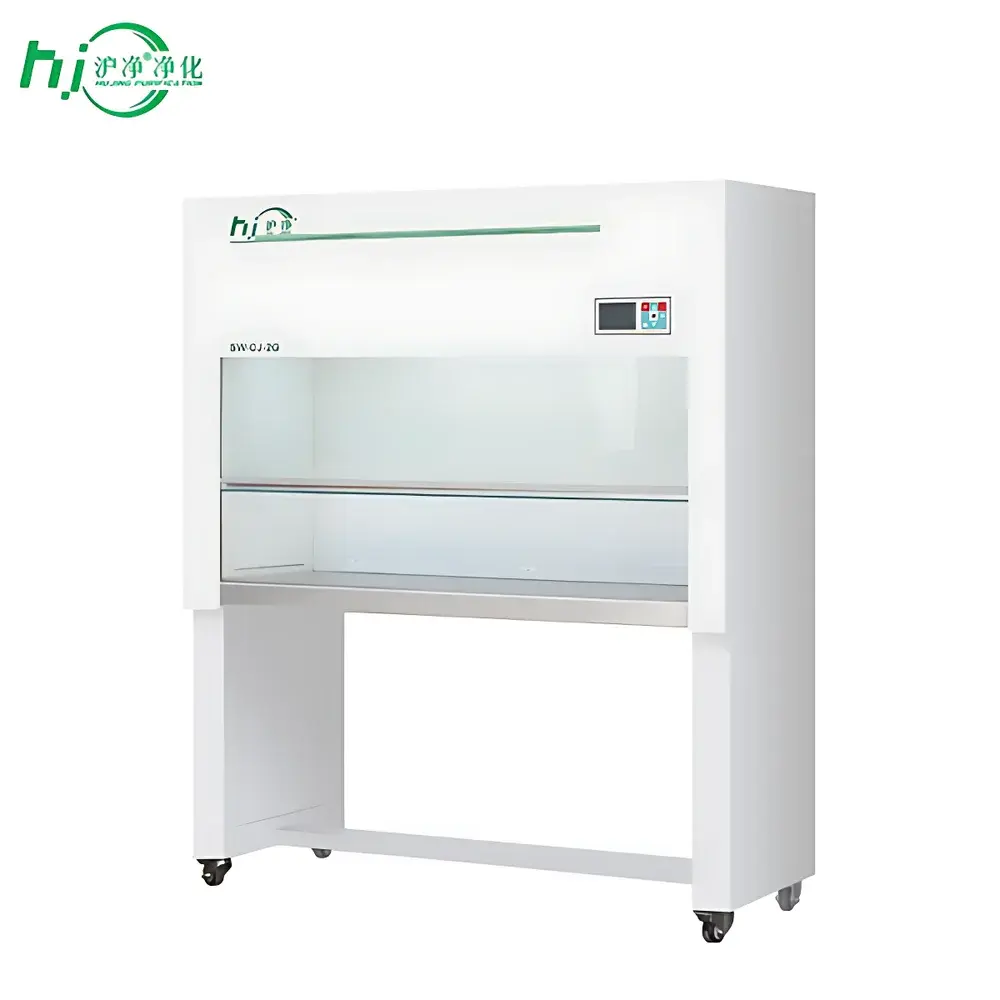
HJ SW-CJ-2G Horizontal Laminar Flow Clean Bench
| Brand | HJ Purification |
|---|---|
| Origin | Shanghai, China |
| Manufacturer Type | Direct Manufacturer |
| Regional Classification | Domestic (China) |
| Model | SW-CJ-2G |
| Instrument Category | Horizontal Laminar Flow Clean Bench |
| Cleanliness Class | ISO Class 5 (equivalent to Fed. Std. 209E Class 100 @ ≥0.5 µm) |
| Noise Level | ≤62 dB(A) |
| Rated Users | 2 |
| Airflow Pattern | Horizontal Unidirectional Flow |
| Average Air Velocity | 0.25–0.45 m/s |
| Microbial Contamination | ≤0.5 CFU/plate·hour (90 mm Petri dish) |
| Vibration Amplitude (half-peak) | ≤5 µm (X/Y/Z axes) |
| Illuminance | ≥300 lx |
| Power Supply | AC 220 V / 50 Hz |
| Max. Power Consumption | 500 W |
| Net Weight | 110 kg |
| Work Area Dimensions (W×D×H) | 1150 × 410 × 580 mm |
| Overall Dimensions (W×D×H) | 1310 × 590 × 1600 mm |
| HEPA Filter Specification | 1130 × 565 × 50 mm (1 unit) |
| Fluorescent Lamp | 12 W × 1 |
| UV Lamp | 30 W × 1 |
Overview
The HJ SW-CJ-2G Horizontal Laminar Flow Clean Bench is an ISO Class 5-certified laboratory containment system engineered for routine aseptic procedures requiring protection of the sample and operator from ambient particulate and microbial contamination. Unlike vertical flow hoods, this bench employs a horizontal unidirectional airflow configuration: air is drawn through a pre-filter, conditioned via a high-efficiency particulate air (HEPA) filter (≥99.99% @ 0.3 µm), and delivered across the work surface at a controlled velocity of 0.25–0.45 m/s. This laminar stream forms a sterile barrier that sweeps contaminants away from the operator and out of the working zone—ideal for applications where cross-contamination between samples must be minimized and open handling of non-hazardous biological or pharmaceutical materials is required.
Key Features
- Full steel construction: Cold-rolled carbon steel frame with electrostatic powder coating; work surface fabricated from brushed AISI 304 stainless steel for corrosion resistance, mechanical durability, and ease of decontamination.
- Horizontal airflow architecture with integrated downward-flowing air curtain at the front aperture—enhancing containment integrity by minimizing ingress of room air during operation.
- Intelligent digital LCD control panel featuring real-time monitoring of operational status, UV lamp timer (programmable up to 99 min), and interlocked safety logic: UV irradiation is automatically disabled when the sash is opened, and lighting circuits are decoupled from germicidal operation.
- Adjustable vertical sash system with frictionless, position-locking mechanism—enabling precise ergonomic height adjustment without tools or calibration drift.
- Dual-stage filtration: A G4-grade pre-filter extends HEPA service life by capturing coarse particulates; the primary HEPA filter (1130 × 565 × 50 mm) meets EN 1822-1:2019 and IEST-RP-CC001.6 performance criteria.
- Low-noise centrifugal blower assembly (<62 dB[A] at 1 m) and vibration-damped mounting reduce acoustic fatigue and prevent micro-vibrational interference with sensitive instrumentation placed adjacent to the bench.
Sample Compatibility & Compliance
The SW-CJ-2G is validated for use in non-hazardous microbiological culture preparation, media dispensing, cell line maintenance, and sterile packaging of medical devices. It complies with ISO 14644-1:2015 (Cleanrooms and associated controlled environments), adheres to the particle concentration limits defined in Fed. Std. 209E Class 100 (now superseded but still widely referenced), and supports GLP-compliant documentation workflows. While not certified for personnel or environmental protection against biohazards (i.e., it is not a biosafety cabinet), its design satisfies ASTM E2500-13 requirements for qualification of non-sterile equipment used in pharmaceutical manufacturing support areas. The UV lamp output (254 nm) conforms to IEC 62471 photobiological safety classification for Germicidal UV-C sources.
Software & Data Management
This clean bench operates as a standalone mechanical system with no embedded firmware or network connectivity. All operational parameters—including UV exposure duration, lighting activation, and fan speed—are managed locally via the tactile LCD interface. The control module logs runtime hours for both UV and fluorescent lamps, supporting preventive maintenance scheduling per manufacturer-recommended service intervals (e.g., HEPA replacement every 18–24 months under typical lab usage). For regulated environments, users may integrate external environmental monitoring systems (e.g., temperature/humidity data loggers) into their facility-wide compliance framework; however, the bench itself does not generate electronic records compliant with FDA 21 CFR Part 11.
Applications
- Aseptic transfer of bacterial and fungal cultures in academic and industrial microbiology laboratories.
- Preparation of agar plates, broth tubes, and diagnostic reagents under low-bioburden conditions.
- Assembly and inspection of sterile components in medical device packaging lines.
- Handling of non-pathogenic mammalian cell lines during passaging and cryopreservation workflows.
- Quality control testing of raw materials in pharmaceutical excipient manufacturing where ISO Class 5 air quality is mandated by internal SOPs.
FAQ
Is the SW-CJ-2G suitable for handling hazardous biological agents?
No. This is a clean bench—not a biosafety cabinet—and provides no protection against aerosolized pathogens or chemical vapors. It is intended solely for product protection in non-hazardous applications.
What standards govern the HEPA filter performance?
The installed HEPA filter complies with EN 1822-1:2019 (H14 class) and meets the efficiency threshold of ≥99.995% at MPPS (Most Penetrating Particle Size ≈ 0.3 µm).
Can the UV lamp be operated while the sash is open?
No. The UV circuit is hardware-interlocked with the sash position sensor; illumination is physically disabled if the front shield is raised beyond 50 mm.
Does the unit include validation documentation?
Factory-assembled units ship with a Certificate of Conformance (CoC) and filter test reports (DOP scan data available upon request). IQ/OQ protocols are user-defined and must be executed on-site per ISO 14644-3:2019 guidelines.
What maintenance intervals are recommended?
Pre-filter replacement every 3–6 months; HEPA filter replacement every 18–24 months (subject to ambient air quality and usage frequency); annual calibration of air velocity and illuminance sensors using NIST-traceable instruments.



