
English Product Name
| Brand | Jihepu |
|---|---|
| Origin | Shandong, China |
| Model | RE-3000A |
| Capacity | 3 L |
| Ultimate Vacuum | 0.098 MPa |
| Rotation Speed | 0–180 rpm |
| Temperature Range | 0–99 °C |
| Temperature Control Accuracy | ±1 °C |
| Condenser Cooling Surface Area | 0.11 cm² |
| Power Supply | 220 V / 50 Hz (optional 110 V / 60 Hz) |
| Heating Power | 1.5 kW |
| Motor Power | 40 W |
| Lift Motor Power | 20 W |
| Rotating Flask Dimensions | Φ195 mm × Φ50 mm (standard 35# ground joint) |
| Collection Flask Capacity | 2 L (Φ166 mm, 35# ground joint) |
| Condenser Dimensions | Φ100 × 510 mm (vertical double-layer coiled tube) |
| Bath Volume | ~6.3 L (Φ250 × 130 mm) |
| Overall Dimensions | 660 × 420 × 830 mm (L×W×H) |
| Net Weight | 30 kg |
Overview
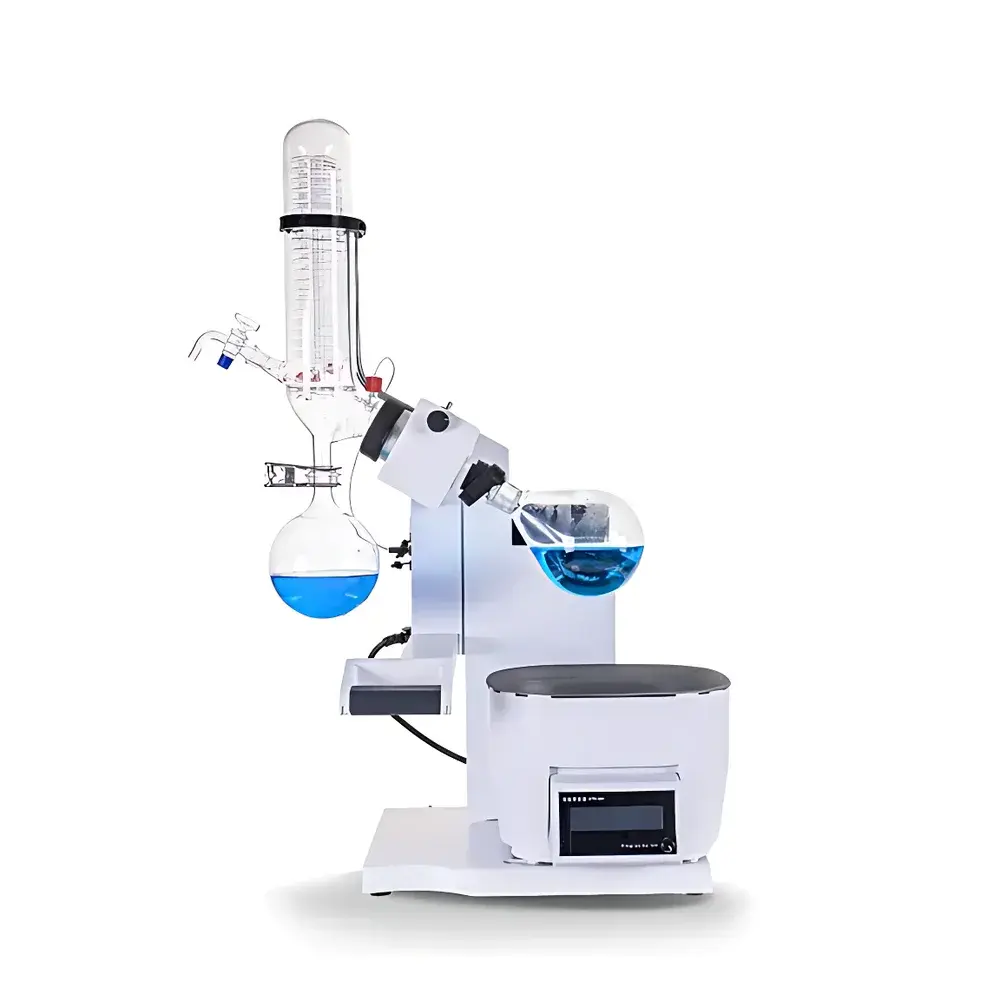
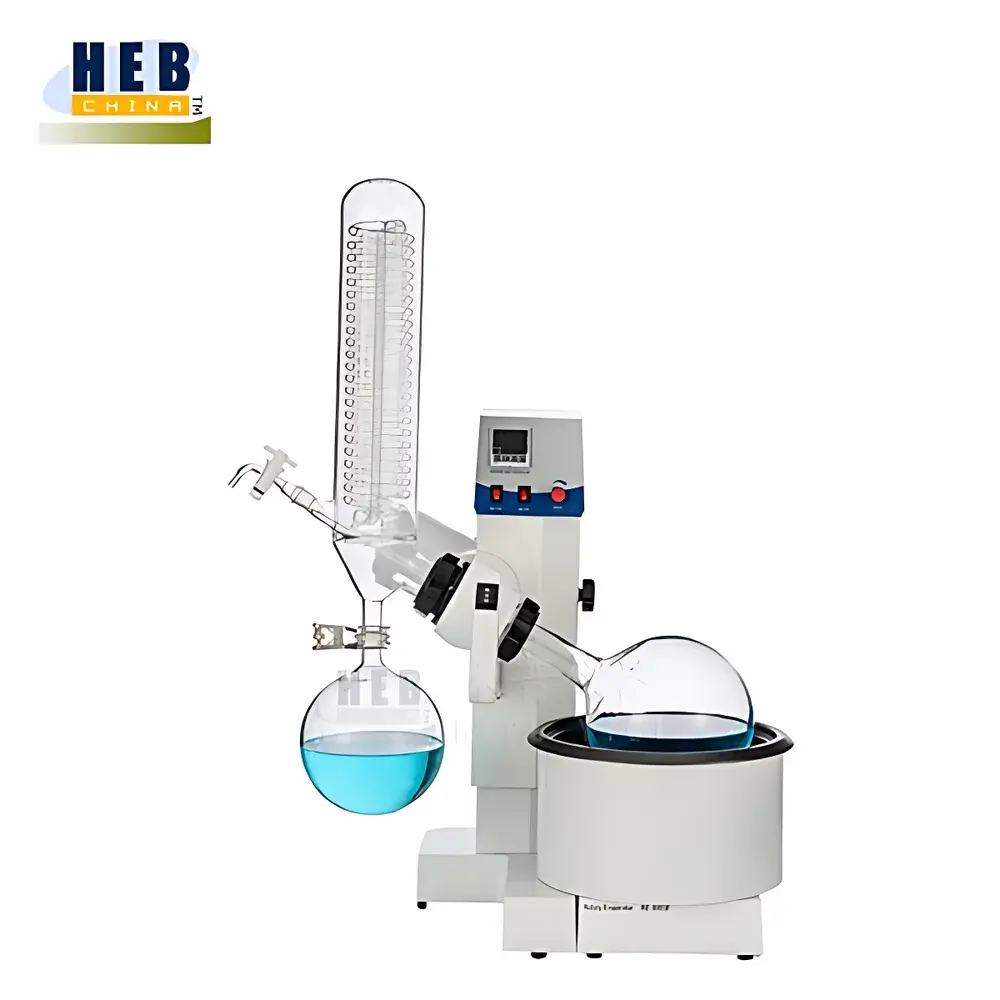
The Jihepu RE-3000A Rotary Evaporator is a precision-engineered vacuum distillation system designed for gentle, efficient solvent removal and concentration under reduced pressure. It operates on the principle of thin-film evaporation: a motor-driven rotating flask spreads sample liquid into a uniform, high-surface-area film along the inner wall; simultaneous controlled heating via an intelligent water bath—combined with vacuum-induced boiling point depression—enables rapid, low-temperature evaporation. Vapor travels through a vertical dual-layer coiled condenser cooled by circulating coolant, where it undergoes phase transition and is collected in a dedicated receiving flask. Constructed entirely from GG-17 borosilicate glass and PTFE components, the system ensures chemical inertness, thermal stability (−80 °C to 250 °C), and compatibility with acid-, alkali-, and solvent-intensive workflows. Its design prioritizes reproducibility, operator safety, and compliance-ready operation in regulated R&D and pilot-scale production environments across pharmaceutical, fine chemical, natural product extraction, and academic laboratories.
Key Features
- Aluminum alloy main frame with optimized structural rigidity and corrosion resistance for long-term laboratory deployment.
- Dual-material sealing system: imported fluororubber gaskets combined with PTFE-faced rotary seals to maintain stable vacuum down to 0.098 MPa (≤2 mbar absolute).
- Full GG-17 borosilicate glass assembly—including rotating flask (3 L, Φ195 mm), collection flask (2 L), condenser (Φ100 × 510 mm), and vapor duct—certified to ISO 3585 standards for thermal shock resistance and hydrolytic stability.
- Intelligent digital temperature control using PT100 platinum resistance sensors, delivering ±1 °C accuracy across 0–99 °C range; optional high-temp configuration supports up to 400 °C with external oil bath.
- Stepless electronic speed regulation (0–200 rpm, factory-set 0–180 rpm) with micro-stepper motor drive ensuring smooth, vibration-minimized rotation and precise film thickness control.
- Automated lift mechanism (0–150 mm travel) with overload protection and positional memory, enabling safe flask immersion/extraction without manual adjustment.
- Stainless steel bath pot with integrated PTFE coating prevents scaling, facilitates cleaning, and eliminates direct electrical contact with heating elements.
- Comprehensive safety architecture: dry-run prevention circuit, thermal cutoff fuse, and current-limiting power management compliant with IEC 61010-1 for laboratory electrical equipment.
Sample Compatibility & Compliance
The RE-3000A accommodates diverse sample matrices—including heat-labile biomolecules (e.g., peptides, enzymes, plant extracts), thermally sensitive APIs, polymer solutions, and viscous organic intermediates—without degradation. All wetted surfaces are chemically inert per ASTM D543 and USP extractables testing protocols. Vacuum integrity meets ISO 2859-1 sampling requirements for leak-rate validation. The system supports integration into GLP/GMP workflows via documented calibration procedures for temperature (traceable to NIST-certified references) and rotational speed (verified with optical tachometer). Optional accessories—including vacuum controllers with pressure logging, insulated cold traps, and solvent recovery manifolds—facilitate alignment with FDA 21 CFR Part 11 data integrity expectations when paired with validated third-party acquisition software.
Software & Data Management
While the RE-3000A operates as a standalone instrument with analog/digital hybrid controls, its modular interface enables seamless integration with external process monitoring systems. Standard 0–10 V analog outputs (rotation speed, bath temperature) and RS-485 Modbus RTU communication support real-time data streaming to SCADA or LIMS platforms. Optional digital vacuum gauges with USB/RS-232 output allow synchronized pressure–temperature–rotation profiling. All parameter settings are retained after power cycling, and temperature setpoints can be logged manually or via external dataloggers for audit trail generation. Firmware updates (where applicable) follow secure signed-binary protocols to ensure configuration integrity.
Applications
- Solvent recovery and reuse in API synthesis (e.g., ethyl acetate, dichloromethane, THF removal post-reaction workup).
- Concentration of aqueous or alcoholic botanical extracts while preserving volatile terpenoids and polyphenols.
- Removal of low-boiling solvents from polymer solutions prior to film casting or rheological characterization.
- Distillative purification of fragrance compounds and essential oils under mild vacuum to avoid thermal decomposition.
- Parallel evaporation support in combinatorial chemistry workflows using interchangeable flask assemblies.
- Preparative-scale dehydration of hygroscopic intermediates prior to lyophilization or crystallization trials.
FAQ
What vacuum level is required for optimal performance?
The RE-3000A achieves stable operation at ≤0.098 MPa (≤2 mbar); however, optimal evaporation efficiency for most solvents occurs between 10–50 mbar—adjustable via external vacuum controller.
Can the unit be used with corrosive solvents like concentrated HCl or HF?
No. While GG-17 glass resists most organic solvents and dilute acids/bases, hydrofluoric acid and fuming sulfuric acid will etch glass and compromise structural integrity.
Is the water bath compatible with silicone oil or ethylene glycol for elevated temperature operation?
Yes—the stainless-steel/PTFE-coated bath accepts heat-transfer fluids up to 250 °C; maximum fluid volume remains ~6.3 L, and external circulation is recommended above 120 °C.
How is calibration traceability maintained for regulatory submissions?
Users must perform periodic verification using NIST-traceable PT100 probes and certified tachometers; calibration records should include date, instrument ID, technician signature, and deviation thresholds per internal SOPs.
What maintenance intervals are recommended for long-term reliability?
Inspect PTFE seals and O-rings every 6 months; clean condenser coils quarterly with ethanol/isopropanol; verify vacuum pump oil quality biweekly if operating continuously.



