
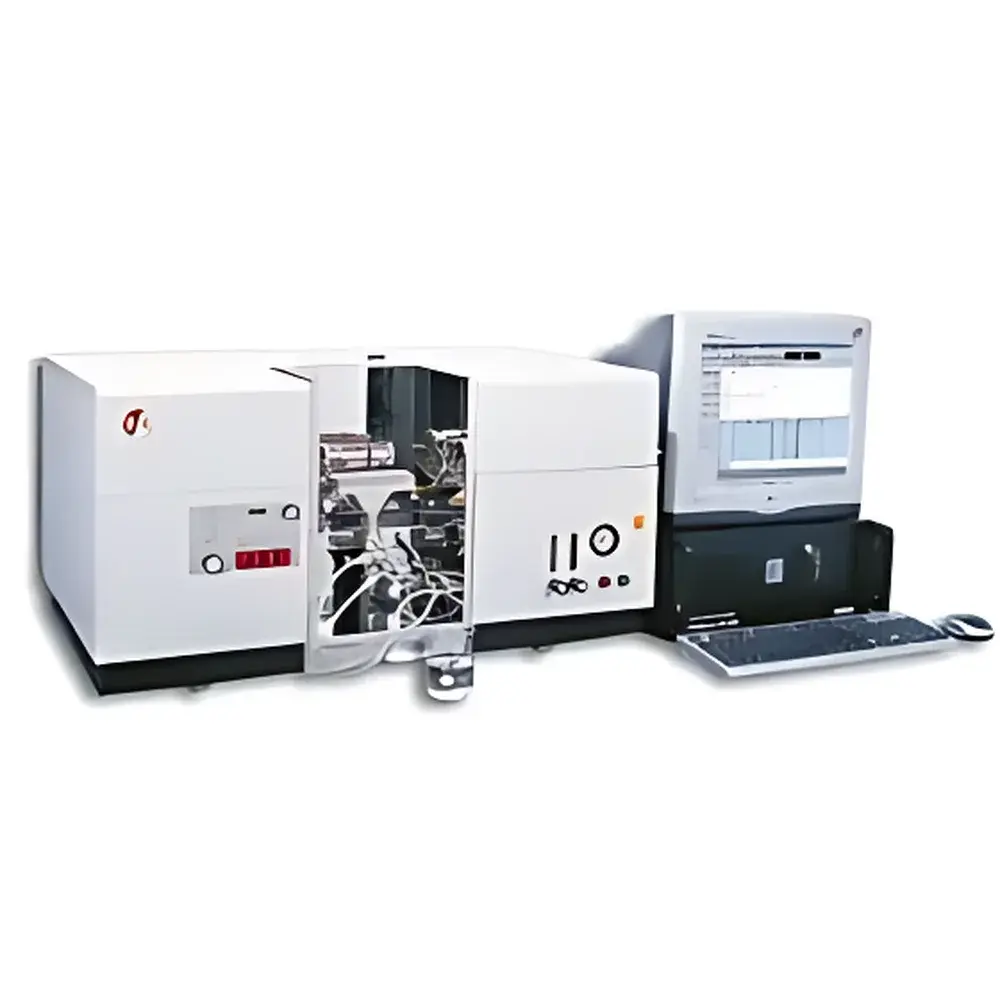
English Product Name
| Origin | Shandong, China |
|---|---|
| Manufacturer Type | Authorized Distributor |
| Domestic Origin | Yes |
| Model | AA-7001 |
| Price Range | USD 7,000–14,000 (FOB) |
| Instrument Type | Dual-mode Flame/GF-AAS |
| Monochromator | Plane grating (1800 lines/mm) |
| Optical System | Single-beam |
| Detector | Solid-state photodiode array |
| Background Correction | D₂-lamp and self-reversal (SR) methods |
| Spectral Resolution | ≤0.3 nm |
| Cu Sensitivity | ≥0.3 A at 5 ppm |
| RSD (Flame) | ≤0.7% |
| RSD (Graphite Furnace) | ≤2% for 3 µg/L Cd (n=11) |
| Detection Limit (Flame) | ≤0.004 mg/L Cu |
| Detection Limit (GF) | ≤0.4 pg Cd |
| Wavelength Range | 190–900 nm |
| Slit Widths | 0.1, 0.2, 0.4, 1.0, 2.0 nm (motorized) |
| Baseline Drift (Static) | ≤±0.002 A/30 min |
| Baseline Drift (Dynamic) | ≤±0.004 A/30 min |
Overview
The Shandong AA-7001 Flame and Graphite Furnace Atomic Absorption Spectrophotometer is a dual-mode atomic absorption system engineered for high-precision elemental quantification across diverse sample matrices—from aqueous standards and environmental digests to high-salt food extracts and biological tissues. It operates on the fundamental principle of atomic absorption spectroscopy: ground-state atoms in a flame or graphite furnace vapor phase absorb characteristic radiation emitted by element-specific hollow cathode lamps. The instrument integrates flame atomization, electrothermal graphite furnace atomization, integrated power supply, optical path, and detection electronics within a single compact chassis—eliminating inter-unit alignment drift and minimizing footprint without compromising optical integrity. Its single-beam Czerny-Turner monochromator employs an 1800-line/mm plane grating (focal length: 300 mm), delivering high radiant throughput and spectral resolution ≤0.3 nm across the full 190–900 nm range. This architecture ensures sufficient photon flux even for low-energy transitions (e.g., As 193.7 nm, Se 196.0 nm), enabling robust detection in demanding applications where signal-to-noise ratio is critical.
Key Features
- Fully integrated dual-atomizer platform: Flame burner and graphite furnace—including internal GF power supply—are housed in one mechanically stable mainframe, reducing thermal and vibrational coupling between subsystems.
- Titanium-based nebulization system: Aerospace-grade, investment-cast pure titanium雾化室 (nebulizer chamber) and burner heads resist corrosion from aggressive acids (HNO₃, HCl, HF blends) and high-temperature oxidation, extending service life beyond 10,000 flame firings.
- Automated mode switching: Flame-to-graphite furnace transition completes in ≤2 seconds via motorized optical and mechanical reconfiguration—no manual realignment required.
- Dual background correction: Simultaneous D₂-lamp and self-reversal (SR) techniques provide accurate correction over broad spectral ranges (190–350 nm), essential for high-background samples such as soy sauce, seawater, or clinical serum.
- Intelligent safety architecture: Real-time monitoring includes hollow cathode lamp current limiting, fuel gas/argon pressure validation, leak detection, graphite furnace overtemperature cutoff, and flame extinction sensing—all logged with timestamped event records.
- Thermally optimized graphite furnace: Programmable 20-step temperature ramping (heating rates ≥3000 °C/s), with hold, ramp, and step modes; compatible with standard pyrolytic graphite tubes rated for continuous operation at 2000 °C.
Sample Compatibility & Compliance
The AA-7001 supports flame AAS for major and minor metals (Na, K, Ca, Mg, Fe, Zn, Cu, Mn), graphite furnace AAS for trace and ultra-trace elements (Cd, Pb, As, Se, Hg, Cr), and hydride generation AAS (when coupled with optional HG-01 ceramic tube system) for volatile species. Its robust titanium combustion system enables direct analysis of high-acidity digestates (EPA Method 200.7, ISO 11885) and saline matrices without clogging. The instrument complies with core performance criteria outlined in ASTM E1901 (Standard Guide for AAS), ISO 7149 (Water Quality — Determination of Metals), and USP for pharmaceutical elemental impurities. Data acquisition and method storage meet GLP audit requirements, including electronic signature support and full audit trail functionality (21 CFR Part 11 ready when deployed with compliant LIMS integration).
Software & Data Management
The embedded Windows-based control software provides intuitive workflow navigation for method development, calibration (linear/non-linear regression, standard addition), and quantitative reporting. All instrumental parameters—including slit width, lamp current, atomization temperature program, and background correction mode—are stored per method. Signal time profiles, calibration curves, and raw absorbance data are auto-saved in vendor-neutral CSV and XML formats. Integrated printing modules generate compliant reports containing instrument ID, operator name, date/time stamps, calibration verification results, and QC check values. Optional AS-01 autosampler integration enables unattended standard dilution series preparation, multi-point calibration, and up to 60-sample batch runs with programmable rinse cycles and carryover mitigation.
Applications
- Environmental laboratories: Quantification of heavy metals in soil extracts (EPA 7000B), wastewater (ISO 11885), and drinking water (WHO guidelines).
- Food safety testing: Cd/Pb in rice flour (GB 5009.15/12), As in seafood (AOAC 999.10), and total Hg in infant formula (EU 1881/2006).
- Clinical and forensic toxicology: Trace Cd and Pb in whole blood (CLIA-waived protocols), urinary As speciation support (with HG interface).
- Geochemical research: Rare earth element screening in rock leachates using GF-AAS with Zeeman background correction (optional upgrade path).
- Pharmaceutical quality control: Elemental impurity screening per ICH Q3D, particularly for catalyst residues (Pd, Ni, Ru) in API intermediates.
FAQ
Does the AA-7001 support compliance with 21 CFR Part 11 for electronic records?
Yes—the system supports user authentication, electronic signatures, and full audit trails when configured with validated networked data storage and time-stamped method execution logs.
What is the maximum operating temperature of the graphite furnace, and how is temperature accuracy verified?
The furnace achieves up to 3000 °C with ±5 °C accuracy across its full range, calibrated using NIST-traceable Pt–Rh thermocouple reference and verified during startup self-test.
Can the instrument analyze mercury without cold vapor generation?
No—Hg analysis requires hydride generation (HG-01 module) or cold vapor AAS (CVAAS) accessories; the standard GF configuration does not support volatile Hg determination.
Is routine maintenance of the titanium burner system different from stainless-steel equivalents?
Titanium components require no passivation or acid soaking; routine cleaning involves ultrasonic bath in 5% HNO₃ for ≤10 minutes—significantly reducing downtime versus conventional alloys.
How is wavelength accuracy maintained over extended operation?
An internal holmium oxide reference filter performs automatic wavelength calibration at startup and every 4 hours during continuous use, ensuring ≤±0.2 nm accuracy per ISO 11007.





