
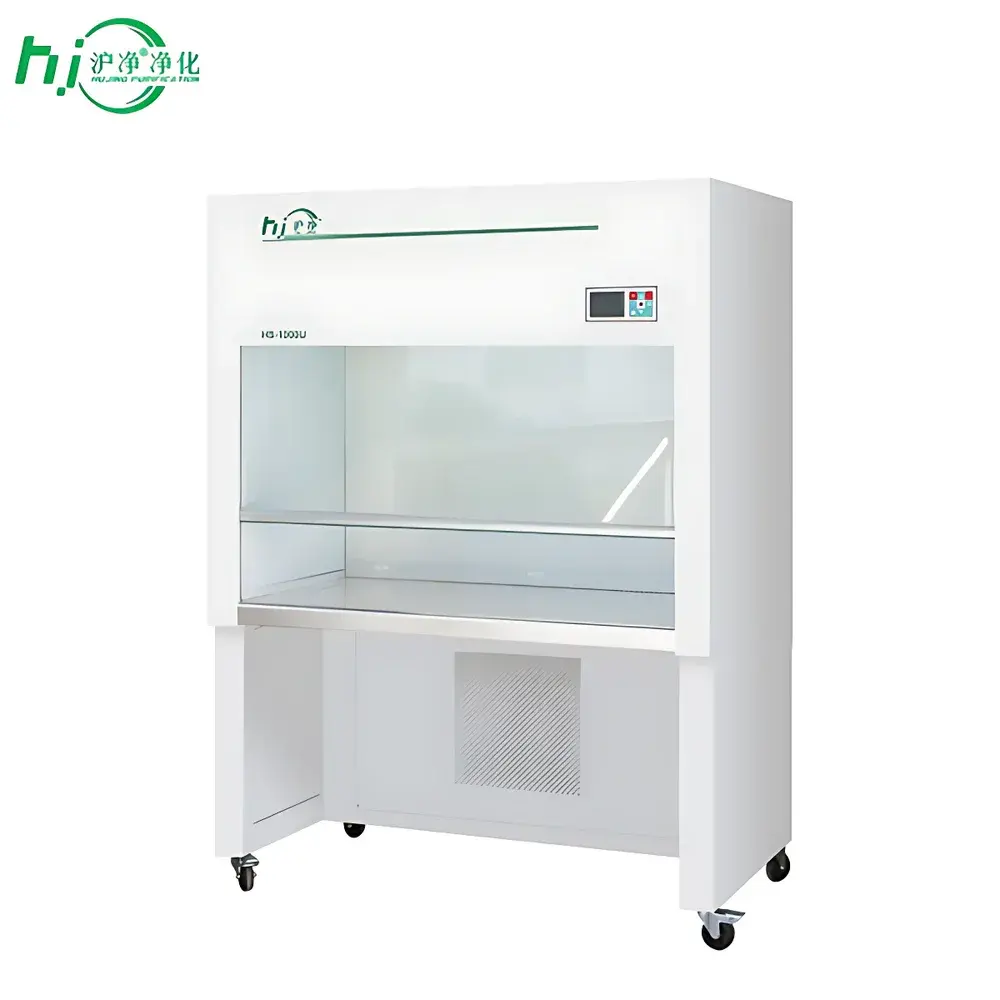
HJ HS1300U Dual-Operator Horizontal Laminar Flow Clean Bench
| Brand | HJ Purification |
|---|---|
| Origin | Shanghai, China |
| Manufacturer Type | Direct Manufacturer |
| Product Category | Domestic |
| Model | HS1300U |
| Instrument Type | Horizontal Laminar Flow Clean Bench |
| Cleanliness Class | ISO Class 5 (100 @ ≥0.5 µm, Fed. Std. 209E) |
| Noise Level | ≤62 dB(A) |
| Operator Capacity | Dual-Operator, Single-Face Configuration |
| Airflow Pattern | Horizontal Unidirectional Flow |
| Work Surface Material | SUS304 Brushed Stainless Steel |
| Cabinet Material | Cold-Rolled Steel with Electrostatic Powder Coating |
| Pre-filter | Pleated Synthetic Media |
| HEPA Filter | 1125 × 540 × 50 mm, ≥99.995% @ 0.3 µm |
| Average Air Velocity | 0.25–0.45 m/s |
| Illumination | ≥300 lx (12 W Fluorescent Lamp) |
| UV Lamp | 30 W, Interlocked Safety Control |
| UV Timer | Digital Programmable |
| Power Supply | AC 220 V ±10%, 50 Hz |
| Max. Power Consumption | 500 W |
| Net Weight | 150 kg |
| Working Area Dimensions (W×D×H) | 1140 × 600 × 700 mm |
| Overall Dimensions (W×D×H) | 1300 × 760 × 1760 mm |
| Vibration Amplitude | ≤5 µm (peak-to-peak, X/Y/Z axes) |
| Microbial Recovery | ≤0.5 CFU/plate·hr (Φ90 mm settle plate) |
Overview
The HJ HS1300U Dual-Operator Horizontal Laminar Flow Clean Bench is an ISO Class 5-certified containment system engineered for non-hazardous sample handling in microbiology, cell culture, pharmaceutical quality control, and precision assembly environments. It operates on the principle of horizontal unidirectional airflow: ambient air is drawn through a pre-filter to remove coarse particulates, then passes through a certified HEPA filter (≥99.995% efficiency at 0.3 µm), and exits across the work surface at a uniform, low-turbulence velocity (0.25–0.45 m/s). This laminar curtain creates a sterile barrier between the operator and the work zone, preventing cross-contamination from room air while maintaining product integrity. Unlike vertical flow hoods, the horizontal configuration directs filtered air away from the operator—ideal for applications requiring extended exposure of open samples without UV-induced photodegradation of sensitive reagents or biologicals.
Key Features
- Robust structural architecture: Cold-rolled steel cabinet with electrostatic powder coating ensures long-term corrosion resistance and mechanical stability.
- SUS304 brushed stainless steel work surface—non-porous, non-shedding, and compatible with common disinfectants (e.g., 70% ethanol, sodium hypochlorite).
- Dual-operator, single-face layout with optimized ergonomics: 1140 mm wide working area accommodates collaborative workflows while maintaining full ISO Class 5 compliance across the entire plane.
- Three-speed digital fan control (low/medium/high) enables precise adaptation to procedural requirements—e.g., low speed for delicate tissue manipulation, high speed for rapid particle clearance after surface decontamination.
- Interlocked UV germicidal system (30 W, 254 nm) with programmable timer prevents accidental exposure; illumination (12 W fluorescent) activates only when UV is deactivated.
- Vertical quasi-closed sash design enhances aerodynamic containment: downward-flowing air curtain at the front aperture minimizes ingress of unfiltered room air during operation.
- Integrated pre-filter extends HEPA service life by capturing >90% of airborne particulates ≥5 µm—reducing maintenance frequency and total cost of ownership.
Sample Compatibility & Compliance
The HS1300U supports a broad range of non-volatile, non-toxic samples including bacterial and mammalian cell cultures, sterile media preparation, semiconductor component handling, and optical lens assembly. It complies with Fed. Std. 209E Class 100 (equivalent to ISO 14644-1 Class 5) for particle concentration (≤3,520 particles/m³ ≥0.5 µm). Microbiological validation per ISO 14698-1 confirms ≤0.5 CFU/plate·hr using Φ90 mm settle plates under static conditions. The unit meets IEC 61010-1 safety requirements for laboratory electrical equipment and incorporates grounding continuity, overcurrent protection, and thermal cutoff mechanisms. While not designed for chemical fume or biohazard containment, its airflow profile and construction materials align with GLP-compliant facility SOPs for aseptic technique validation.
Software & Data Management
The HS1300U employs a microprocessor-based digital controller with LCD interface—no embedded software or network connectivity. All operational parameters (fan speed, UV timer, lighting status) are locally monitored and adjusted via tactile buttons. Critical settings—including UV exposure duration and fan speed selection—are retained across power cycles. Though lacking audit-trail functionality, the system supports manual logbook documentation aligned with FDA 21 CFR Part 11 Annex 11 expectations for non-computerized systems. Optional external data loggers (e.g., calibrated anemometers, particle counters) may be used to record velocity profiles and particulate counts during routine qualification (IQ/OQ/PQ).
Applications
- Aseptic transfer of primary cell lines and stem cells in academic and contract research laboratories.
- Preparation of sterile culture media, buffers, and reagent aliquots in QC labs supporting USP sterility testing.
- Assembly of microfluidic devices and MEMS components where electrostatic discharge (ESD) and particle contamination must be minimized.
- Handling of light-sensitive compounds (e.g., retinoids, photosensitizers) benefiting from UV-free horizontal airflow during weighing and dissolution steps.
- ISO/IEC 17025-accredited calibration labs performing instrument verification under controlled environmental conditions.
FAQ
Does the HS1300U require annual certification for ISO Class 5 compliance?
Yes. Per ISO 14644-3, periodic performance verification—including airflow velocity mapping, particle count testing, and filter integrity checks—is required at least annually or after filter replacement or physical relocation.
Can the unit be installed in a room with positive pressure?
Yes. Horizontal flow benches perform optimally in positively pressurized cleanrooms (e.g., ISO Class 7 or better), as this further suppresses infiltration of unfiltered air at the front aperture.
Is the HEPA filter field-replaceable without specialized tools?
Yes. The filter housing features quick-release latches and gasketed sealing—replacement can be completed by trained personnel in under 30 minutes using standard PPE and post-change DOP testing.
What is the recommended maintenance interval for the pre-filter?
Inspect visually every 2 weeks; replace when visibly soiled or when measured static pressure drop across the pre-filter exceeds 150 Pa (typically every 3–6 months under continuous use).
Does the unit meet CE or UL certification requirements?
It complies with IEC 61010-1 for electrical safety. CE marking is not applicable as the device is manufactured for domestic Chinese market distribution; UL listing requires separate third-party evaluation.



