
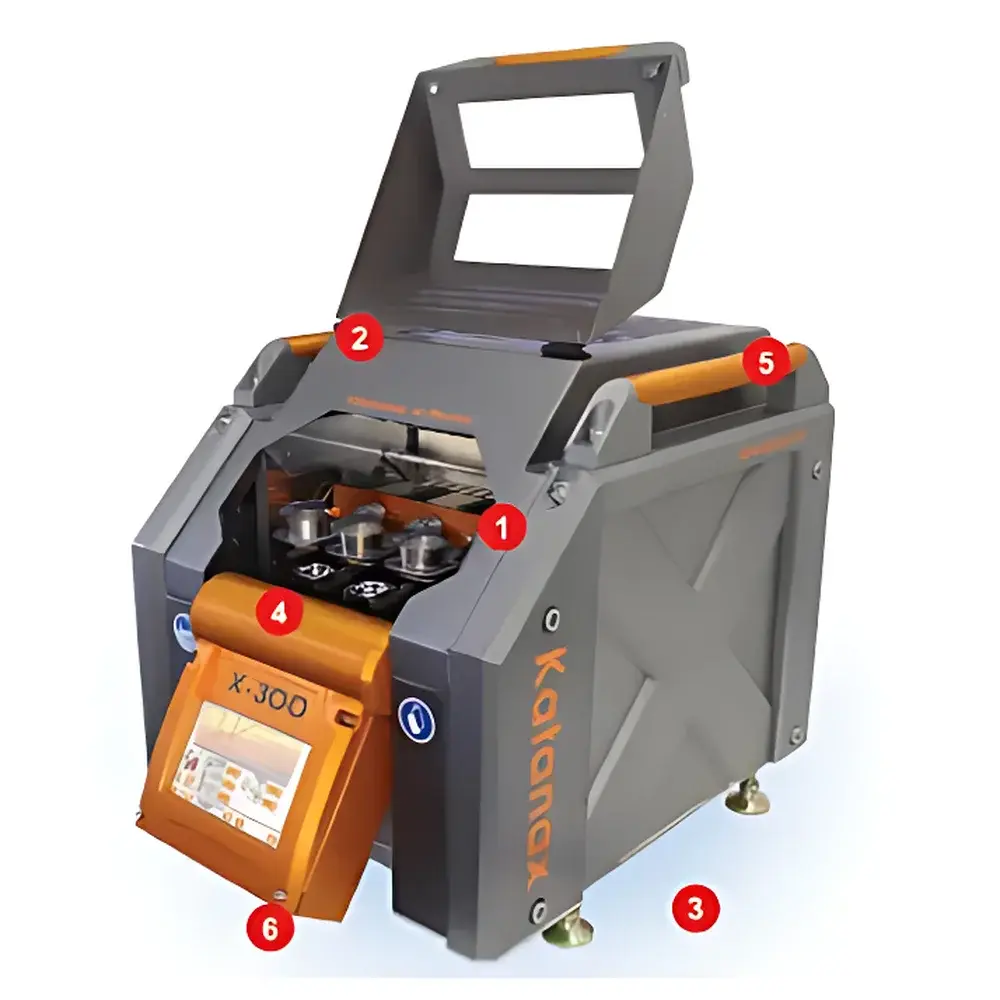
Katanax X-300 X-FLUXER Automated Multi-Position Fusion Machine
| Brand | Katanax |
|---|---|
| Origin | USA |
| Model | X-300 |
| Max Operating Temperature | 1200 °C |
| Dimensions (H×W×D) | 51 cm × 48 cm × 63 cm |
| Weight | 54 kg |
| Power Supply | 220 VAC, 50–60 Hz |
| Max Power Consumption | 3000 W |
| Safety Fuse | 15 A |
| Sample Capacity | 1–3 positions (configurable) |
| Cooling | Air-cooled, no external coolant required |
| Control Interface | Adjustable-height LCD touchscreen with USB firmware update port |
| Compliance | Designed for GLP/GMP environments |
Overview
The Katanax X-300 X-FLUXER is an automated, multi-position fusion machine engineered for high-precision sample preparation in analytical laboratories performing X-ray fluorescence (XRF), inductively coupled plasma (ICP-OES/MS), and atomic absorption (AA) spectroscopy. It employs resistive heating within a fully enclosed, ceramic-lined furnace chamber to achieve controlled, reproducible fusion of solid samples—typically geological, metallurgical, cementitious, or environmental matrices—with fluxing agents (e.g., lithium tetraborate, lithium metaborate, or mixtures). Unlike gas-fired furnaces, the X-300 eliminates combustion-related variability, gas handling risks, and flame instability, delivering superior thermal uniformity across up to three independent crucible positions. Its core architecture integrates dynamic temperature profiling (DTP), individual heating element compensation, and real-time thermal feedback to maintain ±2 °C uniformity across all sample zones during ramp, hold, and pour phases—critical for minimizing matrix effects and ensuring stoichiometric glass disc homogeneity.
Key Features
- Triple-configurable sample capacity: Operates as a 1-, 2-, or 3-position fusion unit without hardware modification—enabling scalability from R&D to routine QA/QC throughput.
- Ceramic-fused heating elements: Non-porous, chemically inert to fluxes and halogenated additives; resistant to thermal shock and mechanical abrasion; field-replaceable without recalibration.
- Automated safety interlock system: Motorized lid with force-sensing lock engages before heating initiates and remains sealed until post-cool cycle completes—meeting IEC 61010-1 requirements for laboratory equipment.
- Low-noise thermal management: Acoustic emission <55 dB(A) across standby, heating, fusion, and cooling phases—suitable for open-plan lab environments.
- Adjustable ergonomic control panel: Height-adjustable touchscreen interface with icon-driven navigation, multilingual OS support (English, French, German, Spanish, Chinese), and USB port for secure firmware updates.
- Modular auxiliary capability: Optional variable-speed solution stirrer enables simultaneous dissolution of up to three ICP/AA samples in PTFE or quartz beakers—eliminating need for separate hotplate systems.
- Industrial PLC-based controller: Real-time OS independent of Windows updates; deterministic timing for thermal profiles; built-in event logging with timestamped operational states (red = active process, blue = complete).
Sample Compatibility & Compliance
The X-300 accommodates standard platinum–gold or Pt–Rh crucibles (30–40 mm diameter) and matching molds, supporting common fusion protocols for silicates, oxides, sulfides, alloys, slags, and fly ash. Its ceramic chamber construction prevents metallic contamination—ensuring trace-level integrity for ultra-low detection limit analysis. The system complies with ASTM D5630 (ash content), ISO 9556 (iron and steel—determination of total carbon), and USP (loss on drying) sample prep prerequisites. When deployed in regulated environments, its deterministic control logic, non-volatile parameter storage, and electronic signature-capable software interface support 21 CFR Part 11 compliance when paired with validated data acquisition platforms. All thermal profiles are stored with full metadata—including operator ID, date/time stamp, crucible ID, and deviation logs—for GLP/GMP audit readiness.
Software & Data Management
The embedded firmware includes over 25 preloaded fusion methods covering oxide, carbonate, sulfide, metal, and peroxide matrices, each with customizable ramp rates, hold durations, pour temperatures, and cooling gradients. Users can save, rename, duplicate, or delete methods via intuitive file-like navigation. Method parameters—including DTP setpoints, element-specific compensation offsets, and stirrer speed curves—are stored in non-volatile memory with SHA-256 checksum verification. USB export enables method transfer between instruments or archival in centralized LIMS. No proprietary drivers or cloud dependencies: firmware updates are performed offline via signed binary files. Audit trail functionality records all user actions, parameter changes, and system faults with immutable timestamps—fully traceable for internal quality reviews or regulatory inspections.
Applications
- XRF quantitative analysis of geological surveys (rocks, soils, ores) requiring homogeneous glass discs with <0.5% relative standard deviation (RSD) in major oxide concentrations.
- Preparation of certified reference materials (CRMs) for inter-laboratory proficiency testing under ISO/IEC 17043 guidelines.
- High-throughput fusion for cement and clinker analysis per ASTM C114 and EN 196-2 standards.
- Metallurgical QC of ferrous and non-ferrous alloys, including Ni-based superalloys and stainless steels, where minimal boron contamination is critical.
- Environmental monitoring labs processing fly ash, slag, and contaminated sediments for EPA Method 6010D and ISO 11885 compliance.
- Research applications involving refractory ceramics, nuclear fuel simulants, and rare-earth element concentrates requiring >1100 °C fusion stability.
FAQ
What power supply is required for the X-300?
The X-300 operates on single-phase 220 VAC, 50–60 Hz, with no requirement for three-phase infrastructure or external cooling water.
Can the X-300 be integrated into a laboratory automation workflow?
Yes—it features industrial PLC I/O ports (24 V DC) for seamless integration with robotic sample handlers, barcode readers, or central SCADA systems.
Is platinum crucible compatibility guaranteed across all configurations?
Yes—the adjustable mold holder accepts 30 mm, 32 mm, 35 mm, and 40 mm crucibles and molds; all Pt–Rh and Pt–Au alloys meeting ASTM E172 specifications are supported.
How does the X-300 ensure temperature uniformity across multiple positions?
Through Dynamic Temperature Profiling (DTP) and per-element power compensation—each of the three independent heating zones is actively monitored and adjusted in real time to maintain ±2 °C inter-positional variance.
Does the system require annual calibration by the manufacturer?
No—its self-compensating heater architecture and NIST-traceable internal thermocouple array eliminate mandatory annual recalibration; users may perform in-house verification using certified reference thermocouples per ISO/IEC 17025.



