
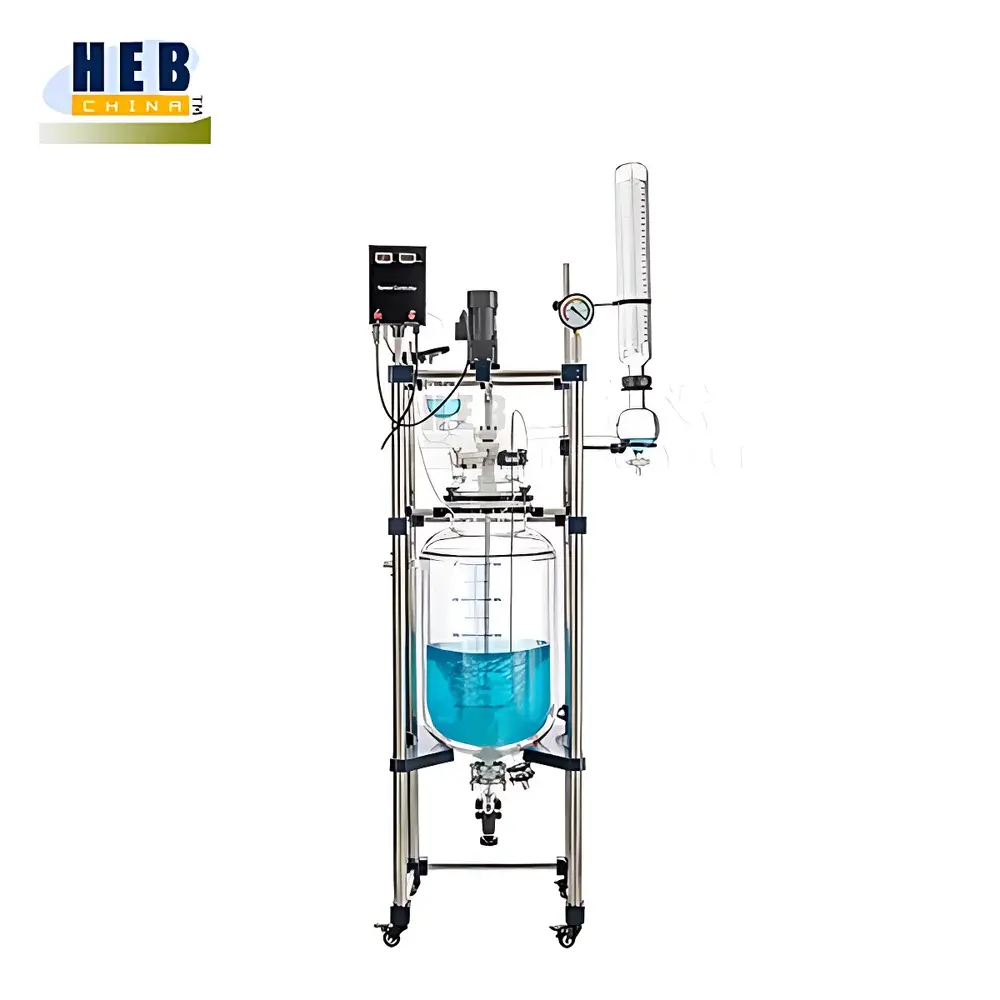
Jihepu HEB-50L Dual-Jacketed Glass Reactor
| Brand | Jihepu |
|---|---|
| Origin | Shandong, China |
| Manufacturer Type | Authorized Distributor |
| Country of Origin | China |
| Model | HEB-50L |
| Capacity | 50 L |
| Working Pressure | Low-pressure (up to 0.1 MPa gauge) |
| Vacuum Degree | −0.098 MPa (absolute) |
| Jacket Volume | 12 L |
| Operating Temperature Range | −80 °C to +250 °C |
| Stirring Speed | 0–450 rpm |
| Motor Power | 120 W |
| Voltage/Frequency | 220 V / 50 Hz |
| Stirring Shaft Diameter | 12 mm |
| Discharge Port Height | 450 mm |
| Overall Dimensions (L×W×H) | 760 × 560 × 2450 mm |
| Net Weight | 92 kg |
| Material | GG-17 borosilicate glass (ASTM E438 Type I, Class A), 304 stainless steel frame, PTFE-coated stirrer, ceramic bearing, mechanical seal |
Overview
The Jihepu HEB-50L Dual-Jacketed Glass Reactor is an engineered laboratory-scale reaction system designed for controlled synthesis, distillation, reflux, concentration, and separation under variable thermal and vacuum conditions. It operates on the principle of indirect temperature regulation via a circulating fluid medium (e.g., silicone oil, ethylene glycol, or chilled water) within the annular jacket surrounding the main reaction vessel. This enables precise thermal management—both heating and cooling—of the reaction mass while maintaining full visual access through the transparent GG-17 borosilicate glass body. The reactor integrates a sealed, magnetically coupled or mechanically driven stirring system with vacuum-tight integrity, allowing operation under reduced pressure for low-boiling-point solvent recovery or high-boiling-point compound processing. Its modular port configuration (six-neck lid) supports concurrent integration of condensers, dropping funnels, thermometers, inert gas inlets, and vacuum lines—making it suitable for multi-step batch synthesis protocols in compliance with GLP-aligned lab practices.
Key Features
- GG-17 borosilicate glass vessel (ASTM E438 Type I, Class A) offering >95% optical transparency, thermal shock resistance up to ΔT = 120 °C, and chemical inertness toward most organic solvents, acids, and bases.
- Robust support structure composed of 304 stainless steel frame and aluminum alloy components, providing long-term dimensional stability and corrosion resistance in humid or solvent-rich environments.
- PTFE-sheathed stainless steel stirring shaft and impeller, compatible with aggressive media including halogenated solvents, strong acids, and alkaline solutions without leaching or degradation.
- Explosion-proof AC motor with frequency-controlled speed regulation (0–450 rpm), delivering consistent torque output across the full range and eliminating spark hazards in flammable vapor environments.
- High-integrity sealing system featuring ceramic bearings and PTFE-composite mechanical seals, rated for continuous operation at −0.098 MPa absolute vacuum and temperatures from −80 °C to +250 °C.
- Dual digital display controller showing real-time stir speed and internal vessel temperature (via integrated PT100 sensor), enabling synchronized process parameter logging.
- Zero-dead-volume inclined discharge valve with PTFE seat, facilitating complete material evacuation and minimizing cross-contamination between batches.
- Integrated casters with locking brakes for safe relocation within fume hoods or shared synthesis labs; compact footprint optimized for Class II biosafety cabinets or standard benchtop use.
Sample Compatibility & Compliance
The HEB-50L accommodates liquid-phase, slurry, and heterogeneous reaction mixtures up to 50 L working volume. Its all-glass wetted path ensures compatibility with pH-sensitive, metal-catalyzed, or photochemically active systems where metallic contamination must be avoided. The reactor meets structural requirements referenced in ISO 15500-5 (pressure equipment for laboratory use) and aligns with general safety provisions outlined in ANSI Z9.5–2012 (Laboratory Ventilation). While not certified as ASME BPVC Section VIII or PED-compliant due to its low-pressure classification (<0.5 bar gauge), it is routinely deployed in academic research, pilot-scale pharmaceutical development (non-GMP), and materials science synthesis where regulatory-grade documentation is supplemented by user-generated risk assessments per ICH Q5C and USP .
Software & Data Management
This analog-digital hybrid reactor does not include embedded software or network connectivity. However, its dual digital display outputs (RPM and PT100 temperature) are compatible with third-party data acquisition systems via 0–10 V or 4–20 mA analog signal interfaces (optional add-on modules available). Users may integrate the unit into validated electronic lab notebooks (ELNs) such as LabArchives or Benchling using external USB loggers. For regulated environments requiring audit trails, manual entry of setpoints and observed values satisfies FDA 21 CFR Part 11 basic requirements when paired with controlled SOPs and signed batch records.
Applications
- Fine chemical synthesis: Grignard reactions, Friedel-Crafts acylations, and Suzuki couplings under inert atmosphere and controlled exotherm management.
- Pharmaceutical intermediate purification: Solvent-based recrystallization, extractive workups, and vacuum-assisted solvent stripping.
- Polymerization studies: Step-growth polycondensation (e.g., polyesters) and free-radical emulsion polymerization with temperature ramping profiles.
- Nanomaterial preparation: Hydrothermal synthesis of metal oxides (e.g., TiO₂, ZnO) using high-temperature/low-vacuum cycles.
- Biochemical processing: Enzymatic transesterification of triglycerides under mild vacuum and sub-ambient temperature control.
- Teaching laboratories: Demonstration of phase equilibria, Raoult’s law deviations, and kinetic modeling in undergraduate physical chemistry curricula.
FAQ
What is the maximum allowable operating pressure for this reactor?
The HEB-50L is rated for low-pressure service only, with a maximum gauge pressure of +0.1 MPa. It is not designed for pressurized hydrogenation or supercritical fluid applications.
Can the reactor be used with dry ice/acetone baths for sub-zero reactions?
Yes—when paired with a compatible low-temperature circulation chiller (e.g., −80 °C capable), the jacket can maintain internal temperatures down to −80 °C. Direct immersion of the glass vessel in cryogenic baths is prohibited due to thermal stress risk.
Is the six-port lid standardized for common lab glassware connections?
All ports conform to ISO 297 (DIN 1583) ground-glass joint standards: four 24/40, one 29/32, and one 14/23 taper—enabling direct attachment of condensers, addition funnels, and thermowells without adapters.
Does the mechanical seal require periodic maintenance or lubrication?
No—this is a dry-running, spring-loaded PTFE/ceramic mechanical seal with no grease or oil requirement. Seal life exceeds 5,000 hours under normal vacuum and thermal cycling conditions.
What certifications accompany the unit for international shipment?
Each unit ships with CE-marked electrical components (EN 61010-1), RoHS declaration of conformity, and a Factory Calibration Certificate traceable to NIST standards for temperature and vacuum sensors.



