
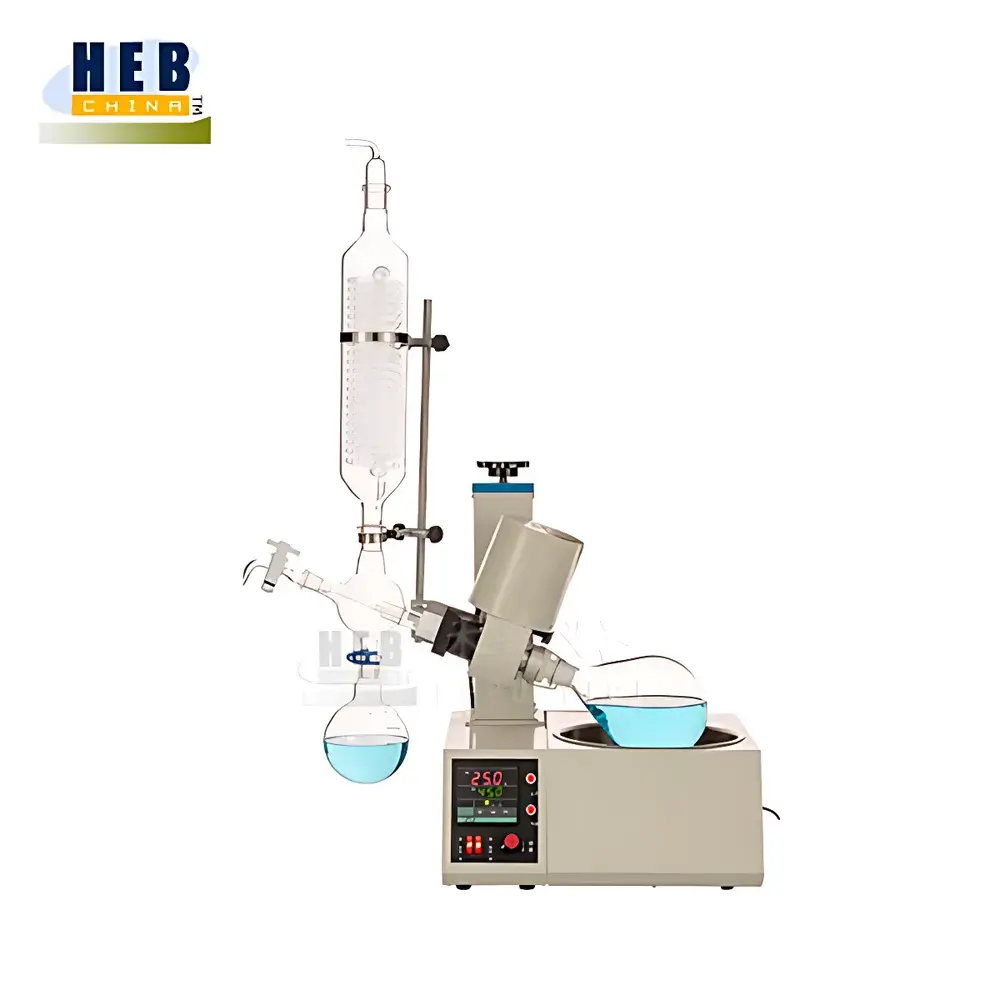
English Product Name
| Brand | Jihepu |
|---|---|
| Origin | Shandong, China |
| Model | RE-52C |
| Capacity | 1 L |
| Ultimate Vacuum | 0.098 MPa |
| Rotational Speed | 0–120 rpm |
| Temperature Control Range | 0–99 °C |
| Temperature Accuracy | ±1 °C |
| Condenser Cooling Area | 0.11 m² |
| Heating Power | 1 kW |
| Motor Power | 30 W |
| 升降 Power | 15 W |
| Bath Volume | ~5.4 L |
| Dimensions (L×W×H) | 700 × 440 × 1005 mm |
| Net Weight | 21 kg |
Overview
The Jihepu RE-52C Rotary Evaporator is a precision-engineered vacuum distillation system designed for gentle, efficient solvent removal, concentration, and recovery under reduced pressure. Operating on the principle of thin-film evaporation, it rotates a sample-containing flask at controlled speeds while applying uniform conductive heating via a thermostatically regulated water bath. Under vacuum conditions (down to 0.098 MPa), the lowered boiling point enables rapid yet thermally benign phase transition—critical for heat-sensitive compounds such as pharmaceutical intermediates, natural product extracts, enzymatic preparations, and polymer solutions. All wetted surfaces are constructed from GG-17 high-borosilicate glass and PTFE, ensuring chemical inertness, thermal stability (−80 °C to +250 °C), and compliance with ISO 3585 standards for laboratory glassware. Its modular architecture supports integration into GLP-compliant workflows where traceability, repeatability, and material compatibility are essential.
Key Features
- Microprocessor-based ON-OFF power control with digital temperature display and intelligent PID regulation using a Cu50 platinum resistance sensor for stable thermal response (±1 °C accuracy).
- Stepless electronic speed control (0–120 rpm) via rotary encoder, enabling precise optimization of film thickness and evaporation kinetics across diverse viscosities.
- Vertical dual-layer coiled condenser (Φ85 × 460 mm) with enhanced surface area (0.11 m²) and optimized coolant flow path—maximizing condensation efficiency and solvent recovery yield.
- Corrosion-resistant support frame combining anodized aluminum structural elements and epoxy-coated steel, engineered for long-term mechanical stability in multi-shift lab environments.
- PTFE–FKM hybrid sealing system rated for sustained operation at ≤0.098 MPa vacuum, minimizing vapor leakage and maintaining process integrity during extended runs.
- Motor-driven vertical lift mechanism (0–150 mm travel) with overload protection, facilitating safe flask immersion/extraction without manual handling.
- Stainless steel bath pot (304 grade) with integrated heater and overheat cut-off fuse, supporting continuous operation within 0–99 °C range (optional 0–400 °C upgrade available).
- Standardized ground-glass joints (24/35 standard taper) and 19# feed valve compatible with PTFE tubing—enabling seamless connection to external chillers, vacuum controllers, or automated dosing systems.
Sample Compatibility & Compliance
The RE-52C accommodates a broad spectrum of organic solvents (e.g., acetone, ethanol, ethyl acetate, dichloromethane), aqueous buffers, and moderately viscous mixtures up to ~500 cP. Its all-glass/PTFE fluid path eliminates metal ion leaching and adsorption artifacts—making it suitable for USP , ISO 10993, and ICH Q5A-aligned biopharmaceutical purification steps. While not certified to UL/CE or FDA 21 CFR Part 11 out-of-the-box, its deterministic control logic, non-volatile parameter storage, and physical interlocks provide a foundational architecture for validation under GMP Annex 15 and ASTM E2500-22 risk-based qualification protocols.
Software & Data Management
The RE-52C operates as a standalone instrument with embedded firmware governing temperature setpoint, rotation speed, and lift actuation. No proprietary software is required; however, analog output signals (0–10 V or 4–20 mA) can be interfaced with third-party SCADA or LIMS platforms for audit-trail generation. For laboratories requiring full electronic record compliance, optional RS-485 Modbus RTU communication modules enable integration with validated data acquisition systems supporting 21 CFR Part 11 signature and change-control requirements.
Applications
- Solvent recovery and reuse in synthetic chemistry labs—reducing hazardous waste volume by >70% versus atmospheric distillation.
- Concentration of thermolabile natural product fractions (e.g., flavonoids, alkaloids) prior to HPLC fractionation.
- Removal of residual solvents from API crystallization slurries per ICH Q3C guidelines.
- Lyophilization pre-concentration of protein solutions to minimize freeze-drying cycle time.
- Extraction solvent recycling in cannabis and botanical processing facilities compliant with state-level environmental reporting mandates.
FAQ
What vacuum level is required for optimal performance?
A minimum vacuum of 0.095 MPa is recommended for most low-boiling solvents; the system achieves stable operation down to 0.098 MPa using standard diaphragm or rotary vane pumps.
Can the RE-52C be used with corrosive solvents like concentrated HCl or HF?
No—while GG-17 glass resists mild acids and bases, hydrofluoric acid and fuming sulfuric acid will etch glass and degrade PTFE seals. Use only with solvents listed in Corning’s GG-17 compatibility chart.
Is the water bath temperature range field-upgradable to 400 °C?
Yes—replacement of the standard stainless steel bath with a high-temp aluminum alloy unit and upgraded silicone oil medium allows extended range operation; contact technical support for retrofit documentation.
Does the unit include a vacuum controller or pressure sensor?
No—the RE-52C accepts external vacuum regulation via standard 10 mm hose barb ports but does not integrate real-time pressure feedback or auto-compensation algorithms.
What maintenance intervals are recommended for long-term reliability?
Inspect PTFE seals and O-rings every 6 months; clean condenser coils quarterly with isopropanol; calibrate temperature sensor annually using NIST-traceable reference baths.



