
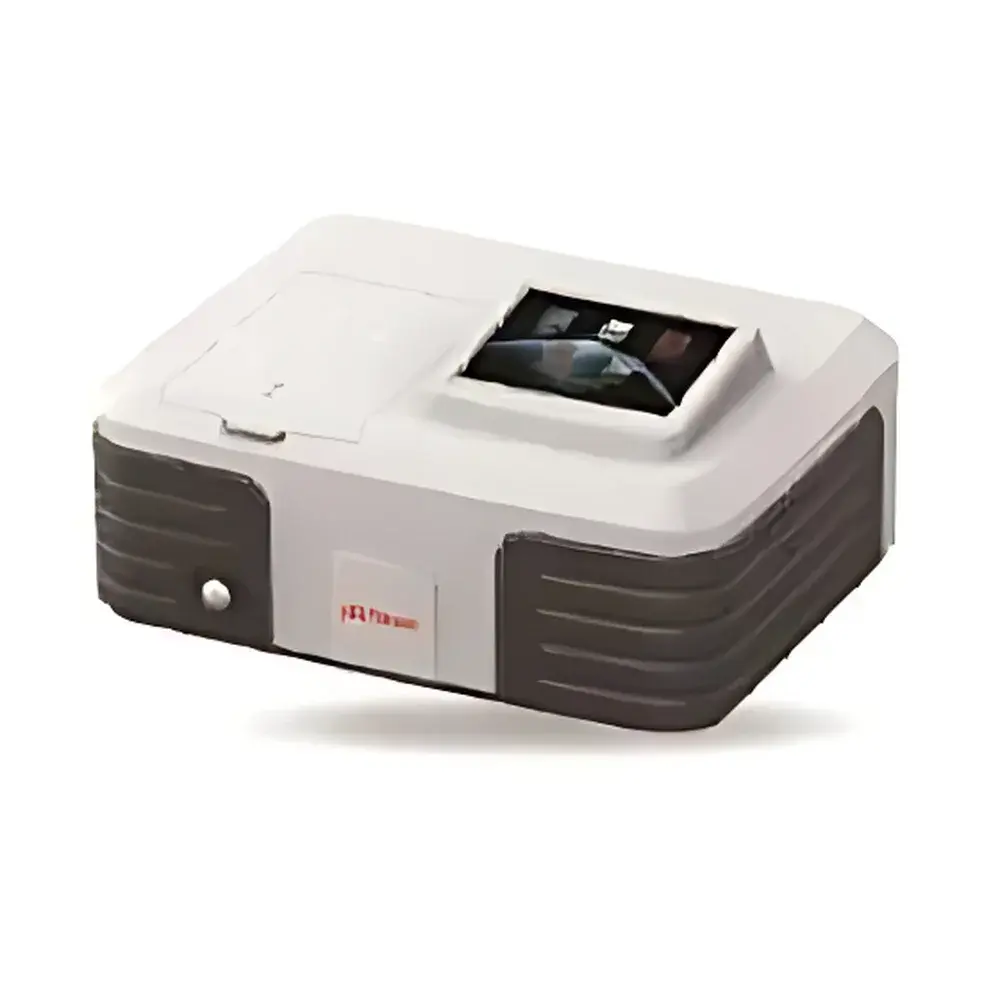
HePu UV-8000 Touchscreen Dual-Beam Ultraviolet-Visible Spectrophotometer
| Brand | HePu (Jihepu) |
|---|---|
| Origin | Shandong, China |
| Manufacturer Type | Authorized Distributor |
| Instrument Type | Domestic |
| Model | UV-8000 Touchscreen |
| Optical Design | Dual-beam |
| Detector | Photomultiplier Tube (PMT) |
| Wavelength Range | 190–1100 nm |
| Wavelength Accuracy | ±0.1 nm at D₂ 656.1 nm, ±0.3 nm across full range |
| Spectral Bandwidth | 1.8 nm |
| Stray Light | ≤0.03% T at 220 nm and 360 nm |
| Wavelength Repeatability | ≤0.1 nm |
| Photometric Accuracy | ±0.2% T (0–100% T), ±0.002 A (0–0.5 A), ±0.004 A (0.5–1.0 A) |
| Photometric Repeatability | ≤0.1% T, ±0.001 A (0–0.5 A), ±0.002 A (0.5–1.0 A) |
| Baseline Flatness | ±0.0004 A (190–1100 nm) |
| Drift | ±0.0003 A/h at 500 nm |
| Noise | ±0.0003 A at 500 nm |
| Photometric Range | 0–200% T, –4.0 to +4.0 A, 0–9999 C |
| Display | 10-inch HD capacitive touchscreen |
| Internal Storage | 32 GB embedded memory |
| Connectivity | USB host/device, Wi-Fi |
| Dimensions | 600 × 400 × 210 mm |
| Weight | 20 kg |
| Power Supply | AC 220 V/50 Hz or 110 V/60 Hz |
Overview
The HePu UV-8000 Touchscreen Dual-Beam Ultraviolet-Visible Spectrophotometer is engineered for high-precision quantitative and qualitative analysis across research laboratories, quality control environments, and educational institutions. Based on the dual-beam optical architecture—where sample and reference beams are simultaneously measured using a high-stability chopper system—the instrument minimizes errors arising from source intensity drift, lamp aging, and environmental fluctuations. It employs a 1200 lines/mm holographic grating for enhanced spectral resolution and reduced stray light, coupled with a photomultiplier tube (PMT) detector optimized for sensitivity in the deep UV region (190 nm). The optical path is mechanically isolated via a suspended optical assembly mounted on a rigid 16 mm aluminum baseplate, eliminating coupling of mechanical vibration or thermal deformation into the measurement axis—a design feature critical for long-term baseline stability and reproducibility in regulated workflows.
Key Features
- Dual-beam optical configuration with real-time reference compensation ensures superior photometric stability and accuracy over extended measurement sessions.
- 10-inch high-resolution capacitive touchscreen interface with intuitive icon-driven navigation—no external PC required for routine operation.
- Embedded 32 GB solid-state storage enables local saving of spectra, calibration curves, method files, and audit logs; data export via USB flash drive in CSV, TXT, or native .spc format.
- Integrated Wi-Fi module supports secure network connectivity for remote firmware updates, method synchronization, and LIMS integration (IEEE 802.11 b/g/n).
- Self-diagnostic startup sequence performs automatic wavelength calibration using deuterium and tungsten lamp emission lines, followed by optical alignment verification and baseline correction.
- Optical suspension architecture decouples the spectrometer core from chassis vibrations and ambient thermal gradients, contributing to baseline flatness of ±0.0004 A across 190–1100 nm.
Sample Compatibility & Compliance
The UV-8000 accommodates standard 10 mm square cuvettes (quartz, fused silica, or high-transmission glass), as well as micro-volume adapters and flow cells compatible with HPLC effluent monitoring. Its optical design meets essential performance criteria outlined in ISO 9001:2015 (calibration traceability), ASTM E275–22 (spectrophotometer performance verification), and USP (UV-Vis absorbance instrumentation qualification). While not pre-certified for 21 CFR Part 11 compliance out-of-the-box, the instrument supports electronic signature-ready audit trails when operated within validated laboratory information management systems (LIMS) or ELN platforms. All firmware and software modules adhere to GLP/GMP documentation standards, including timestamped event logging, user-access controls, and immutable method versioning.
Software & Data Management
The onboard operating system includes fully functional spectroscopic software capable of executing photometric mode, quantitative analysis (single/multi-point calibration, linear/non-linear regression), spectral scanning (full-range or user-defined windows), kinetic assays (time-resolved absorbance at fixed or variable wavelengths), DNA/protein quantification (A₂₆₀/A₂₈₀ ratio calculation with built-in extinction coefficients), and multi-wavelength analysis. Data visualization includes overlayable spectra, derivative plots, peak identification, and baseline correction algorithms (polynomial, rubberband, or rolling ball). Raw absorbance/transmittance values are stored with metadata (date/time, operator ID, instrument serial number, lamp hours, and calibration status). Export formats support interoperability with third-party statistical tools (e.g., OriginLab, GraphPad Prism) and regulatory reporting systems.
Applications
The UV-8000 serves as a primary analytical tool in diverse application domains: pharmaceutical QC (active ingredient assay, dissolution testing, excipient compatibility), environmental monitoring (nitrate, phosphate, COD determination), biochemical research (enzyme kinetics, ligand binding, oligonucleotide purity assessment), food and beverage analysis (colorimetric additives, antioxidant capacity), and academic teaching (Beer–Lambert law validation, spectral deconvolution exercises). Its low stray light (<0.03% T) and high photometric accuracy enable reliable measurements of highly absorbing samples—such as concentrated protein solutions or colored dyes—without signal saturation or nonlinearity artifacts. The dual-beam architecture further enhances robustness during temperature-dependent studies where reference path compensation mitigates thermal-induced baseline shifts.
FAQ
Does the UV-8000 support 21 CFR Part 11-compliant electronic signatures?
The instrument itself does not include native digital signature functionality; however, its audit-trail-capable data export and time-stamped event logs are compatible with external Part 11–compliant LIMS or ELN platforms that enforce user authentication, role-based access, and electronic approval workflows.
What cuvette materials are recommended for UV measurements below 220 nm?
Quartz or synthetic fused silica cuvettes are required for transmission measurements between 190–220 nm; standard glass or plastic cuvettes exhibit significant absorption in this region and must be avoided.
Can the instrument perform kinetic measurements over extended time periods (e.g., >60 minutes)?
Yes—the optical stability (±0.0003 A/h drift at 500 nm) and thermal isolation design allow for reproducible kinetic assays lasting up to 2 hours without recalibration, provided ambient temperature remains within ±2 °C.
Is the PMT detector user-replaceable?
The photomultiplier tube is factory-aligned and sealed within the optical housing; replacement requires recalibration and should only be performed by certified HePu service engineers.
How is wavelength accuracy verified during routine qualification?
Wavelength verification is conducted using certified holmium oxide and didymium oxide filters per ASTM E275–22, or by referencing atomic emission lines from deuterium (656.1 nm) and tungsten (589.0 nm, 837.8 nm) lamps during automated startup diagnostics.






