
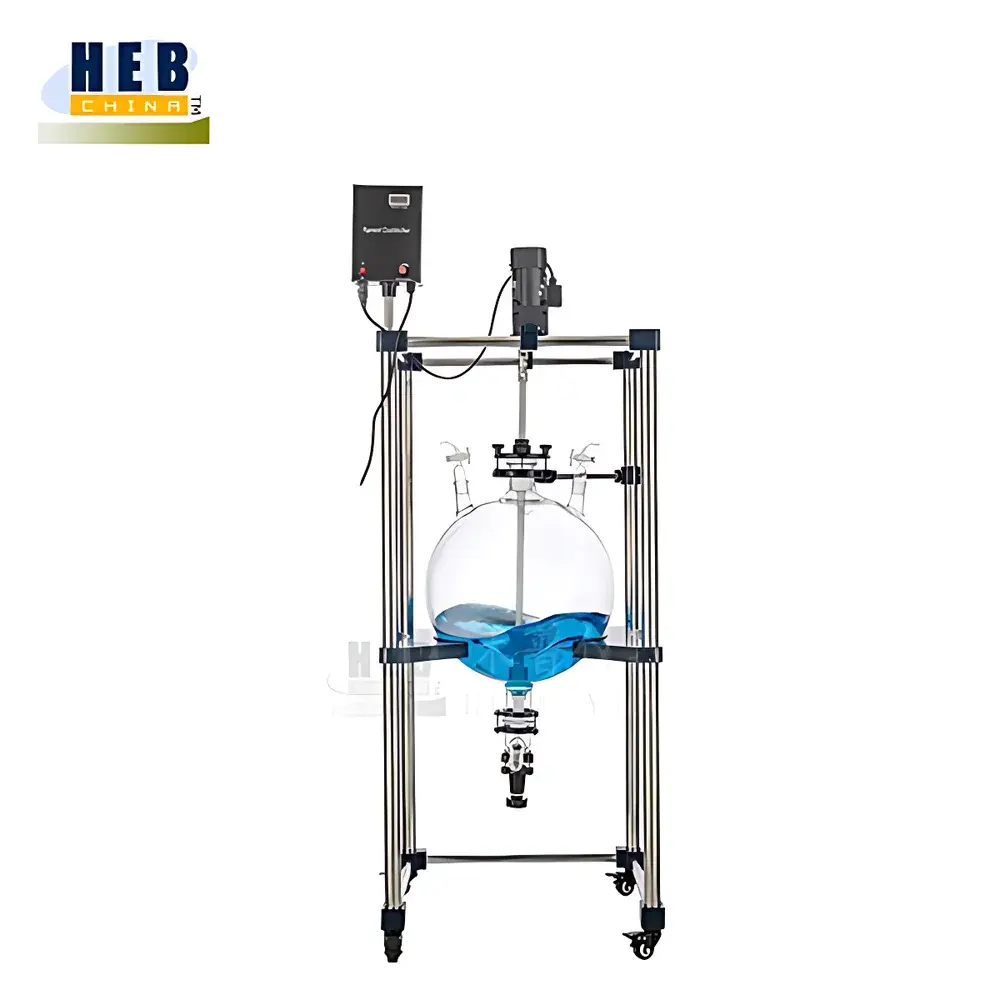
HePu FY-50L Borosilicate Glass Separatory Funnel Reactor System
| Brand | HePu (Jihepu) |
|---|---|
| Origin | Shandong, China |
| Model | FY-50L |
| Capacity | 50 L |
| Construction Material | GG-17 borosilicate glass |
| Frame Material | Stainless steel (304) |
| Stirring Speed Range | 0–450 rpm |
| Stirring Power | 120 W |
| Vacuum Performance | ≤ −0.098 MPa (gauge) |
| Sealing Method | PTFE-faced flange seals (Ø70 mm), standard taper joints (34/34) |
| Overall Dimensions (W×D×H) | 490 × 490 × 1500 mm |
| Net Weight | 70 kg |
| Mobility | Lockable swivel casters |
| Compliance | Designed for GLP-compliant lab environments |
Overview
The HePu FY-50L Borosilicate Glass Separatory Funnel Reactor System is a purpose-engineered laboratory-scale reaction platform integrating controlled liquid–liquid phase separation with simultaneous agitation, vacuum operation, and visual process monitoring. Unlike conventional jacketed reactors or simple separatory funnels, this system functions as a hybrid unit—combining the chemical inertness and optical clarity of GG-17 borosilicate glass with a mechanically robust stainless-steel support frame and precision-engineered PTFE-sealed fluid handling components. Its operational principle relies on gravity-driven phase separation under controlled vacuum conditions, enhanced by low-shear, variable-speed magnetic or mechanical stirring (via optional PTFE-coated anchor impeller). The reactor operates within low-pressure regimes (up to −0.098 MPa), enabling solvent removal, reduced-boiling-point distillations, and moisture-sensitive reactions without thermal degradation. Designed for synthetic organic chemistry, pharmaceutical process development, and fine chemical R&D, it supports reproducible batch operations from screening through pilot-scale optimization.
Key Features
- GG-17 borosilicate glass vessel (50 L spherical design) with ≥ 93% optical transmittance and coefficient of thermal expansion of 3.3 × 10⁻⁶ /°C—resistant to thermal shock up to ΔT = 120°C and compatible with aggressive reagents including concentrated acids, alkalis, and halogenated solvents.
- Stainless steel 304 support frame with powder-coated or optional PTFE-sprayed finish; equipped with four lockable swivel casters (load rating ≥ 100 kg per caster) for stable repositioning in fume hoods or shared lab spaces.
- Electronically controlled variable-speed drive (0–450 rpm) with digital LCD speed display, integrated gearmotor (3:1 reduction ratio), and overload protection—ensuring torque consistency across viscosity ranges up to 10⁴ mPa·s.
- Full-glass discharge assembly featuring Ø80 mm PTFE-sealed flanged valve and removable bottom port—enabling complete solids evacuation and CIP-compatible cleaning without disassembly of main vessel.
- Multi-port configuration (four standard 34/34 taper joints) accommodating reflux condensers, thermocouple ports, addition funnels, and vacuum manifolds—configured per user-defined reaction schematics.
- Hermetic sealing architecture utilizing PTFE gaskets at all flange interfaces and tapered ground-glass joints—validated to maintain ≤ −0.095 MPa vacuum for ≥ 4 hours under static conditions (per ASTM D3136 test protocol).
Sample Compatibility & Compliance
The FY-50L system accommodates heterogeneous mixtures including emulsions, suspensions, and biphasic systems (e.g., aqueous/organic, immiscible polymer solutions). Its all-glass wetted path eliminates metal ion leaching—critical for catalyst-sensitive transformations (e.g., Pd-catalyzed cross-couplings) and high-purity API synthesis. The reactor meets structural requirements outlined in ISO 3585 (borosilicate glass specifications) and conforms to mechanical safety guidelines in EN 61000-6-3 (EMC emissions). When operated with optional EX-rated components (180 W explosion-proof motor, ATEX-certified frequency inverter), it satisfies IEC 60079-0 for use in Zone 2 hazardous locations. Documentation packages support 21 CFR Part 11–compliant electronic records when paired with validated third-party data acquisition software.
Software & Data Management
While the base unit operates via standalone analog/digital controls, optional integration modules enable RS-485 or USB-to-serial connectivity for logging speed, vacuum level (via external gauge), and runtime duration. Compatible with LabArchives ELN and DeltaV DCS platforms, the system supports audit-trail generation for GLP/GMP audits. Firmware updates are delivered via secure HTTPS endpoint; calibration logs and maintenance history can be exported in CSV or PDF format compliant with ISO/IEC 17025 clause 7.7.
Applications
- Controlled extraction protocols (e.g., acid–base workups, natural product isolation)
- Multi-step sequential reactions requiring intermediate phase separation (e.g., Suzuki–Miyaura coupling followed by aqueous quench and organic layer recovery)
- Solvent exchange under reduced pressure for moisture-sensitive intermediates
- Kinetic studies involving real-time observation of interfacial phenomena (e.g., micelle formation, coacervate precipitation)
- Scale-up trials bridging 500 mL round-bottom flask workflows to 50 L batch volumes while preserving mixing efficiency (Reynolds number maintained > 10³)
- Teaching laboratories demonstrating mass transfer principles, Le Chatelier’s principle under vacuum, and glass apparatus engineering standards
FAQ
Is the FY-50L suitable for exothermic reactions requiring external cooling?
Yes—standard configurations include provision for circulating coolant through an optional double-jacketed glass mantle (not included); users may integrate with recirculating chillers rated for −20°C to +100°C.
Can the glass vessel be custom-fabricated with non-standard neck geometries or additional ports?
Yes—HePu offers OEM engineering services for modified joint configurations (e.g., 24/40, 45/50), side-arm outlets, or integrated sight glasses, subject to minimum order quantities and lead time validation.
What maintenance intervals are recommended for PTFE seals and stirrer bearings?
PTFE gaskets should be inspected prior to each high-vacuum run and replaced after 50 cumulative hours of operation under −0.09 MPa; ceramic stirrer bearings require lubrication every 200 operating hours and replacement every 1,000 hours.
Does the system comply with FDA requirements for pharmaceutical manufacturing equipment?
As supplied, the FY-50L is intended for R&D and non-GMP environments; however, full GMP qualification (IQ/OQ/PQ) documentation, material traceability (3.1 certs), and surface roughness verification (Ra ≤ 0.8 µm for wetted 304 SS) are available as add-on services.



