
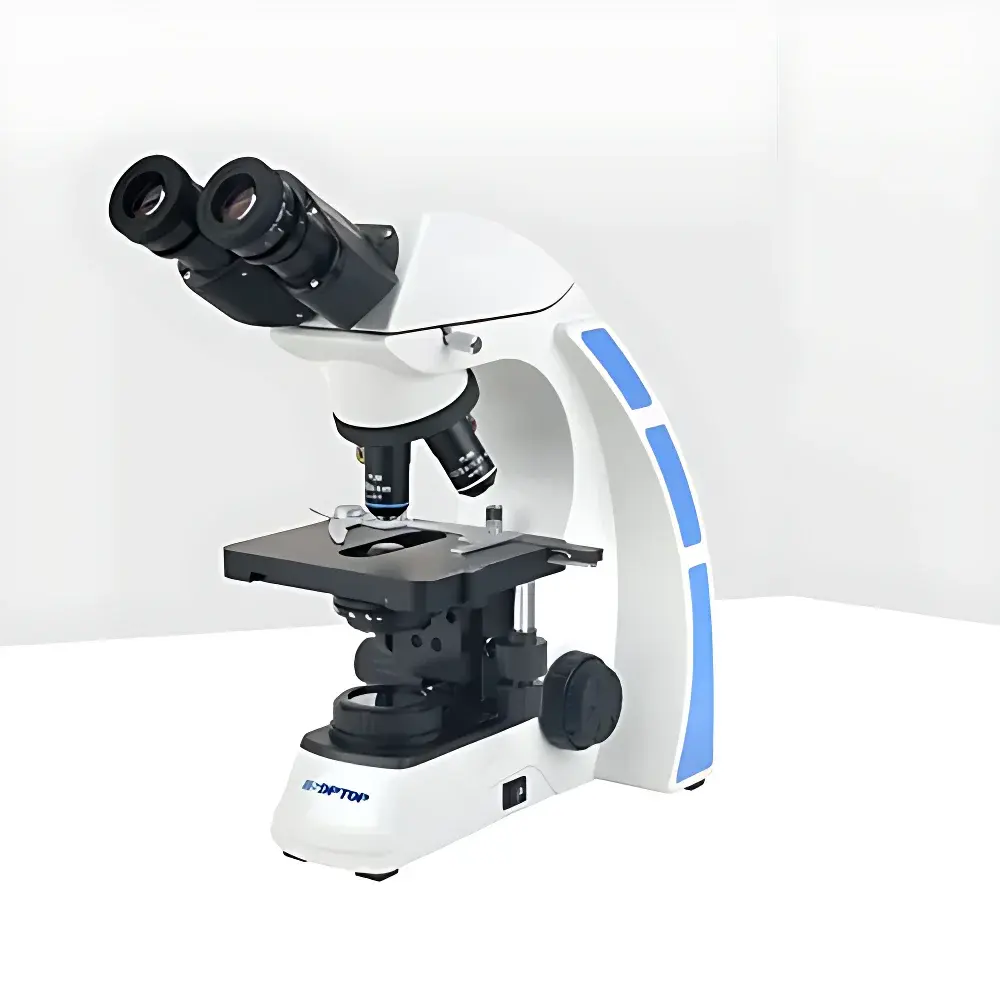
HePu EX20 Upright Biological Microscope
| Brand | HePu (Jihepu) |
|---|---|
| Origin | Shandong, China |
| Manufacturer Type | Authorized Distributor |
| Country of Origin | China |
| Model | EX20 |
| Price Range | USD 2,800–7,000 |
| Instrument Type | Upright Microscope |
| Optical System | Infinity-Corrected Achromatic Plan Objective System |
| Illumination | 3W High-Power LED (Daylight-Matched, 5500K), Adjustable Intensity, Pre-Centered |
| Eyepieces | PL10X/18mm & PL10X/20mm Wide-Field Plan Eyepieces with Adjustable Diopter and High-Eye-Point Design |
| Objectives | Infinity-Corrected Achromatic Plan (2X, 4X, 10X, 20X, 40X, 60X, 100X Oil) |
| Nosepiece | Internal-Positioning 4-Position or 5-Position Revolving Turret |
| Focus Mechanism | Coaxial Coarse/Fine Adjustment |
| Coarse Travel | 25 mm |
| Fine Adjustment Resolution | 2 µm |
| Stage | 140 × 132 mm Dual-Layer Mechanical Stage |
| X-Y Travel | 76 × 50 mm |
| Graduation | 0.1 mm |
| Condenser | Abbe Condenser, NA 1.25, Centerable, Gear-and-Rack Vertical Adjustment, Integrated Slots for Phase Contrast & Darkfield Accessories |
| Camera Adapters | C-Mount, Adjustable Focus, Magnification Options: 0.35X, 0.5X, 0.65X, 1X |
Overview
The HePu EX20 Upright Biological Microscope is engineered for routine laboratory and academic applications requiring high-fidelity brightfield observation of fixed and live biological specimens. Built upon an infinity-corrected optical architecture, the EX20 integrates plan achromatic objectives and wide-field eyepieces to deliver flat, high-contrast images with minimal chromatic and spherical aberration across the entire field of view. Its modular design supports both standard histological examination and advanced contrast techniques—including phase contrast—without optical compromise. The microscope employs a Köhler illumination system with a pre-centered, adjustable-intensity 3W LED light source (5500K color temperature), offering stable, cool-running, energy-efficient illumination ideal for extended teaching sessions or time-lapse documentation. Designed for ergonomic operation, the 30° inclined hinge-mounted binocular, trinocular, or digital viewing head accommodates users with varying interpupillary distances (54–75 mm) and includes dual-side diopter adjustment for consistent visual acuity.
Key Features
- Infinity-corrected optical path with plan achromatic objectives (2X–100X oil immersion) and optional phase contrast objectives for enhanced contrast in unstained, transparent specimens.
- High-brightness, thermally stable 3W LED illumination with continuous intensity control and built-in centering—eliminating the need for filter compensation in brightfield imaging.
- Coaxial coarse/fine focusing mechanism with 25 mm coarse travel and 2 µm fine-step resolution, coupled with upper limit stop and tension adjustment for reproducible focusing across user groups.
- Dual-layer mechanical stage (140 × 132 mm) with 76 × 50 mm travel range and 0.1 mm vernier scale, enabling precise specimen repositioning during multi-field surveys or serial section analysis.
- Abbe condenser (NA 1.25) featuring gear-and-rack vertical movement, centering capability, and standardized slots for plug-in phase contrast and darkfield modules—supporting future functional expansion without hardware replacement.
- Modular trinocular port with 80:20 beam-splitting ratio and C-mount interface compatible with industry-standard digital cameras (0.35X–1X relay optics), facilitating integration into GLP-compliant image documentation workflows.
Sample Compatibility & Compliance
The EX20 is optimized for glass slide-mounted biological samples—including stained tissue sections (H&E, Gram, Giemsa), wet mounts, blood smears, and cultured cells in chamber slides or coverslip preparations. Its phase contrast configuration enables real-time observation of living, non-fixed specimens such as protozoa, algae, and mammalian cell monolayers without exogenous staining. All optical components comply with ISO 8578:2017 (microscope performance standards) and are manufactured to meet CE marking requirements for laboratory equipment. While not FDA 510(k)-cleared as a diagnostic device, the EX20 conforms to general safety standards IEC 61010-1 for electrical equipment used in laboratory environments. Its stable LED illumination and calibrated mechanical stage support repeatable measurements required under ASTM E29-23 for reporting significant figures in educational and QC contexts.
Software & Data Management
The EX20 does not include proprietary acquisition software but functions seamlessly with third-party imaging platforms compliant with TWAIN and DirectShow protocols—including ImageJ/Fiji, NIS-Elements (basic mode), and CellSens Standard. When paired with a C-mount camera and appropriate relay lens, the system supports metadata embedding (objective magnification, exposure time, illumination intensity) via EXIF-compatible drivers. Audit trails for image capture parameters can be maintained externally using timestamped folder structures or LIMS-integrated file naming conventions (e.g., “EX20_20240517_Tissue_Section_40X_Phase”). For regulated environments, users may implement 21 CFR Part 11-compliant digital signature workflows through validated third-party image management systems that interface with the microscope’s analog/digital video output.
Applications
The EX20 serves core functions across undergraduate life science laboratories, hospital pathology training units, and contract research organization (CRO) quality control labs. Typical use cases include: morphological assessment of hematological smears; identification of microorganisms in clinical microbiology education; verification of cell confluence prior to transfection or passaging; routine inspection of plant root tip mitotic stages; and preliminary screening of immunohistochemical staining uniformity. Its robust mechanical construction and standardized mounting interfaces also make it suitable for integration into custom-built automated slide scanning rigs where manual focus repeatability and illumination consistency are prerequisites.
FAQ
Is the EX20 compatible with oil immersion objectives?
Yes—the EX20 supports 100X oil immersion achromatic plan objectives and includes a dedicated 100X phase contrast objective optimized for high-NA oil-based imaging.
Can the LED illumination be replaced with a halogen lamp?
Yes—two illumination options are available: the standard 3W LED module or an optional 6V/20W halogen lamp assembly, both sharing the same pre-centered Köhler alignment mechanism.
Does the microscope meet ISO or ASTM standards for optical performance?
The EX20 adheres to ISO 8578:2017 specifications for resolution, field flatness, and chromatic correction when equipped with factory-calibrated objectives and eyepieces.
What is the maximum supported sensor size for digital imaging?
With the 1X C-mount adapter, the EX20 projects a 18 mm diagonal field onto the sensor—compatible with APS-C (23.6 × 15.7 mm) and smaller sensors without vignetting.
Is service and calibration support available outside China?
Authorized HePu distributors in North America, Europe, and Southeast Asia provide local technical support, periodic optical alignment verification, and replacement part fulfillment under standard warranty terms (24 months).




