
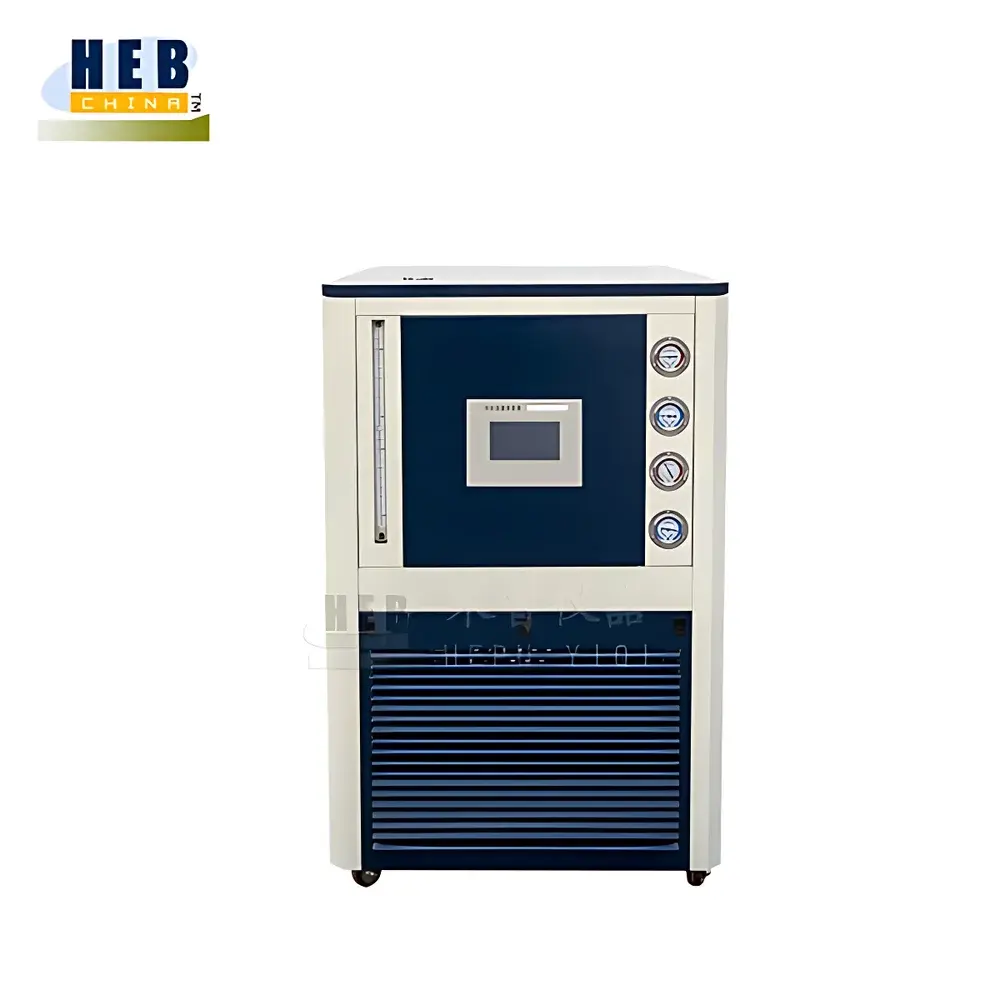
English Product Name
| Brand | Jihepu |
|---|---|
| Origin | Shandong, China |
| Model | GDSZ-200/30 |
| Temperature Range | −30 °C to +200 °C |
| Ambient Operating Conditions | 5–35 °C, ≤70% RH |
| Power Supply | 3-phase 380 V / 50 Hz |
| Control Accuracy | ±0.1 °C |
| Sensor Type | PT100 |
| Total Power Consumption | 2215 W |
| Heating Power | 9000 W |
| Refrigerant | R22 |
| Circulation Pressure | ≤0.2 MPa |
| Pump Flow Rate | Not specified (standard industrial range) |
| External Port Size | 3/4″ BSP (6-point thread) |
| Cabinet Material | Cold-rolled steel with anti-corrosive epoxy coating |
| Dimensions (W×D×H) | 1420×1020×1700 mm (wooden crate) |
| Net Weight | Not specified |
| Volume of Packing | 2.47 m³ |
Overview
The Jihepu GDSZ-200/30 is a vertically configured high-low temperature circulating chiller engineered for precise thermal control in laboratory-scale chemical synthesis, material testing, and analytical instrumentation support. It operates on a dual-mode thermodynamic principle: mechanical compression refrigeration (using R22 refrigerant) for sub-ambient cooling, and resistive electric heating for elevated temperature maintenance—both integrated within a single closed-loop circulation architecture. Unlike simple water baths or immersion chillers, this unit delivers stable, programmable temperature regulation across a broad operational span (−30 °C to +200 °C), enabling seamless transition between exothermic and endothermic process conditions without equipment changeover. Its design conforms to fundamental safety and thermal management requirements for Class II laboratory equipment under IEC 61010-1, including overtemperature cutoff, phase-loss detection, compressor high-pressure protection, and delayed startup sequencing to prevent electrical surge.
Key Features
- Integrated dual-function system: independent yet coordinated refrigeration and heating circuits ensure rapid thermal response and minimal overshoot during setpoint transitions.
- Industrial-grade plate-type heat exchanger optimized for high thermal efficiency and long-term stability with silicone oil-based heat transfer fluids.
- Liquid crystal display with membrane keypad interface supports real-time monitoring of bath temperature, setpoint, pump status, and fault codes—including visual indicators for refrigerant pressure anomalies and heater open-circuit conditions.
- Robust circulation pump rated for continuous operation at ≤0.2 MPa backpressure; compatible with standard jacketed reactors, calorimeters, and spectroscopic sample cells via 3/4″ BSP external ports.
- Corrosion-resistant cold-rolled steel chassis with electrostatic epoxy powder coating ensures durability in humid or chemically exposed lab environments.
- Comprehensive safety architecture includes overcurrent protection, thermal cutout relays, phase sequence monitoring, and timed compressor restart delay to mitigate mechanical stress.
Sample Compatibility & Compliance
The GDSZ-200/30 is intended for use with non-volatile, non-flammable heat transfer media—primarily premium-grade methylphenyl silicone oil (e.g., Dow Corning PMX series)—which remains thermally stable across its full operating range. It is not rated for direct contact with aqueous solutions below 0 °C or organic solvents with low flash points. The unit complies with general-purpose laboratory equipment safety standards per IEC 61010-1:2010 and meets electromagnetic compatibility requirements under EN 61326-1. While not certified for cleanroom or GMP manufacturing environments, its sealed refrigeration circuit and traceable temperature control make it suitable for GLP-aligned research workflows where audit-ready documentation of thermal profiles is required.
Software & Data Management
This model operates via embedded firmware without proprietary PC software; however, the LCD interface supports manual logging of temperature setpoints and runtime duration. For integration into automated systems, optional analog (0–10 V or 4–20 mA) output signals are available upon request to interface with SCADA platforms or PLC-controlled reaction stations. All internal sensor readings—including PT100 resistance values and compressor duty cycles—are stored in volatile memory for diagnostic review. No data encryption, user access levels, or FDA 21 CFR Part 11-compliant electronic signature functionality is provided; users requiring regulatory-grade data integrity must implement external validation protocols and third-party acquisition hardware.
Applications
- Temperature-controlled batch synthesis in jacketed glass reactors (5–50 L capacity), particularly for Grignard reactions, polymerization initiations, and cryogenic lithiation steps.
- Thermal conditioning of HPLC column ovens, FTIR sample compartments, and XRD stage controllers where ±0.1 °C stability is critical for baseline reproducibility.
- Accelerated aging studies per ASTM D573 and ISO 188, utilizing sustained exposure at +125 °C or cyclic profiles between −20 °C and +85 °C.
- Calibration verification of secondary temperature sensors (thermocouples, RTDs) against NIST-traceable reference probes in metrology labs.
- Supporting vacuum distillation setups by maintaining condenser jacket temperatures well below dew point to maximize recovery yield.
FAQ
What heat transfer fluids are compatible with the GDSZ-200/30?
Only high-purity, low-volatility silicone oils meeting ASTM D4672 specifications are recommended. Water-glycol mixtures are prohibited below 0 °C due to freezing risk and corrosion potential.
Can this unit be used for continuous operation at +200 °C?
Yes, provided ambient conditions remain within 5–35 °C and relative humidity does not exceed 70%. Sustained operation above +180 °C requires periodic inspection of gasket integrity and thermal insulation performance.
Is remote monitoring or Ethernet connectivity supported?
No native network interface is included. Integration with building management systems requires external analog signal converters and custom configuration.
Does the unit include a built-in calibration certificate?
Factory calibration is performed using traceable PT100 references, but formal calibration documentation (e.g., ISO/IEC 17025) must be requested separately and incurs additional lead time and cost.
What maintenance intervals are recommended for the refrigeration system?
Compressor oil and refrigerant charge should be verified annually by qualified service personnel. Condenser coil cleaning is advised every six months in dusty environments to maintain heat rejection efficiency.



