
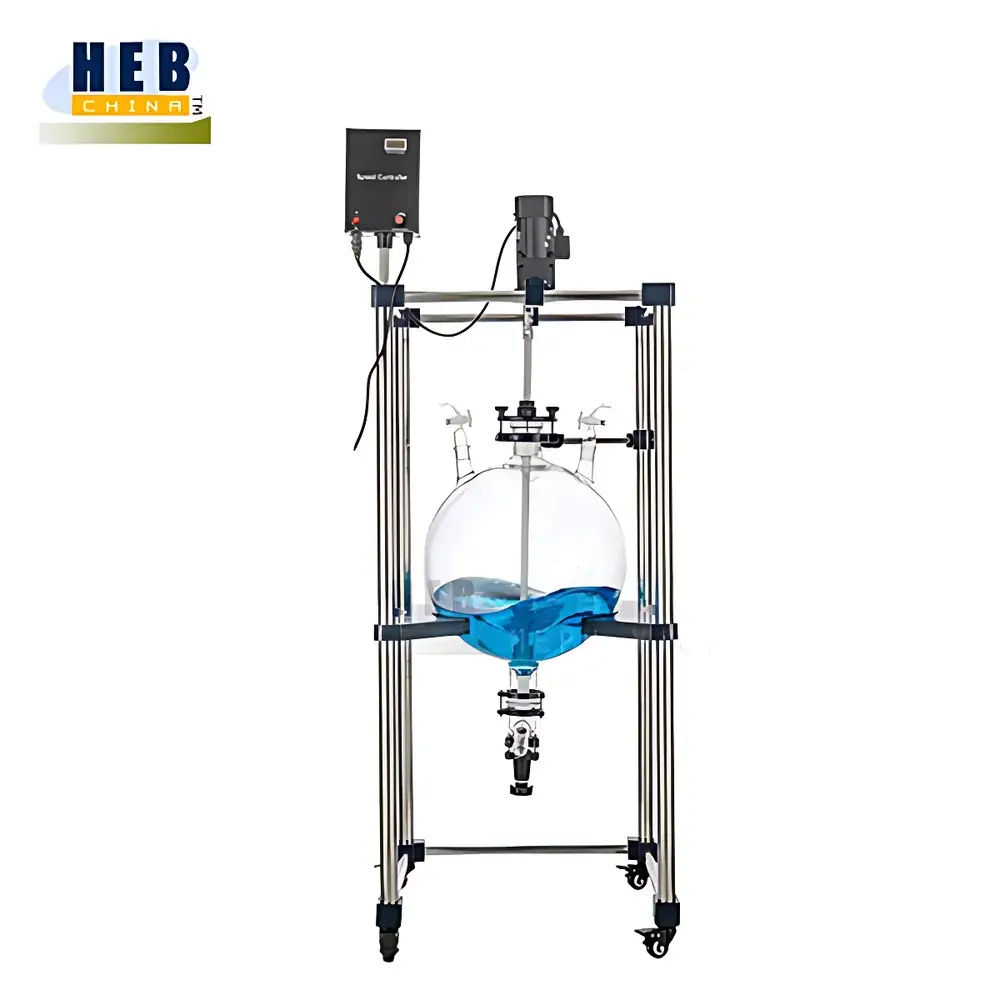
Brookfield FY-10L Spherical Glass Separatory Funnel with Integrated Stirring & Vacuum System
| Brand | Jihepu (Jinan Hepu) |
|---|---|
| Origin | Shandong, China |
| Model | FY-10L |
| Capacity | 10 L |
| Vessel Shape | Spherical |
| Construction Material | Borosilicate Glass 3.3 (DIN ISO 3585) + PTFE-sealed Components |
| Working Pressure Range | Atmospheric to Vacuum (Max Vacuum: −0.098 MPa / ~20 mbar abs) |
| Stirring Motor | 90 W, DC Brushless, 0–450 rpm, Digital Speed Display, Electronic Stepless Control |
| Stirring Shaft | 304 Stainless Steel Core with Full PTFE Sleeve |
| Impeller | Crescent-shaped, PTFE-coated 304 SS blades (150 mm span, 600 mm total length) |
| Sealing | Mechanical Seal with Ceramic Bearing |
| Inlet/Outlet Ports | Four standard 34/40 ground-glass joints (addition, vacuum, vent, sampling) |
| Frame | Aluminum Alloy + 304 Stainless Steel support structure |
| Mobility | Four swivel casters with locking brakes |
| Safety | Integrated thermal fuse protection |
| Overall Dimensions (W×D×H) | 530 × 440 × 1550 mm |
| Net Weight | 30 kg |
| Shipping Volume | 0.4 m³ (Wooden Crate) |
| Compliance | Designed for GLP-compliant lab-scale liquid–liquid extraction, phase separation, and batch reaction monitoring under reduced pressure. |
Overview
The Jihepu FY-10L Spherical Glass Separatory Funnel is an integrated laboratory reactor system engineered for controlled liquid–liquid extraction, density-based phase separation, and small-batch chemical synthesis under ambient or reduced-pressure conditions. Unlike conventional static separatory funnels, this unit combines a spherical borosilicate glass vessel (DIN ISO 3585 compliant, expansion coefficient α = 3.3 × 10⁻⁶ K⁻¹) with a motor-driven, low-shear stirring mechanism and vacuum-capable sealing architecture. Its spherical geometry enhances mixing homogeneity and minimizes dead volume during settling, while the angled side-discharge outlet enables precise, residue-free layer-by-layer withdrawal without disturbing the interfacial boundary. The system operates within a safe working pressure range from atmospheric (101.3 kPa) down to −0.098 MPa (equivalent to ~20 mbar absolute), supporting solvent removal, degassing, and moisture-sensitive reactions. All wetted surfaces consist exclusively of high-purity borosilicate glass and virgin PTFE—materials certified for chemical inertness across pH 0–14 and compatible with common organic solvents (e.g., chloroform, ethyl acetate, THF, DCM) and aqueous reagents.
Key Features
- Spherical 10 L borosilicate glass vessel (Φ280 mm) with four standardized 34/40 ground-glass joints: addition port, vacuum port, vent port, and sampling port—ensuring modular connectivity with condensers, drying tubes, or pressure sensors.
- PTFE-lined, ceramic-bearing mechanical seal and low-speed, high-torque DC motor (90 W) delivering 0–450 rpm with digital speed readout and smooth electronic stepless regulation—optimized for gentle emulsification and post-reaction homogenization.
- Crescent-shaped impeller (150 mm blade span, 600 mm shaft length) fabricated from 304 stainless steel with full PTFE cladding—eliminating metal ion leaching and enabling corrosion resistance in halogenated and acidic media.
- Side-mounted, glass-PTFE composite discharge valve with Φ34 mm bayonet-style outlet (OD 12 mm) positioned 350 mm above floor level—facilitating gravity-fed transfer into receiving flasks without tilting or manual siphoning.
- Modular aluminum–stainless steel frame with lockable omnidirectional casters—supporting rapid repositioning within fume hoods or between synthesis stations while maintaining structural rigidity under vacuum load.
- Integrated thermal fuse circuit protection and IP20-rated electrical enclosure—meeting IEC 61010-1 requirements for laboratory electrical safety.
Sample Compatibility & Compliance
The FY-10L is validated for use with immiscible liquid systems exhibiting distinct density differentials (Δρ ≥ 0.1 g/cm³), including but not limited to aqueous–organic extractions (e.g., acid/base workups per USP residual solvents protocols), catalyst recovery suspensions, and polymer solution fractionation. Its all-glass/PTFE fluid path eliminates adsorption artifacts and ensures trace-metal-free operation—critical for ICP-MS sample prep and pharmaceutical intermediate isolation. While not certified to ASTM E2500 or ISO 13485 out-of-box, the design conforms to fundamental principles of GLP Annex 3 (OECD) for equipment qualification: material traceability (glass batch certificates available upon request), calibration-ready interfaces (speed sensor output, optional vacuum gauge port), and audit-trail-capable operation logs when paired with external data acquisition modules.
Software & Data Management
This is a manually operated, stand-alone instrument with no embedded microcontroller or proprietary software. Speed setpoint and real-time RPM are displayed via a front-panel LED module; vacuum level must be monitored externally using a calibrated digital manometer (e.g., MKS Baratron series). For regulated environments requiring 21 CFR Part 11 compliance, users may integrate the unit into a validated SCADA or LIMS ecosystem via analog 4–20 mA outputs (optional retrofit) or digital RS-485 Modbus RTU interface (available as OEM add-on). All mechanical adjustments—including stirrer height, valve actuation torque, and joint lubrication intervals—are documented in the bilingual (EN/CN) Operation & Maintenance Manual, which includes preventive maintenance schedules aligned with ISO/IEC 17025 clause 6.4.10.
Applications
- Multi-stage liquid–liquid extraction of natural product isolates (e.g., alkaloid purification from plant extracts using CHCl₃/H₂O systems).
- In situ monitoring of biphasic Heck or Suzuki couplings under nitrogen/vacuum, followed by immediate phase separation without reactor transfer.
- Preparative-scale isolation of hydrophilic peptides from TFA cleavage mixtures using EtOAc/water partitioning.
- Removal of residual solvents from API intermediates via simultaneous stirring and vacuum application—reducing hold time versus rotary evaporation alone.
- Teaching laboratory demonstration of interfacial tension effects, coalescence kinetics, and Stokes’ law sedimentation behavior in model emulsions.
FAQ
Is the FY-10L suitable for exothermic reactions under reflux?
Yes—when coupled with a jacketed condenser on the 34/40 addition port and operated below its maximum vacuum rating, it supports controlled reflux at ≤80 °C with common low-boiling solvents. Thermal mass of the spherical glass body provides inherent buffering against thermal shock.
Can the stirring system handle viscous solutions (>1000 mPa·s)?
It is rated for Newtonian fluids up to ~2500 mPa·s at 100 rpm; for non-Newtonian or particle-laden slurries, we recommend verifying torque margin using the supplied calibration curve (provided in Appendix B of the manual).
What validation documentation accompanies the unit?
Each shipment includes a Certificate of Conformance (CoC), borosilicate glass material test report (per DIN 7080), and PTFE lot traceability sheet. IQ/OQ protocol templates are available upon request for GMP-aligned installations.
Is replacement glassware available as spare parts?
Yes—vessel bodies, ground-glass joints, and custom-machined PTFE stopcocks are stocked with 4-week lead time; all components carry individual serial-numbered traceability.
Does the unit meet CE or UKCA marking requirements?
It complies with the essential health and safety requirements of the EU Machinery Directive 2006/42/EC and Low Voltage Directive 2014/35/EU when installed per Section 5.2 of the manual; CE marking is applied post-installation verification by authorized EU representatives.



