
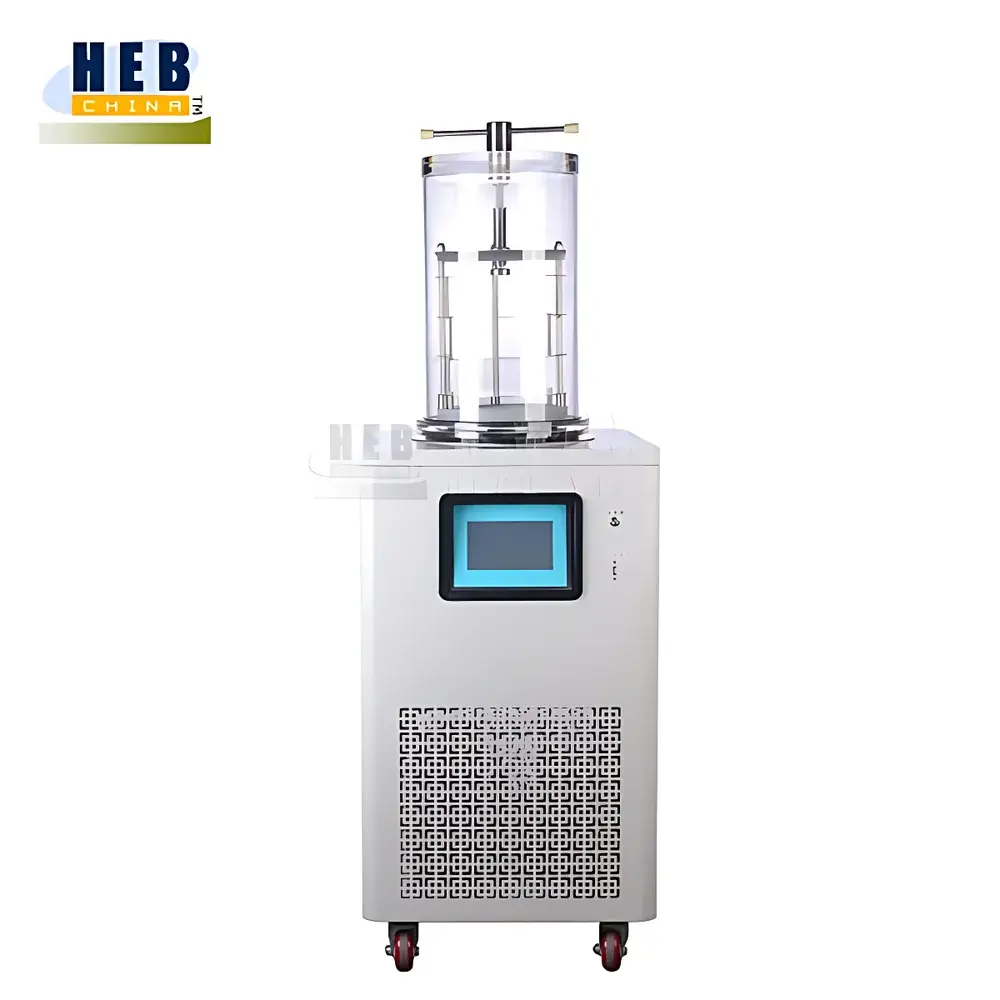
ZLGJ-18 Benchtop Stoppering Vacuum Freeze Dryer
| Brand | Jihepu (Jinan Hepu) |
|---|---|
| Origin | Shandong, China |
| Model | ZLGJ-18 |
| Instrument Type | Stoppering Freeze Dryer |
| Application | Laboratory-Scale Lyophilization |
| Shelf Area | 0.09 m² |
| Ultimate Vacuum | <5 Pa |
| Condenser Temperature | −55 °C (standard), optional −80 °C |
| Water Capture Capacity | 6 kg/24 h |
| Dimensions (W×D×H) | 560 × 560 × 980 mm |
| Weight | 88 kg |
| Cooling Method | Air-Cooled |
| Power Supply | 220 V ±10%, 50 Hz, 1100 W |
| Ambient Operating Conditions | 10–30 °C, RH ≤70%, non-corrosive/non-explosive environment |
Overview
The ZLGJ-18 Benchtop Stoppering Vacuum Freeze Dryer is an integrated, compact lyophilization system engineered for precise, reproducible freeze-drying of heat-sensitive biologicals, pharmaceuticals, and research samples in regulated laboratory environments. It operates on the fundamental principle of sublimation—removing water from frozen samples under deep vacuum while maintaining product integrity through controlled thermal management. Unlike shelf-only systems, the ZLGJ-18 incorporates a built-in hydraulic or pneumatic stoppering mechanism that enables sterile, in-chamber sealing of vials post-drying—critical for maintaining sterility and moisture barrier integrity during storage and transport. Its all-stainless-steel condenser chamber and tray structure ensure corrosion resistance and compliance with cleaning validation requirements. The unit features an air-cooled, high-efficiency compressor and a dedicated high-flow vacuum pump (4 L/s pumping speed), enabling rapid evacuation to <5 Pa and stable operation across extended cycles.
Key Features
- Integrated stoppering function: Fully automated vial sealing inside the drying chamber without exposure to ambient air—eliminates secondary handling and supports aseptic workflow continuity.
- Patented gas flow distribution design: Ensures uniform ice deposition across the entire condenser surface, maximizing capture efficiency and minimizing re-deposition risk during primary drying.
- Large-diameter, coil-free condenser: Facilitates rapid pre-freezing of samples directly on shelves—no external ultra-low temperature freezer required—and simplifies cleaning and maintenance.
- Industrial-grade 7-inch color touchscreen interface with SH-HPSC-II modular controller: Delivers high-resolution process control, real-time parameter monitoring, and intuitive navigation for multi-user environments.
- Comprehensive data logging: Records and stores time-stamped curves for condenser temperature, shelf temperature (via optional PT100 probe), chamber pressure, and elapsed cycle time; data exportable via USB in CSV format for audit-ready documentation.
- Vacuum pump protection logic: Automatically delays pump activation until condenser reaches target temperature (e.g., −45 °C), preventing oil contamination and extending pump service life.
- Multi-level user access control: Configurable operator, technician, and administrator roles with password authentication and activity logging—aligned with GLP and basic GMP traceability expectations.
- Onboard sensor calibration utility: Supports field verification and adjustment of temperature and pressure transducers to maintain long-term measurement fidelity per ISO/IEC 17025 metrological practices.
Sample Compatibility & Compliance
The ZLGJ-18 accommodates standard pharmaceutical vials (e.g., 12 mm, 16 mm, and 22 mm diameter) on three removable stainless steel trays (Φ200 mm), supporting up to 990, 555, or 360 units respectively. Its inert wetted-path materials—including 304 stainless steel shelves, condenser, and chamber housing—meet USP Class VI biocompatibility criteria and are compatible with common sterilization methods (e.g., vaporized hydrogen peroxide). While not certified to FDA 21 CFR Part 11 out-of-the-box, the system’s audit trail functionality (user login events, parameter change logs, and timestamped curve exports) provides foundational support for GLP-compliant studies and internal quality assurance protocols. All electrical components conform to IEC 61010-1 safety standards for laboratory equipment.
Software & Data Management
The embedded SH-HPSC-II controller firmware supports full-cycle programmability—including ramp-hold profiles for shelf temperature, pressure-controlled drying steps, and automatic end-point detection based on pressure rise test (PRT) logic. Process data is stored internally with ≥30-day retention and exported as timestamped CSV files for integration into LIMS or electronic lab notebooks (ELN). No proprietary software installation is required: raw data files open natively in Excel or Python/Pandas for statistical analysis. Optional Ethernet or RS485 interfaces enable remote monitoring via SCADA-compatible platforms—subject to site-specific network security policies.
Applications
This system is routinely deployed in academic research labs for stabilizing enzymes, antibodies, plasmid DNA, and microbial cultures; in QC/QA departments for stability testing of excipient formulations and reference standards; and in early-stage biopharma development for small-batch lyophilization of clinical trial materials. Its stoppering capability makes it especially suitable for preparing sterile, ready-to-reconstitute vials of diagnostic reagents, vaccine candidates, and cell therapy intermediates where post-drying exposure must be minimized. The −55 °C condenser (upgradable to −80 °C) ensures efficient removal of volatile solvents beyond water—such as tert-butanol or acetonitrile—in specialized formulation workflows.
FAQ
Does the ZLGJ-18 support validation protocols such as IQ/OQ?
Yes—documentation packages including FAT/SAT checklists, calibration certificates for included sensors, and electrical safety test reports can be provided upon request to support installation and operational qualification.
Can shelf temperature be monitored during drying?
Standard configuration includes condenser and chamber pressure sensors; optional PT100 shelf temperature probes are available for direct product temperature monitoring and cycle optimization.
Is the system compatible with organic solvent drying?
With the −80 °C condenser option and appropriate pump oil selection, the unit can safely handle low-boiling-point solvents—consult technical specifications for maximum allowable concentration limits.
What maintenance intervals are recommended?
Vacuum pump oil replacement every 500 operating hours; condenser cleaning after each batch if visible ice buildup occurs; annual verification of temperature and pressure sensor accuracy using NIST-traceable references.
Related Products



