
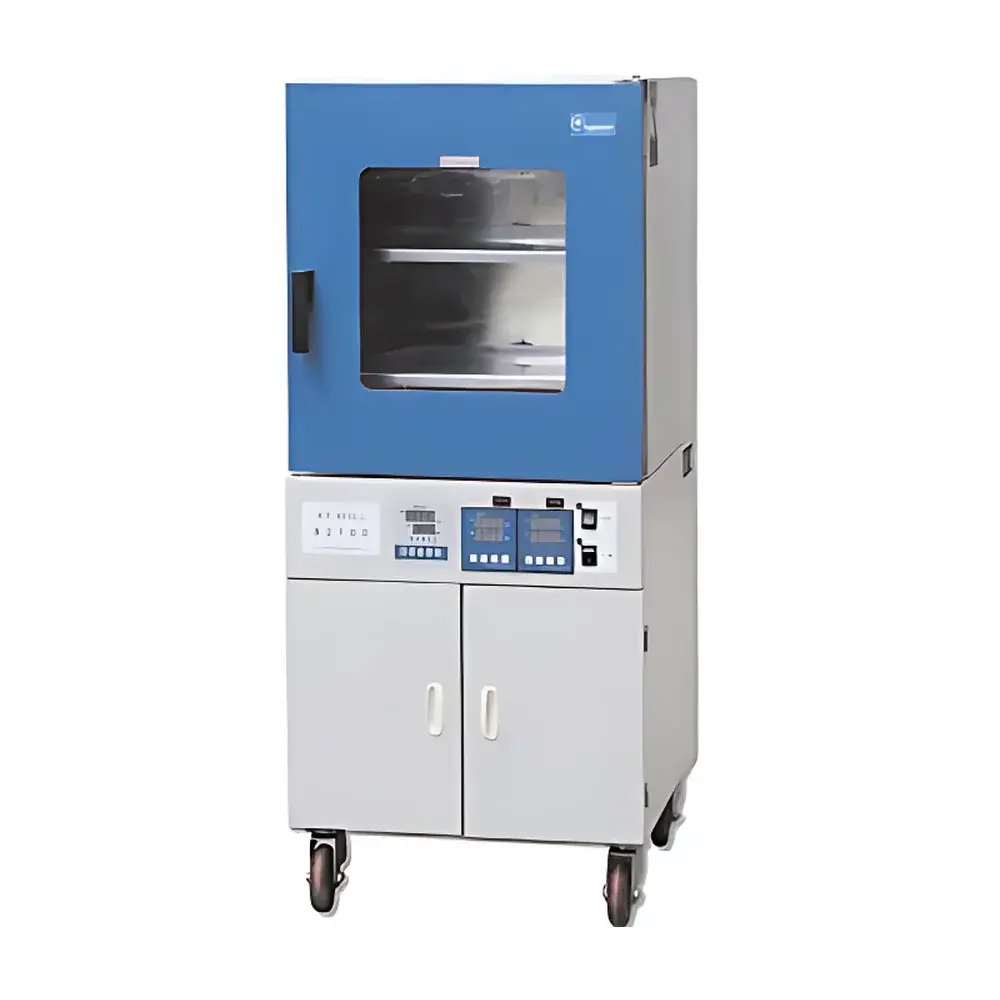
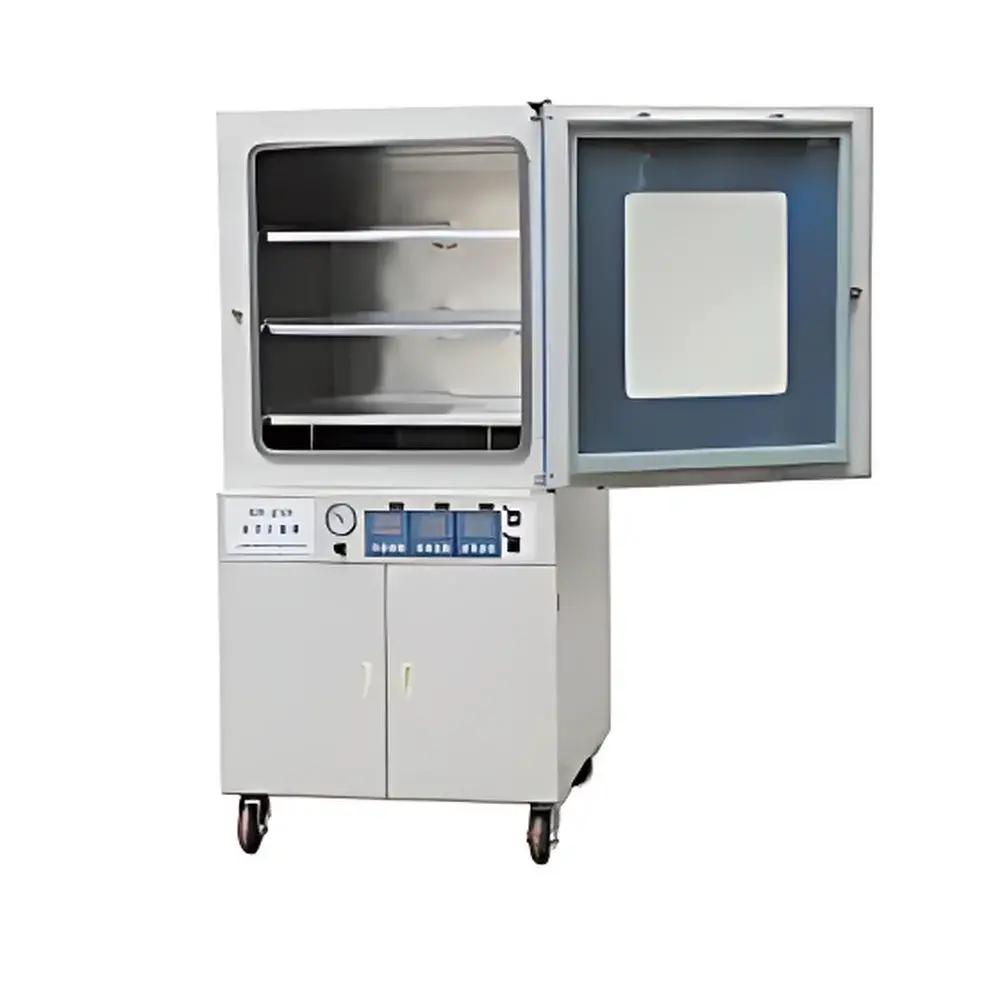
HePu DZF-6210 Vacuum Drying Oven
| [Brand | HePu |
|---|---|
| Origin | Shandong, China |
| Model | DZF-6210 |
| Type | Vacuum Oven |
| Temperature Range | +10 °C to 250 °C |
| Temperature Uniformity | ±1 °C |
| Chamber Dimensions (W×D×H) | 560 × 600 × 640 mm |
| External Dimensions (W×D×H) | 720 × 805 × 1680 mm |
| Chamber Material | Stainless Steel (AISI 304 equivalent, 1Gr18Ni9Ti) |
| Heating Method | Electric Resistive Heating |
| Ultimate Vacuum | <133 Pa |
| Power Supply | 220 V, 50 Hz |
| Input Power | 1450 W |
| Timer Range | 1–9999 min |
| Shelf Quantity | 3 adjustable stainless steel shelves] |
Overview
The HePu DZF-6210 Vacuum Drying Oven is an engineered solution for controlled, low-pressure thermal processing of moisture-sensitive, thermally labile, or oxidation-prone materials. Operating on the principle of vacuum-assisted evaporation—where reduced ambient pressure lowers the boiling point of solvents and water—the unit enables gentle drying at lower temperatures than atmospheric ovens, minimizing degradation of active pharmaceutical ingredients (APIs), polymers, electronic components, catalysts, and botanical extracts. Its design conforms to fundamental requirements for stability-indicating drying protocols in R&D and QC laboratories, particularly where residual solvent removal, moisture content validation (per USP & ISO 8573), or inert-atmosphere conditioning is required.
Key Features
- Precision microprocessor-based temperature controller with 0.1 °C resolution and programmable 10-segment ramp-soak profiles (D-series intelligent controller), supporting reproducible thermal cycles across batches.
- Robust stainless steel (1Gr18Ni9Ti) chamber construction ensures long-term corrosion resistance, mechanical integrity under repeated vacuum cycling, and compliance with cleanroom-compatible surface finish standards (Ra ≤ 0.8 µm).
- Double-layer tempered glass observation door with argon-filled interlayer provides real-time visual monitoring while maintaining structural safety and thermal insulation—critical during vacuum transitions and high-temperature holds.
- Adjustable door sealing mechanism with integrally molded silicone gasket delivers consistent vacuum integrity; validated leak rate ≤ 5 Pa·min⁻¹ under steady-state conditions at 100 Pa absolute pressure.
- Independent temperature control for each of three removable stainless steel shelves enables multi-sample parallel processing with differential thermal setpoints—supporting comparative drying studies or mixed-load workflows.
- Integrated vacuum interface (KF-25 or ISO-KF compatible) allows direct connection to oil-free diaphragm or dual-stage rotary vane pumps; vacuum level can be monitored optionally via external digital gauges (not included in base configuration).
Sample Compatibility & Compliance
The DZF-6210 accommodates a broad spectrum of sample formats—including glass vials, aluminum trays, ceramic crucibles, and polymer-coated substrates—without risk of cross-contamination or outgassing-induced contamination. Its operating envelope (+10 °C to 250 °C, <133 Pa) supports applications aligned with ASTM E145 (Standard Specification for Gravity-Convection and Forced-Ventilation Ovens), ISO 12099 (Animal feeding stuffs — Vocabulary and general requirements for analytical methods), and ICH Q5C (Stability Testing of Biotechnological/Biological Products). While not inherently 21 CFR Part 11 compliant, audit-ready data logging (via optional RS485/Modbus output or USB data export) facilitates integration into GLP/GMP environments when paired with validated third-party software platforms.
Software & Data Management
The embedded D-series controller logs time-stamped temperature and vacuum status (when externally interfaced) to internal non-volatile memory. Raw data export is supported via USB flash drive in CSV format, enabling traceable post-processing in Excel or LIMS-compatible tools. Optional communication modules enable remote parameter setting, real-time monitoring, and alarm relay outputs—facilitating centralized lab equipment management systems. All firmware revisions undergo functional verification per IEC 62304 Class B software lifecycle requirements.
Applications
- Pharmaceutical: Residual solvent removal from lyophilized intermediates, moisture determination in excipients (USP & EP methods), and stability testing under accelerated aging protocols.
- Electronics: Degassing of encapsulants prior to potting, desiccation of PCB assemblies pre-conformal coating, and oxide layer preservation on thin-film sensors.
- Materials Science: Solvent exchange in aerogel synthesis, binder burnout in ceramic green bodies, and thermal conditioning of battery electrode coatings.
- Academic Research: Controlled dehydration of biological tissues for SEM preparation, low-temperature drying of nanomaterial dispersions, and inert-gas purging of hygroscopic catalysts.
FAQ
Does the DZF-6210 include a built-in vacuum pump?
No—the DZF-6210 is supplied as a vacuum chamber only. A compatible vacuum pump must be selected and installed separately based on required ultimate pressure, pumping speed, and chemical compatibility with process vapors.
What vacuum gauge options are recommended for accurate pressure monitoring?
For general-purpose operation down to 100 Pa, a Pirani gauge is sufficient; for sub-10 Pa measurements or corrosive vapor environments, a capacitance manometer or cold cathode gauge is advised.
Can the chamber be purged with nitrogen or argon before evacuation?
Yes—the unit features a dedicated inert gas inlet port (M8 × 0.75 thread) allowing manual or automated gas purging sequences to displace oxygen prior to vacuum initiation.
Is the stainless steel chamber electropolished or passivated?
The chamber is fabricated from 1Gr18Ni9Ti stainless steel and undergoes standard acid passivation per ASTM A967 to enhance corrosion resistance and reduce particle shedding.
What is the maximum allowable load weight per shelf?
Each shelf is rated for 15 kg distributed load; total chamber load capacity is limited by thermal uniformity constraints—not mechanical strength—and should not exceed 45 kg for optimal temperature homogeneity.



