
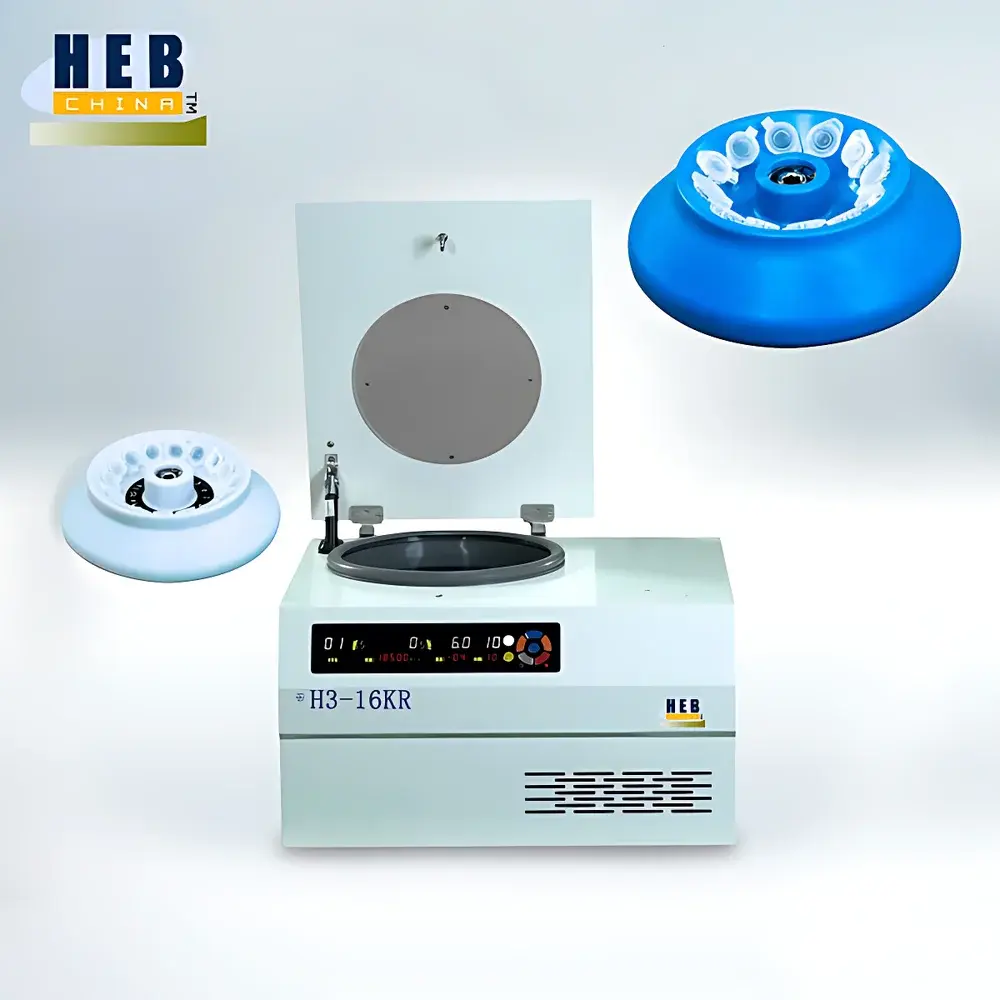
Hebei H3-16KR Benchtop High-Speed Refrigerated Centrifuge
| Brand | Hebei (Jihepu) |
|---|---|
| Origin | Shandong, China |
| Model | H3-16KR |
| Instrument Type | Benchtop Centrifuge |
| Speed Range | 10,000–30,000 rpm (Max. 16,500 rpm) |
| Max. RCF | 18,757 × g |
| Max. Capacity | 6 × 50 mL |
| Temperature Range | –20 °C to +40 °C |
| Temp. Stability | ±1.0 °C |
| Timer | 1–99 min |
| Acceleration/Deceleration | 10 selectable ramps (Ramp 9: free deceleration >540 s) |
| Power Supply | AC 220 V ±10%, 50 Hz, 15 A |
| Total Power | 800 W |
| Noise Level | ≤65 dB(A) |
| Dimensions (W×D×H) | 480 × 560 × 360 mm |
| Net Weight | 70 kg |
| Rotor Auto-ID | Yes |
| Safety Features | Lid interlock, overspeed protection, imbalance detection, rotor recognition |
Overview
The Hebei H3-16KR is a precision-engineered benchtop high-speed refrigerated centrifuge designed for reproducible separation of biological macromolecules—including nucleic acids, proteins, subcellular organelles, and viral particles—under controlled thermal conditions. It operates on the principle of sedimentation equilibrium and rate-zonal centrifugation, leveraging high angular velocity to generate substantial relative centrifugal force (RCF) while maintaining sample integrity through active refrigeration. Its compact footprint (480 × 560 × 360 mm) and modular rotor compatibility make it suitable for shared laboratory environments where space efficiency, thermal stability, and operational safety are critical. The unit complies with IEC 61010-1:2010 for laboratory electrical equipment safety and incorporates design elements aligned with GLP-compliant workflows, including audit-ready parameter logging and hardware-enforced safety interlocks.
Key Features
- High-torque brushless frequency-controlled motor enabling rapid acceleration (540 s) for delicate gradient separations.
- Intelligent rotor identification system: automatically detects installed rotor type (e.g., angle rotors for 6 × 50 mL conical tubes or 24 × 1.5 mL microtubes) and enforces speed/RCF limits per ISO 15197-defined rotor certification data.
- Integrated high-efficiency eco-refrigeration system using R134a refrigerant; maintains chamber temperature at ≤–4 °C even at maximum rotational speed (16,500 rpm), with user-selectable pre-cooling function (–20 °C to +40 °C range).
- Multi-parameter digital interface with color LED display: supports simultaneous real-time monitoring of speed (rpm), RCF (×g), time remaining, chamber temperature, and acceleration/deceleration status; enables one-touch rpm/RCF conversion.
- Comprehensive mechanical and electronic safety architecture: lid interlock switch, dynamic imbalance detection (sensitive to ≥1 g mass asymmetry), overspeed cutoff, and automatic rotor life tracking based on cumulative run hours and max-speed cycles.
- Low-noise operation (≤65 dB[A] at 1 m distance) achieved via balanced rotor housing, vibration-damping feet, and aerodynamically optimized chamber geometry—critical for open-bench placement in QC labs and core facilities.
Sample Compatibility & Compliance
The H3-16KR accommodates standard laboratory consumables across multiple formats: conical 50 mL tubes (round-bottom and pointed-bottom), microcentrifuge tubes (1.5–2.2 mL), 5–10 mL screw-cap tubes, and 2 × 48-well microplate carriers. All certified rotors meet ISO 21501-4 particle size calibration traceability requirements when used with appropriate reference standards. The instrument supports method validation under CLIA, CAP, and ISO/IEC 17025 frameworks, and its parameter lockout mode (via password-protected setup menu) satisfies basic FDA 21 CFR Part 11 requirements for electronic record integrity in regulated bioanalytical environments.
Software & Data Management
While the H3-16KR operates as a standalone instrument with embedded firmware, it features non-volatile memory capable of storing up to 100 user-defined protocols—including speed, temperature, time, and ramp profiles—with timestamped execution logs. Optional RS-232 or USB-to-serial interface (available via accessory module) enables integration with LIMS or ELN systems for automated protocol transfer and result archiving. All stored methods include rotor-specific RCF validation flags and temperature deviation alerts, facilitating internal audit readiness and routine maintenance documentation per ISO 13485 quality management standards.
Applications
- Clinical diagnostics: plasma/serum separation, PBMC isolation, exosome pelleting (≥100,000 × g equivalent via sequential runs).
- Molecular biology: plasmid DNA purification, RNA precipitation, column-based cleanup post-centrifugation.
- Proteomics: membrane protein extraction, organelle fractionation (mitochondria, lysosomes), immunoprecipitation pellet concentration.
- Virology: virus harvesting from cell culture supernatants, density gradient ultracentrifugation prep (in combination with swing-out rotors).
- Quality control: particulate matter analysis in injectables, stability testing of colloidal formulations, vaccine antigen clarification.
FAQ
What is the maximum allowable imbalance tolerance during operation?
The system detects and halts rotation if mass asymmetry exceeds ±1 g between opposing tube positions—verified per ISO 15197 Annex B test procedures.
Does the centrifuge support continuous operation at –20 °C?
No. The –20 °C setting is for pre-cooling only; sustained operation below –4 °C at high speeds is thermodynamically constrained by motor heat dissipation and refrigerant capacity.
Can third-party rotors be used safely with this model?
Only rotors bearing official Hebei/Jihepu part numbers and certified for H3-16KR are recognized by the auto-ID system; unauthorized rotors will not spin and trigger error code E07.
Is remote monitoring or control possible?
Not natively; however, optional serial communication modules enable external triggering and status polling via ASCII command set (AT-style protocol), compatible with LabVIEW and Python-based automation scripts.
How often should the refrigeration system be serviced?
Annual preventive maintenance is recommended, including refrigerant pressure check, condenser coil cleaning, and compressor oil inspection—per ISO 5171 guidelines for laboratory refrigeration units.



