
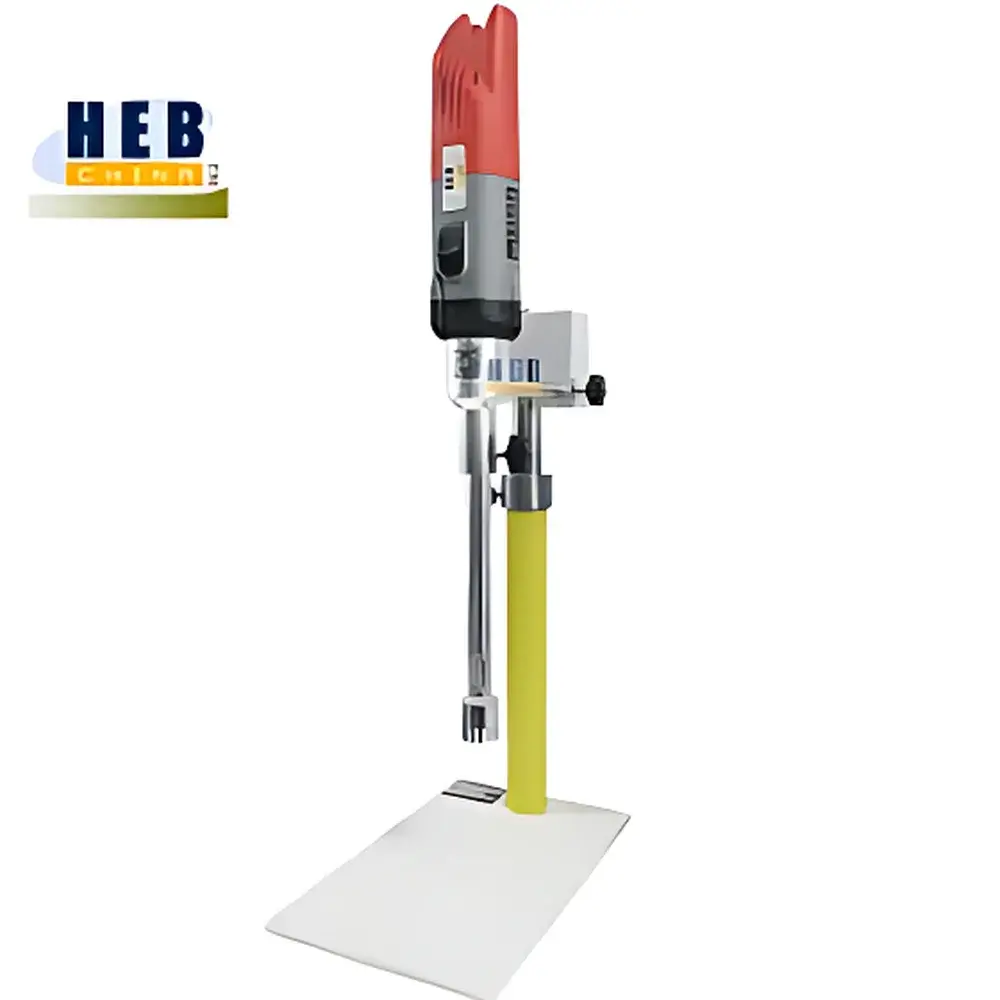
JIHEPU A30 Advanced High-Shear Dispersing & Homogenizing System
| Brand | JIHEPU |
|---|---|
| Model | A30 |
| Type | Probe-type Rotor-Stator Homogenizer |
| Power Supply | 220 V / 50 Hz |
| Motor Power | 850 W (Germany-sourced high-speed motor) |
| Speed Range | 10,000–30,000 rpm |
| Tip Speed | Up to 27 m/s |
| Processing Volume | 500–10,000 mL (H₂O) |
| Max. Viscosity | 30,000 cP |
| Dimensions (W×D×H) | 300 × 200 × 700 mm |
| Net Weight | 8 kg |
| Ambient Temp. | 5–40 °C |
| Relative Humidity | ≤80% |
| Contact Material | SUS316L stainless steel |
| Shaft Sleeve Material | PTFE |
| Compliance | GMP-compliant design for pharmaceutical and biotech applications |
| Standard Probe | 30BC (500–10,000 mL capacity) |
| Optional Probes | 18 interchangeable rotor-stator heads for open/closed, atmospheric/vacuum, or pressurized vessels |
| Safety Features | Overload protection, dual-insulation housing, anti-fall automatic lift mechanism (A30S variant) |
| Display Options | Analog scale (standard) |
Overview
The JIHEPU A30 Advanced High-Shear Dispersing & Homogenizing System is an engineered solution for laboratory-scale batch processing of complex fluid systems requiring controlled mechanical energy input. Based on the proven rotor-stator principle—where a high-speed rotating element (rotor) shears material against a stationary, precisely machined stator—the A30 generates intense hydrodynamic forces including cavitation, turbulent flow, and extensional stress. These mechanisms enable effective particle size reduction, emulsion stabilization, cell disruption, and deagglomeration across diverse formulations. Designed for reproducibility in regulated environments, the system supports process development workflows aligned with ISO 20988 (biological safety), USP (particulate matter in injections), and ICH Q5A (viral clearance validation). Its modular architecture allows method transfer from lab to pilot scale while maintaining consistent shear history per unit volume.
Key Features
- Germany-sourced high-efficiency brushless motor rated for continuous operation ≥4 hours at full load, ensuring thermal stability and minimal speed drift under viscous loads
- Electronically controlled infinitely variable speed regulation (10,000–30,000 rpm), delivering tip speeds up to 27 m/s for scalable shear intensity control
- GMP-compliant wetted parts constructed entirely from electropolished SUS316L stainless steel and FDA-listed PTFE, supporting clean-in-place (CIP) compatibility and residue-free sterilization
- Modular probe system with 18 interchangeable rotor-stator geometries—including conical, flat-bottom, and vacuum-rated configurations—to match rheological behavior and containment requirements
- Integrated anti-fall automatic lifting column (A30S variant) with mechanical lock and vibration-dampened guidance rails, eliminating operator-induced probe misalignment or vessel impact
- Dual-layer electrical insulation and thermal overload cutoff meeting IEC 61000-6-2/6-4 EMC standards for laboratory electromagnetic compatibility
Sample Compatibility & Compliance
The A30 accommodates aqueous, organic, and biphasic systems ranging from low-viscosity buffers (e.g., PBS, Tris-HCl) to high-yield pseudoplastic suspensions (e.g., pigment pastes, coal-water slurries). It has been validated for use in vaccine adjuvant preparation (alum, MF59 analogues), lipid nanoparticle (LNP) formulation, microbial cell lysis (E. coli, yeast), and topical emulsion development (O/W, W/O, microemulsions). All contact surfaces comply with ASME BPE-2022 surface finish specifications (Ra ≤ 0.4 µm) and are fully traceable per ISO 13485 manufacturing records. The system supports audit-ready documentation packages required for GLP/GMP environments, including calibration logs, maintenance history, and IQ/OQ protocols.
Software & Data Management
While the base A30 operates via analog speed control, the optional A30-Digital module provides a validated data acquisition interface compliant with FDA 21 CFR Part 11 requirements. This includes electronic signature capability, audit-trail-enabled rpm logging, time-stamped temperature monitoring (±0.5 °C accuracy), and user-defined timer presets with auto-shutdown. Data export is supported via USB 2.0 to CSV format for integration into LIMS or ELN platforms. Firmware updates are digitally signed and version-controlled, ensuring configuration integrity during regulatory inspections.
Applications
- Pharmaceutical: Liposome extrusion pre-treatment, nanoemulsion pre-homogenization, protein aggregate dispersion, sterile filtration support
- Biotechnology: Mammalian and bacterial cell disruption for intracellular protein recovery, chromatin shearing for ChIP-seq sample prep
- Food & Beverage: Yogurt stabilizer dispersion, juice cloud suspension, flavor oil emulsification
- Materials Science: Carbon nanotube de-bundling in polymer matrices, ceramic slurry homogenization for tape casting
- Agrochemicals: Suspension concentrate (SC) formulation, pesticide microencapsulation matrix dispersion
- Cosmetics: Silicone emulsion stabilization, pigment dispersion in foundation bases, hyaluronic acid gel homogenization
FAQ
What is the maximum recommended operating time before maintenance?
Continuous operation up to 4 hours is validated; however, routine inspection of rotor-stator clearance and bearing preload is advised after every 200 operational hours.
Can the A30 be used under vacuum or inert gas?
Yes—select probe variants (e.g., A30-VAC series) feature hermetic sealing and pressure-rated shaft seals compatible with ≤–0.095 MPa vacuum or nitrogen-purged environments.
Is the digital module compliant with 21 CFR Part 11?
The A30-Digital firmware implements role-based access control, electronic signatures, and immutable audit trails—fully satisfying predicate rule requirements for electronic records in regulated labs.
How is probe wear monitored?
Each rotor-stator set includes a calibrated gap gauge; users perform periodic clearance checks using ISO 4287-compliant surface profilometry and replace components when measured radial runout exceeds 0.02 mm.
Does the system support third-party automation integration?
An RS-485 serial interface (optional) enables Modbus RTU communication for synchronized control within PLC-driven lab automation frameworks.



