
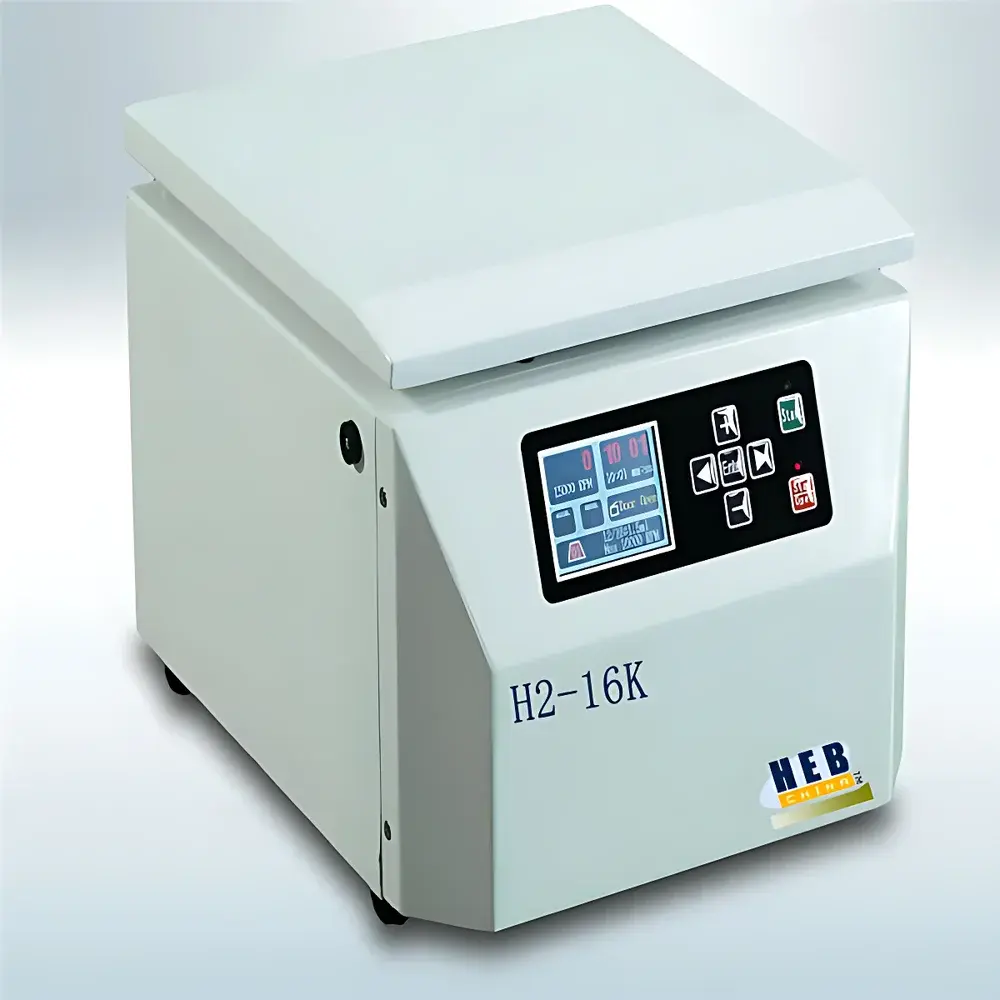
H2-16K Desktop High-Speed Centrifuge
| Brand | Jihepu (Jinan Hepu) |
|---|---|
| Origin | Shandong, China |
| Model | H2-16K |
| Type | Benchtop High-Speed Centrifuge |
| Max Speed | 16500 rpm |
| Max RCF | 18757 ×g |
| Max Capacity | 6 × 50 mL |
| Dimensions (W×D×H) | 400 × 300 × 330 mm |
| Noise Level | ≤60 dB(A) |
| Power Supply | AC 220 V ±10%, 50/60 Hz, 10 A |
| Total Power | 420 W |
| Net Weight | 23 kg |
| Rotor Compatibility | Fixed-angle rotors (e.g., 12×1.5/2.2 mL, 24×1.5/2.2 mL, 6×50 mL conical tubes) |
| Acceleration/Deceleration | 10 selectable profiles, including free-coast mode (>540 s) |
| Control | Microprocessor-based with variable-frequency drive |
| Safety | Electronic lid lock, overspeed protection, imbalance detection, automatic rotor recognition (via preset rotor codes) |
Overview
The H2-16K Desktop High-Speed Centrifuge is an engineered benchtop solution designed for reproducible, high-g centrifugation of biological macromolecules—including nucleic acids, proteins, subcellular organelles, and viral particles—in research, clinical, and quality control laboratories. Utilizing a brushless variable-frequency motor and microprocessor-based closed-loop speed control, the system delivers stable rotational dynamics across its full operating range (1,000–16,500 rpm), minimizing mechanical vibration and thermal drift. Its compact footprint (400 × 300 × 330 mm) and low acoustic signature (≤60 dB[A]) enable seamless integration into biosafety cabinets, shared core facilities, and teaching labs without compromising operational rigor or user comfort.
Key Features
- Microprocessor-controlled operation with real-time monitoring of speed, RCF, time, and acceleration/deceleration profiles.
- Intuitive color LED display with dual-unit readout—simultaneous rpm and ×g values—with one-touch conversion between rotational speed and relative centrifugal force.
- 10 programmable acceleration and deceleration ramps; Profile 9 enables extended free-coast braking (>540 s), critical for pelleting shear-sensitive complexes such as ribosomes or membrane vesicles.
- Dedicated “short-spin” momentary button for rapid, hands-free transient centrifugation (e.g., quick tube wall collection prior to aspiration).
- Electronic lid interlock with automatic rotor recognition logic—prevents operation with incompatible or uncalibrated rotors—and integrated safety algorithms for overspeed, imbalance, and overtemperature detection.
- Fixed-angle rotor compatibility optimized for high-efficiency pelleting: supports up to 6 × 50 mL conical tubes (11,000 rpm / 12,840 ×g), 24 × 1.5/2.2 mL tubes (14,000 rpm / 18,757 ×g), and specialized configurations for microcentrifuge tubes (up to 16,500 rpm / 18,360 ×g).
Sample Compatibility & Compliance
The H2-16K accommodates standard polypropylene and polycarbonate centrifuge tubes meeting ISO 8573-1 purity class 3 and ASTM D4169 performance criteria. Rotors are precision-balanced per ISO 15884 and certified for continuous operation at rated speeds under load. The instrument complies with IEC 61010-1:2010 (Safety Requirements for Electrical Equipment for Measurement, Control, and Laboratory Use) and meets electromagnetic compatibility standards per IEC 61326-1. While not FDA 21 CFR Part 11–validated out-of-the-box, audit-ready operation—including timestamped run logs, parameter lockout, and non-editable event records—is achievable via optional external data logging interfaces compatible with GLP/GMP-aligned laboratory information management systems (LIMS).
Software & Data Management
The embedded firmware stores up to 100 user-defined protocols with recallable parameters (speed, time, RCF, ramp profile). All runs generate immutable local logs containing start/stop timestamps, actual vs. setpoint rpm and RCF, total runtime, and fault codes (if triggered). USB export functionality allows transfer of run history and rotor usage metrics for traceability in regulated environments. No proprietary software installation is required—data exports as CSV files readable by Excel, LabArchives, or ELN platforms supporting ISO/IEC 17025 documentation workflows.
Applications
- Purification of plasmid DNA and genomic DNA from bacterial lysates using silica-membrane or phenol-chloroform extraction workflows.
- Isolation of exosomes and extracellular vesicles from cell culture supernatants or biofluids (serum, urine) via differential ultracentrifugation-compatible protocols.
- Subcellular fractionation: mitochondrial, nuclear, and lysosomal enrichment from tissue homogenates.
- Clinical sample preparation: serum/plasma separation from whole blood (EDTA/K2EDTA tubes), PBMC isolation, and pathogen pellet concentration prior to PCR or ELISA.
- Quality assurance in biomanufacturing: residual host-cell protein removal verification, aggregate analysis in therapeutic protein formulations, and buffer exchange validation.
FAQ
What is the maximum recommended rotor lifetime for the H2-16K?
Rotor service life is defined by cumulative run hours and peak speed cycles. Fixed-angle aluminum rotors should be retired after 1,500 hours of operation at ≥14,000 rpm or 5,000 total runs—whichever occurs first—per manufacturer-recommended maintenance intervals.
Can the H2-16K accommodate swing-bucket rotors?
No. The H2-16K is configured exclusively for fixed-angle rotors; swing-bucket configurations are not supported due to mechanical and safety architecture constraints.
Is calibration traceable to NIST or other national metrology institutes?
Speed calibration is performed using a traceable optical tachometer referenced to NIST-traceable frequency standards; certificate of calibration is provided with each unit shipment.
Does the instrument support remote monitoring or network connectivity?
The base model operates standalone. Ethernet or Wi-Fi modules are not integrated but may be added via third-party serial-to-Ethernet adapters compatible with Modbus RTU protocol for basic status polling in facility-wide equipment monitoring networks.



