
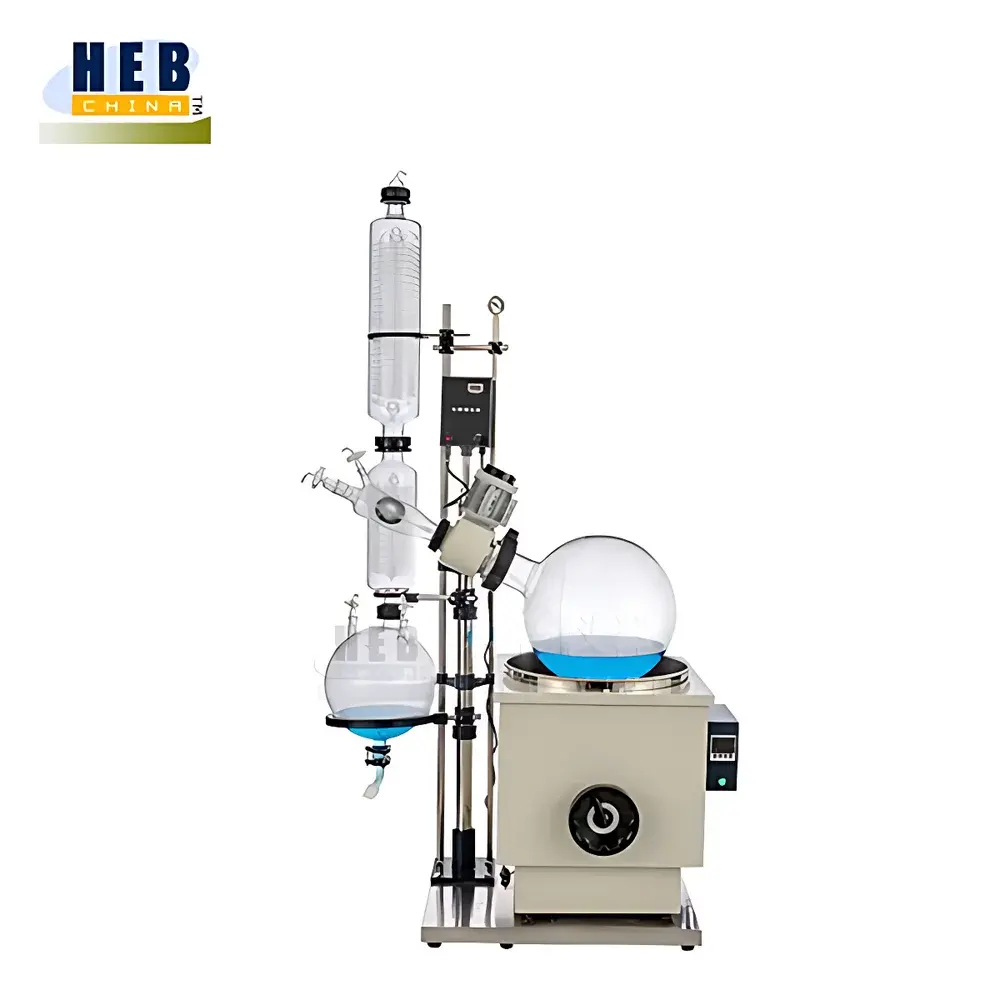
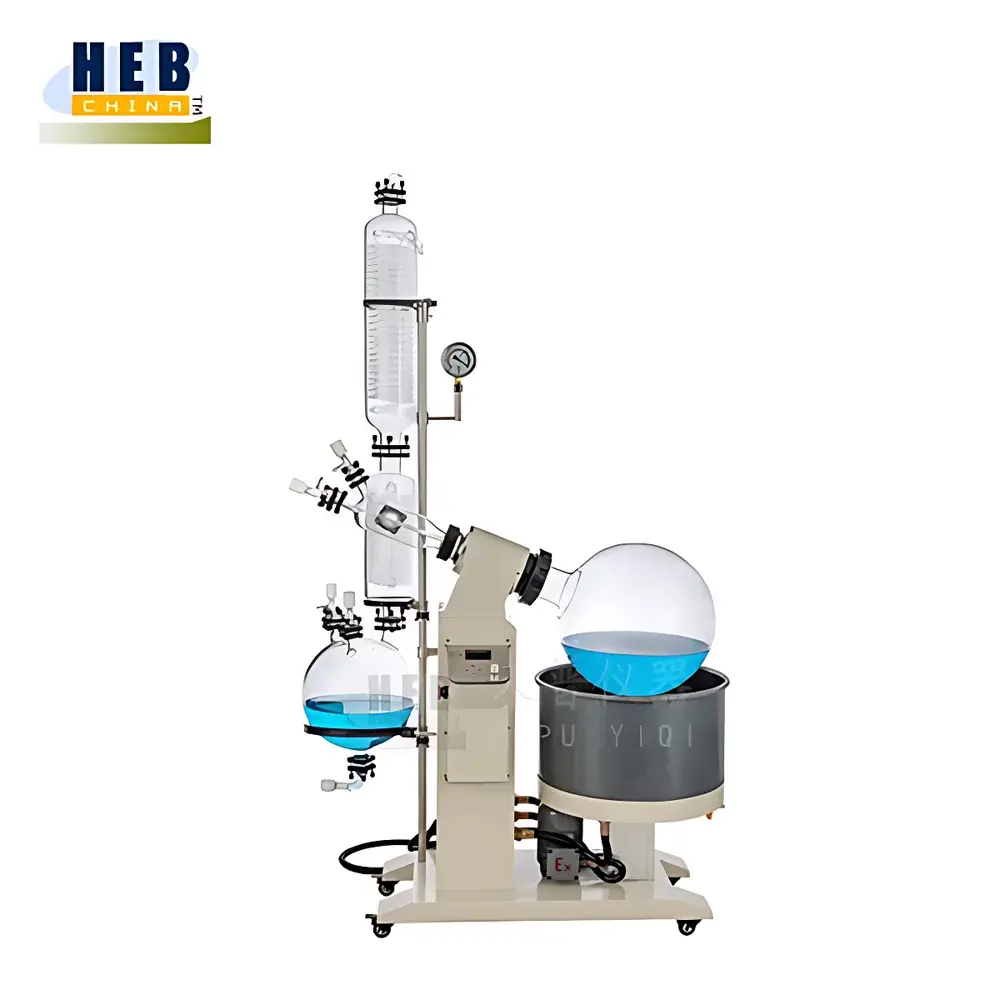
HePu RE-5003 Rotary Evaporator
| Brand | HePu |
|---|---|
| Origin | Shandong, China |
| Model | RE-5003 |
| Rotating Flask Capacity | 50 L |
| Collection Flask Capacity | 20 L |
| Ultimate Vacuum | 0.098 MPa |
| Rotation Speed Range | 0–110 rpm (frequency-controlled, digital display) |
| Bath Temperature Range | 0–400 °C |
| Temperature Control Accuracy | ±1 °C |
| Heating Power | 8 kW (380 V / 50 Hz) |
| Rotation Motor Power | 180 W (220 V / 50 Hz) |
| Condenser Type | Vertical triple-coil glass condenser (main coil: Ø160 × 840 mm |
| auxiliary coil | Ø160 × 530 mm) |
| Cooling Surface Area | 0.11 m² |
| Overall Dimensions (W×D×H) | 1520 × 620 × 2470 mm |
| Net Weight | 170 kg |
Overview
The HePu RE-5003 Rotary Evaporator is a high-capacity, vacuum-enabled solvent removal system engineered for reproducible concentration, distillation, and recovery of heat-sensitive compounds in pharmaceutical R&D, fine chemical synthesis, natural product isolation, and biotechnology applications. Operating on the principle of thin-film evaporation under reduced pressure, the RE-5003 rotates a 50 L evaporation flask at precisely controlled speeds while subjecting its contents to uniform thermal energy from a digitally regulated oil or water bath (0–400 °C). This combination maximizes surface-area-to-volume ratio, minimizes localized overheating, and enables efficient phase separation of volatile solvents from non-volatile residues—particularly critical when handling thermolabile biomolecules, APIs, or polymer precursors. All wetted components—including rotary flasks, condensers, adapters, and collection vessels—are fabricated from GG-17 borosilicate glass (compliant with DIN ISO 3585), ensuring resistance to thermal shock, alkali corrosion, and mechanical stress. The system integrates fluoropolymer (PTFE) and imported FKM elastomer seals to sustain stable vacuum levels up to 0.098 MPa, supporting low-boiling-point solvent recovery (e.g., diethyl ether, dichloromethane, ethyl acetate) without decomposition.
Key Features
- Frequency-controlled DC motor drive with digital RPM readout (0–110 rpm), enabling precise shear control and film thickness modulation across diverse viscosities.
- Triple-coil vertical condenser assembly comprising primary (Ø160 × 840 mm) and auxiliary (Ø160 × 530 mm) cooling sections—optimized for high-efficiency vapor condensation and >95% solvent recovery under continuous operation.
- Intelligent temperature regulation via K-type thermocouple feedback and PID algorithm, delivering ±1 °C stability across the full 0–400 °C range in the stainless steel (304) heating bath.
- Manual bath lift mechanism with 180 mm vertical travel, facilitating safe flask coupling/decoupling and alignment with standardized 19# and 40# ground-glass joints.
- Integrated PTFE stopcock and bottom-discharge valve on the 20 L collection flask for sterile, drip-free transfer of concentrated extracts—compatible with GLP-compliant documentation workflows.
- Explosion-proof configuration options available: EX-rated 180 W motor, intrinsically safe frequency converter, armored cable routing, and aluminum-housed control panels conforming to IEC 60079-0 standards.
- Modular frame constructed from powder-coated stainless steel and aerospace-grade aluminum alloy, supporting long-term structural integrity in multi-shift laboratory environments.
Sample Compatibility & Compliance
The RE-5003 accommodates a broad spectrum of sample matrices—including aqueous extracts, organic reaction mixtures, polymer solutions, and crude fermentation broths—without cross-contamination risk, owing to its all-glass fluid path and chemically inert PTFE/FKM sealing system. It meets material compatibility requirements outlined in USP <661.1>, ISO 10993-1 (biocompatibility screening), and ASTM E2656 (laboratory evaporator performance testing). When operated within validated parameters, the system supports audit-ready processes compliant with FDA 21 CFR Part 11 (electronic records/signatures) and EU Annex 11 (computerized systems), particularly when paired with optional data-logging software and hardware timestamping modules.
Software & Data Management
While the base RE-5003 operates via front-panel microprocessor controls, optional Ethernet- or USB-enabled data acquisition interfaces allow real-time logging of bath temperature, rotation speed, vacuum pressure, and runtime into CSV or LIMS-compatible formats. Calibration certificates traceable to NIST standards are provided for temperature and vacuum sensors. Firmware supports configurable alarm thresholds (e.g., overtemperature, vacuum loss, motor stall), automatic shutdown protocols, and event-driven audit trails—facilitating compliance with GLP and GMP documentation requirements.
Applications
- Concentration of heat-labile natural product isolates (e.g., flavonoids, terpenes) without epimerization or degradation.
- Removal of residual solvents from API intermediates per ICH Q3C guidelines.
- Recovery and reuse of high-purity chlorinated and aromatic solvents in pilot-scale synthesis.
- Preparative-scale dehydration of hydrogels and polysaccharide solutions prior to lyophilization.
- Continuous-feed concentration of cell culture supernatants in upstream bioprocessing development.
FAQ
What is the maximum recommended working volume for the 50 L rotary flask?
For optimal film formation and thermal efficiency, the recommended fill level is ≤40% of nominal capacity (i.e., ≤20 L) when rotating at ≥60 rpm.
Can the RE-5003 be integrated with an external vacuum controller?
Yes—the system features a standard 1/4″ Swagelok vacuum port compatible with programmable vacuum controllers (e.g., Vacuubrand VACUU·SELECT) for dynamic pressure ramping during fractional distillation.
Is the heating bath compatible with silicone oil as a heat transfer medium?
Absolutely—the 304 stainless steel bath vessel and PID-controlled heater support oils with flash points ≥300 °C, enabling stable operation above 250 °C without thermal runaway.
Does the RE-5003 meet CE or UL safety certification requirements?
The base unit complies with IEC 61010-1:2010 for laboratory electrical equipment; CE marking is available upon request with EU Representative registration and DoC submission.
What maintenance intervals are recommended for the PTFE/FKM seal assembly?
Under continuous use (8 h/day), inspect seals every 6 months; replace annually or immediately after exposure to strong oxidizers (e.g., nitric acid, hydrogen peroxide) or halogenated solvents at elevated temperatures.



