
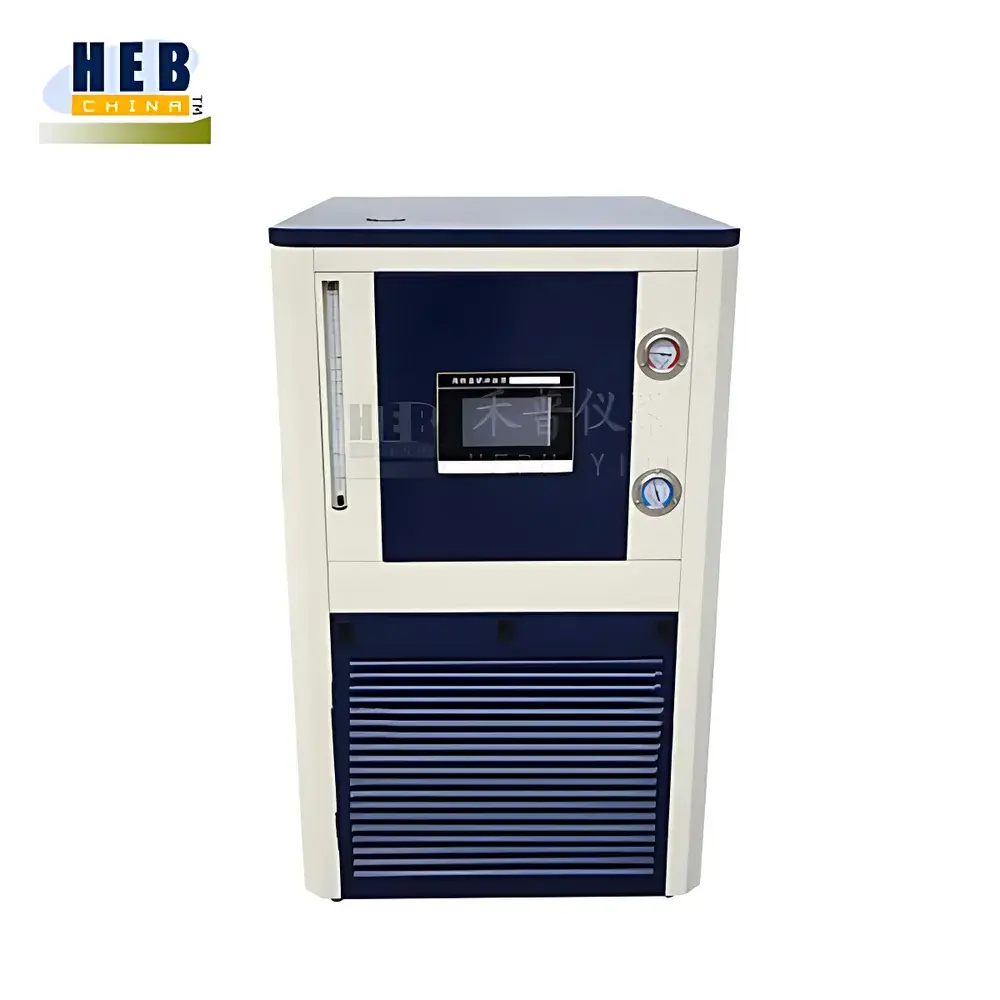
Jihepu GDSZ-10/-20+200 High-Low Temperature Circulating Chiller
| Brand | Jihepu |
|---|---|
| Model | GDSZ-10/-20+200 |
| Temperature Range | -20 °C to +200 °C |
| Ambient Operating Conditions | 5–35 °C, ≤70% RH |
| Power Supply | 220 V AC / 50 Hz |
| Cooling Capacity | 4648 W |
| Heating Power | 3000 W |
| Compressor | 2 HP, R22 refrigerant |
| Circulation Pump | 100 W, 20–40 L/min, 4–6 m head, ≤0.4 MPa |
| Temperature Control Accuracy | ±0.1 °C |
| Sensor | PT100 |
| Heat Exchanger | Plate-type, 0.53 m² |
| External Port | 3/4″ NPT (6-point thread), includes two 2 m stainless steel braided hoses |
| Fluid Compatibility | Premium-grade silicone oil (Class A) |
| Dimensions (W×D×H) | 710×780×1055 mm |
| Net Weight | 115 kg |
| Total Power Consumption | 4570 W |
Overview
The Jihepu GDSZ-10/-20+200 High-Low Temperature Circulating Chiller is an engineered thermal management system designed for precise, bidirectional temperature control of external process equipment—particularly jacketed reactors, calorimeters, and analytical instrumentation requiring stable thermal coupling across a wide operational envelope. Its dual-mode architecture integrates a hermetically sealed R22 refrigeration circuit with independent electric resistance heating, enabling seamless transition between cooling and heating without fluid exchange or manual reconfiguration. The system operates on the principle of forced liquid circulation: a corrosion-resistant silicone oil medium is thermally conditioned within the chiller’s insulated reservoir, then delivered via a high-head, low-pulsation centrifugal pump through standardized 3/4″ NPT ports to external jackets or heat exchangers. Temperature regulation is achieved through real-time feedback from a calibrated PT100 platinum resistance thermometer, processed by a microcontroller-based PID algorithm with ±0.1 °C steady-state accuracy under dynamic load conditions. All critical components—including the plate heat exchanger (0.53 m² effective area), expansion valve, high-pressure cut-off switch, and air-cooled condenser—are selected for long-term reliability in continuous laboratory operation.
Key Features
- Wide operational temperature range: –20 °C to +200 °C, with rapid ramp rates enabled by 3000 W heating and 4648 W refrigeration capacity
- Integrated safety architecture: Over-temperature cutoff, compressor high-pressure protection, delayed start logic, overcurrent interruption, and thermal runaway prevention
- Industrial-grade circulation pump: 100 W motor delivering 20–40 L/min flow at 4–6 m head, with pressure stability ≤0.4 MPa for compatibility with pressurized reactor systems
- Liquid crystal display interface with tactile membrane keypad: Real-time monitoring of setpoint, actual bath temperature, system status, and fault codes
- Corrosion-resistant construction: Cold-rolled steel cabinet with epoxy-polyester powder coating; internal wetted parts compatible with Class A silicone oils
- Standardized external connectivity: Dual 3/4″ NPT male threaded ports (inlet/outlet), supplied with two 2 m stainless steel braided hoses rated for full temperature range
Sample Compatibility & Compliance
The GDSZ-10/-20+200 is validated for use with thermally stable, non-volatile heat transfer fluids meeting ASTM D5275 (silicone-based heat transfer fluids) specifications. It is not intended for water, glycol-water mixtures, or flammable organic solvents due to material compatibility and flash point constraints. The unit complies with IEC 61010-1:2010 for electrical safety in laboratory environments and meets CE marking requirements for electromagnetic compatibility (EN 61326-1). While not certified for hazardous location use (e.g., ATEX), its design supports integration into GLP-compliant workflows when paired with documented calibration procedures traceable to NIST standards. The system’s thermal stability and repeatability support adherence to USP and ISO 17025 requirements for temperature-controlled testing applications.
Software & Data Management
This model operates as a standalone analog/digital hybrid controller with no built-in data logging or remote communication interface. However, the analog 0–5 V or 4–20 mA output signal (optional configuration) enables connection to external SCADA systems, PLCs, or data acquisition hardware for time-stamped temperature trending. For audit-trail compliance in regulated environments, users are advised to pair the unit with third-party validated chart recorders or compliant DAQ software that enforces 21 CFR Part 11 electronic signature and change-control protocols. Firmware updates are not field-upgradable; all calibration and diagnostic functions require authorized service technician intervention using proprietary diagnostic tools.
Applications
- Temperature control of glass or stainless-steel jacketed reactors during exothermic/endothermic synthesis (e.g., Grignard reactions, hydrogenations, polymerizations)
- Stabilization of spectrophotometers, FTIR cells, and viscometers requiring precise thermal equilibration
- Calibration of temperature-sensitive sensors and transducers across extended ranges
- Material testing under controlled thermal cycling per ASTM D696 (coefficient of linear expansion) or ISO 11359 (dynamic mechanical analysis)
- Support of accelerated stability studies in pharmaceutical development where thermal stress profiles must replicate ICH Q1A(R3) guidelines
FAQ
What heat transfer fluid is recommended for operation at +200 °C?
Premium-grade methylphenyl silicone oil (e.g., Dow Corning 200 Fluid, viscosity grade 50 cSt) is required. Standard mineral oils or ethylene glycol solutions must not be used above 120 °C.
Can this unit maintain temperature stability during rapid reaction exotherms?
Yes—its 4648 W cooling capacity and 3000 W heating power, combined with a 0.53 m² plate heat exchanger, enable recovery times under 90 seconds for ±5 °C disturbances when properly sized for the connected jacket volume.
Is the circulation pump compatible with vacuum-jacketed reactor systems?
The pump is rated for positive-pressure delivery only. It must not be installed downstream of a vacuum source; use only in closed-loop, gravity-neutral configurations.
Does the unit include factory calibration documentation?
A basic calibration certificate is provided with shipment, covering PT100 sensor linearity and setpoint accuracy verification at three points (–20 °C, 25 °C, +200 °C); full ISO/IEC 17025 accreditation requires third-party lab verification.
What maintenance intervals are recommended for continuous 24/7 operation?
Compressor oil inspection every 6 months; refrigerant pressure check annually; heat exchanger cleaning with isopropyl alcohol every 12 months; pump impeller inspection every 18 months.



