
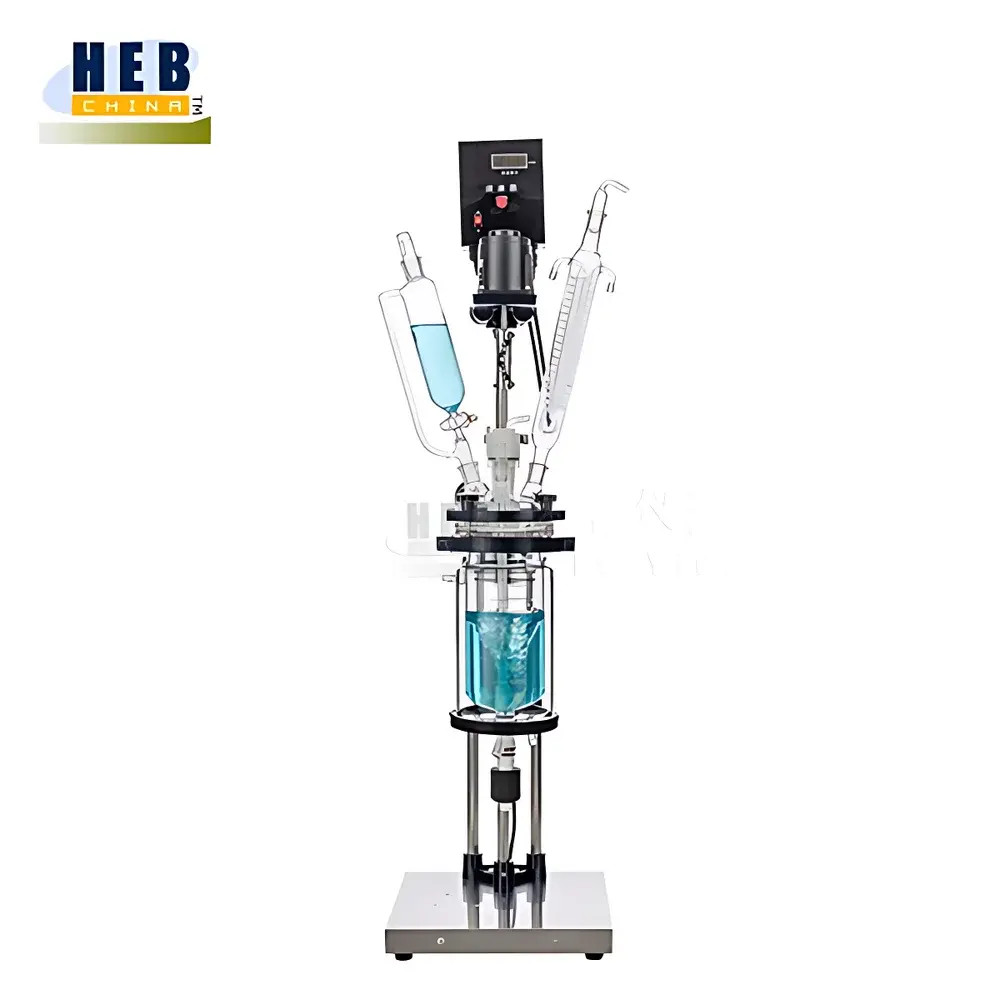
HEB-1L Dual-Jacketed Glass Reactor by Jihepu (Jinan Hepingpu)
| [Brand | Jihepu (Jinan Hepingpu) |
|---|---|
| Origin | Shandong, China |
| Model | HEB-1L |
| Capacity | 1 L |
| Working Pressure | Low-pressure |
| Vacuum Degree | 0.098 MPa |
| Jacket Volume | 0.4 L |
| Temperature Range | −80 °C to 250 °C |
| Stirring Speed | 0–1100 rpm |
| Motor Power | 40 W |
| Voltage/Frequency | 220 V / 50 Hz |
| Stirring Shaft Diameter | 10 mm |
| Discharge Port Height | 300 mm |
| Overall Dimensions (L×W×H) | 350 × 345 × 1000 mm |
| Packing Dimensions (L×W×H) | 1200 × 480 × 400 mm |
| Net Weight | 32 kg |
| Material | GG-17 borosilicate glass body |
Overview
The HEB-1L Dual-Jacketed Glass Reactor is a precision-engineered laboratory-scale reaction system designed for controlled synthesis, distillation, reflux, concentration, and separation under variable thermal and vacuum conditions. Operating on the principle of jacketed heat transfer—where a circulating thermal fluid (e.g., silicone oil, ethylene glycol, or chilled water) flows through the annular space between two concentric glass walls—the reactor enables precise temperature regulation of the reaction mass without direct contact. This design ensures uniform thermal distribution, minimizes localized overheating, and supports both exothermic and endothermic processes across a broad operational range (−80 °C to +250 °C). The all-glass wetted path—constructed from GG-17 high-borosilicate glass—provides exceptional chemical resistance, optical clarity for real-time visual monitoring, and low thermal expansion for mechanical stability under thermal cycling. Its low-pressure rating and validated 0.098 MPa vacuum capability make it suitable for solvent removal, reduced-pressure distillation, and moisture-sensitive reactions.
Key Features
- GG-17 borosilicate glass vessel with full transparency and certified hydrolytic resistance (ISO 719 Class HGB 1), ensuring long-term integrity in acidic, alkaline, and organic media.
- Modular five-neck lid configuration (standard NS29/32 or NS24/29 ports) accommodates condensers, dropping funnels, thermometers, inert gas inlets, and vacuum lines—enabling flexible experimental setup per ASTM E2654 and ISO 17025-compliant workflows.
- PTFE-coated stainless steel stirring shaft and dual-blade impeller deliver consistent mixing with minimal contamination; torque-stable AC motor (40 W) provides smooth operation up to 1100 rpm with digital speed readout and stepless electronic control.
- FKM fluoroelastomer O-ring seals and proprietary PTFE-faced valve assembly maintain vacuum integrity at ≤0.098 MPa and resist swelling in halogenated solvents, esters, and strong acids—validated per ASTM D1418 and ISO 1629 specifications.
- Zero-dead-volume PTFE斜放料 valve (angled discharge port) eliminates retention zones during quantitative sample recovery—critical for yield calculation, analytical sampling, and GMP-aligned batch documentation.
- Integrated vacuum gauge display allows real-time pressure monitoring; standardized 10 mm and 12 mm plug-in ports (12×8 mm OD tubing compatibility) support seamless interfacing with external chillers, oil baths, vacuum pumps, and condensers per ISO 8573-1 clean air class requirements.
Sample Compatibility & Compliance
The HEB-1L is compatible with a wide spectrum of liquid-phase reaction systems, including Grignard couplings, esterifications, hydrogenations (with catalyst slurries), polymerizations, and crystallization studies. Its inert glass surface and fluoropolymer components prevent catalytic side reactions and metal leaching—essential for pharmaceutical intermediate synthesis compliant with ICH Q5A and USP . The reactor meets general laboratory safety standards for low-pressure glass apparatus (EN 15057, DIN 12575) and supports GLP audit trails when paired with calibrated external sensors and validated data loggers. While not intrinsically rated for explosion-proof environments, it may be operated inside certified fume hoods (ANSI/AIHA Z9.5) when handling volatile or pyrophoric reagents.
Software & Data Management
The HEB-1L operates as a standalone analog-controlled instrument without embedded firmware or network connectivity. However, its analog outputs—including real-time RPM signal (0–10 V DC) and optional PT100 RTD interface—enable integration into third-party data acquisition systems (e.g., LabVIEW, Delta Tau PMAC, or Siemens SIMATIC S7) for time-stamped logging of temperature, pressure, and agitation parameters. When used in regulated environments, users may implement 21 CFR Part 11-compliant electronic records via validated SCADA platforms that capture operator ID, setpoint changes, and alarm events—supporting traceability for QC release testing and regulatory submissions.
Applications
- Small-scale process development for API synthesis, including temperature-sensitive cyclizations and anhydrous dehydrations.
- Distillation and solvent recovery under reduced pressure (e.g., THF, DMF, DCM) with integrated cold-finger condensers.
- Controlled crystallization trials requiring precise supersaturation management via programmable cooling ramps.
- Photochemical reactions using UV-transparent GG-17 glass and quartz-jacketed light sources (optional).
- Educational demonstrations of reaction kinetics, phase equilibria, and mass transfer phenomena in university chemistry labs.
- Pilot-scale feasibility studies prior to stainless-steel reactor scale-up—leveraging identical thermal profiles and mixing dynamics.
FAQ
What thermal fluids are compatible with the jacket?
Silicone oils (up to 250 °C), 50% ethylene glycol/water mixtures (−30 °C to 120 °C), and chilled deionized water (4 °C to 30 °C) are routinely used. Avoid halogenated solvents or strong oxidizers in the jacket.
Can the reactor be used under positive pressure?
No—it is rated exclusively for low-pressure and vacuum service (max working pressure: 0.1 MPa gauge). Positive pressure operation voids safety certification and risks glass failure.
Is the PTFE discharge valve autoclavable?
No. PTFE components degrade above 260 °C and are incompatible with steam sterilization. Cleaning is recommended via solvent rinse and ultrasonic bath.
How is temperature measured inside the vessel?
The standard configuration includes a central thermometer port (NS29/32); users must supply a calibrated probe (e.g., Pt100 or thermocouple) and external readout device.
Does the unit include a chiller or heating circulator?
No—these are external accessories. The reactor provides only passive jacket ports (12 mm OD) for connection to user-supplied thermal management systems.



