
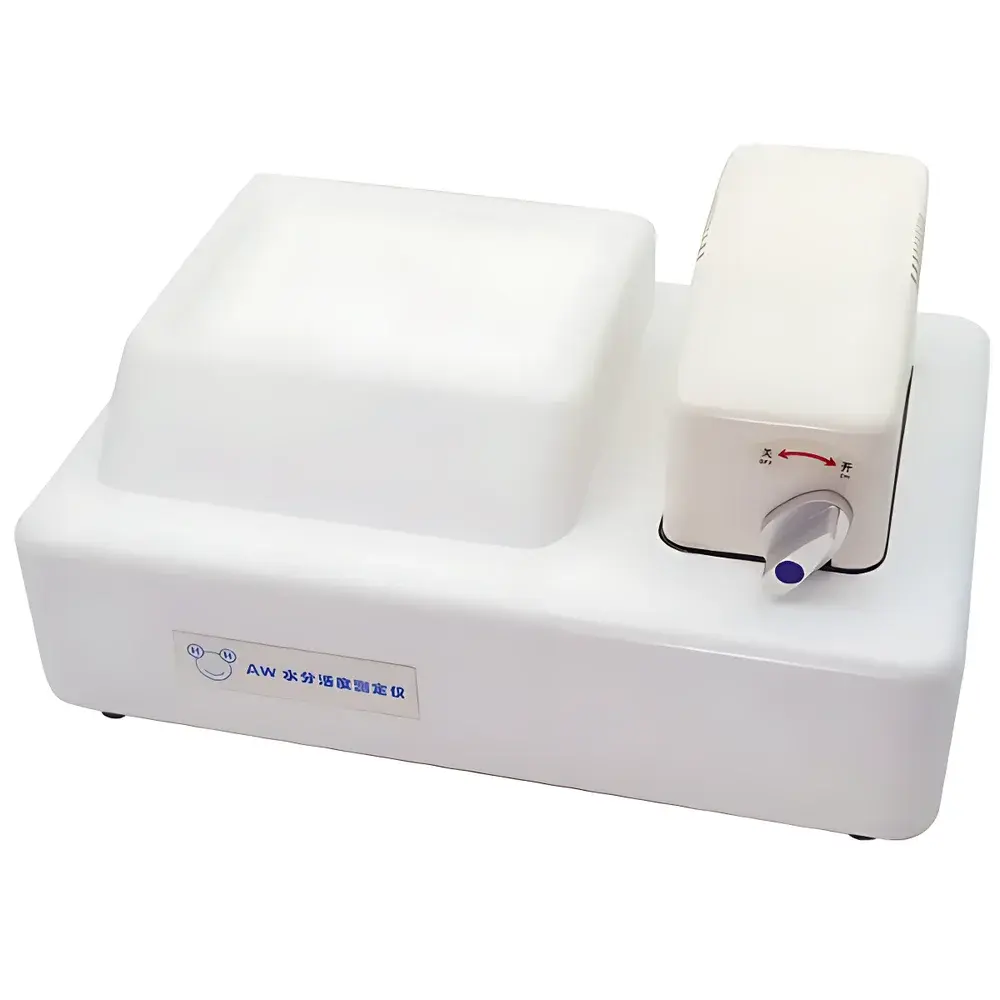
Future-Spectrum AW2000T Water Activity Analyzer
| Brand | Future-Spectrum |
|---|---|
| Model | AW2000T |
| Measurement Range | 0.000–1.000 aw |
| Temperature Control | Peltier-regulated at 25 °C (±0.01 °C) |
| Sensor Type | High-stability capacitive humidity sensor |
| Accuracy | ±0.008 aw at 25 °C |
| Resolution | 0.0001 aw |
| Sample Temperature Monitoring | Non-contact infrared sensor |
| Calibration | Multi-point, up to 20 reference standards |
| Operating System Compatibility | Windows, Linux |
| Interface | Chinese-language GUI with operator-level access control |
| Weight | 4.7 kg |
| Form Factor | Benchtop laboratory instrument |
Overview
The Future-Spectrum AW2000T Water Activity Analyzer is a benchtop instrument engineered for precise, reproducible determination of water activity (aw) in solid and semi-solid matrices across food, pharmaceutical, cosmetic, and agricultural product development and quality control laboratories. It operates on the fundamental thermodynamic principle that water activity is defined as the ratio of the equilibrium vapor pressure of water above a sample (p) to the saturation vapor pressure of pure water (p0) at the same temperature: aw = p/p0. This dimensionless parameter—ranging from 0.000 (anhydrous) to 1.000 (pure water)—quantifies the thermodynamic availability of water for microbial metabolism, enzymatic reactions, and physicochemical degradation pathways. Unlike moisture content alone, aw directly correlates with microbiological stability, chemical shelf life, and physical behavior such as caking, clumping, or texture changes. The AW2000T employs a high-precision capacitive relative humidity (RH) sensor housed within a sealed, temperature-controlled measurement chamber, enabling rapid equilibration and traceable aw quantification under ISO 21807:2022 and ASTM F1718–21 compliant conditions.
Key Features
- Peltier-based thermal regulation ensures stable, programmable measurement temperature at 25 °C (±0.01 °C), eliminating ambient drift and supporting standardized testing per ISO, AOAC, and USP guidelines.
- Non-contact infrared temperature sensor continuously monitors sample surface temperature during equilibration—critical for accurate aw interpretation when sample thermal mass or emissivity varies.
- Capacitive RH sensor with long-term stability and low hysteresis delivers resolution of 0.0001 aw and certified accuracy of ±0.008 aw at 25 °C, validated against NIST-traceable saturated salt standards.
- Multi-point calibration capability supports up to 20 user-defined reference points across the full 0.000–1.000 aw range, accommodating both single-point verification and full-range linearity assessment.
- Modular software architecture compatible with Windows and Linux environments; GUI available in Chinese with role-based operator permissions (e.g., analyst, supervisor, administrator) to support GLP/GMP audit requirements.
- Benchtop footprint (W × D × H ≈ 280 × 320 × 240 mm) and lightweight design (4.7 kg) enable seamless integration into QC labs, R&D workstations, and regulatory submission environments without dedicated HVAC or floor anchoring.
Sample Compatibility & Compliance
The AW2000T accommodates a broad spectrum of sample types—including powders, gels, pastes, granules, dried fruits, confectionery, dairy powders, active pharmaceutical ingredients (APIs), excipients, and cosmetic emulsions—without requiring grinding, dilution, or solvent extraction. Its sealed chamber design minimizes cross-contamination and volatile interference. The instrument conforms to international method validation frameworks: it supports compliance with FDA 21 CFR Part 11 (via optional electronic signature and audit trail modules), ISO/IEC 17025:2017 (for accredited testing laboratories), and pharmacopeial monographs including USP and Ph. Eur. 2.9.37. All calibration and measurement data are timestamped, user-attributed, and exportable in CSV or PDF formats suitable for regulatory submissions.
Software & Data Management
The embedded control software provides configurable report templates—including customizable headers, pass/fail thresholds, statistical summaries (mean, SD, CV%), and calibration history logs. Raw sensor output, equilibration curves, and temperature profiles are stored with metadata (operator ID, sample ID, date/time, environmental conditions). Data export supports LIMS integration via ODBC or RESTful API endpoints. Audit trails record all critical actions—including method edits, calibration events, result overrides, and user logins—ensuring full traceability for internal audits and external inspections under GMP, HACCP, and BRCGS Food Safety Standard v9 protocols.
Applications
- Microbial Risk Assessment: Correlating measured aw values with published inhibition thresholds (e.g., <0.85 for Staphylococcus aureus, <0.60 for xerophilic molds) to validate pathogen control strategies and define safe storage conditions.
- Shelf-Life Modeling: Integrating aw data with Arrhenius-based kinetic models to predict rates of Maillard browning, lipid oxidation, or enzyme-mediated spoilage under accelerated aging protocols.
- Formulation Optimization: Evaluating how humectants (glycerol, sorbitol), anti-caking agents (silicon dioxide), or hygroscopic excipients influence water distribution and phase stability in final products.
- Packaging Barrier Validation: Quantifying moisture ingress through films, laminates, or desiccant-lined pouches by monitoring aw drift over time under controlled RH chambers.
- Raw Material Release Testing: Enforcing incoming inspection criteria per supplier specifications or internal quality agreements—particularly for hygroscopic ingredients where moisture content alone is insufficient.
FAQ
What is the difference between moisture content and water activity?
Moisture content measures total water mass per unit sample mass (e.g., % w/w); water activity measures the *energetic state* of that water—its ability to participate in chemical and biological reactions. Two samples with identical moisture content may exhibit vastly different aw values due to differences in binding strength (e.g., crystalline vs. amorphous lactose), making aw the superior predictor of stability.
Does the AW2000T require routine sensor replacement?
No—the capacitive sensor is designed for ≥5 years of continuous operation under standard lab conditions. Performance is verified via multi-point calibration; sensor drift is detectable and correctable before impact on measurement integrity.
Can the instrument measure frozen or refrigerated samples?
The AW2000T performs measurements at a fixed 25 °C chamber temperature. Samples must be brought to thermal equilibrium at this temperature prior to analysis. Sub-ambient storage does not affect final aw value, provided equilibration is complete.
Is the calibration traceable to national standards?
Yes—calibration utilizes saturated aqueous salt solutions with certified aw values at 25 °C (e.g., LiCl, MgCl₂, NaCl, KCl), whose reference values are traceable to NIST SRM 2371 and ISO 21807 Annex A.
How does the AW2000T handle highly viscous or low-volatility samples?
The sealed chamber and extended equilibration algorithm (up to 2 hours, user-configurable) accommodate slow vapor diffusion kinetics typical of honey, syrups, or polymer-based cosmetics—without compromising endpoint detection fidelity.







