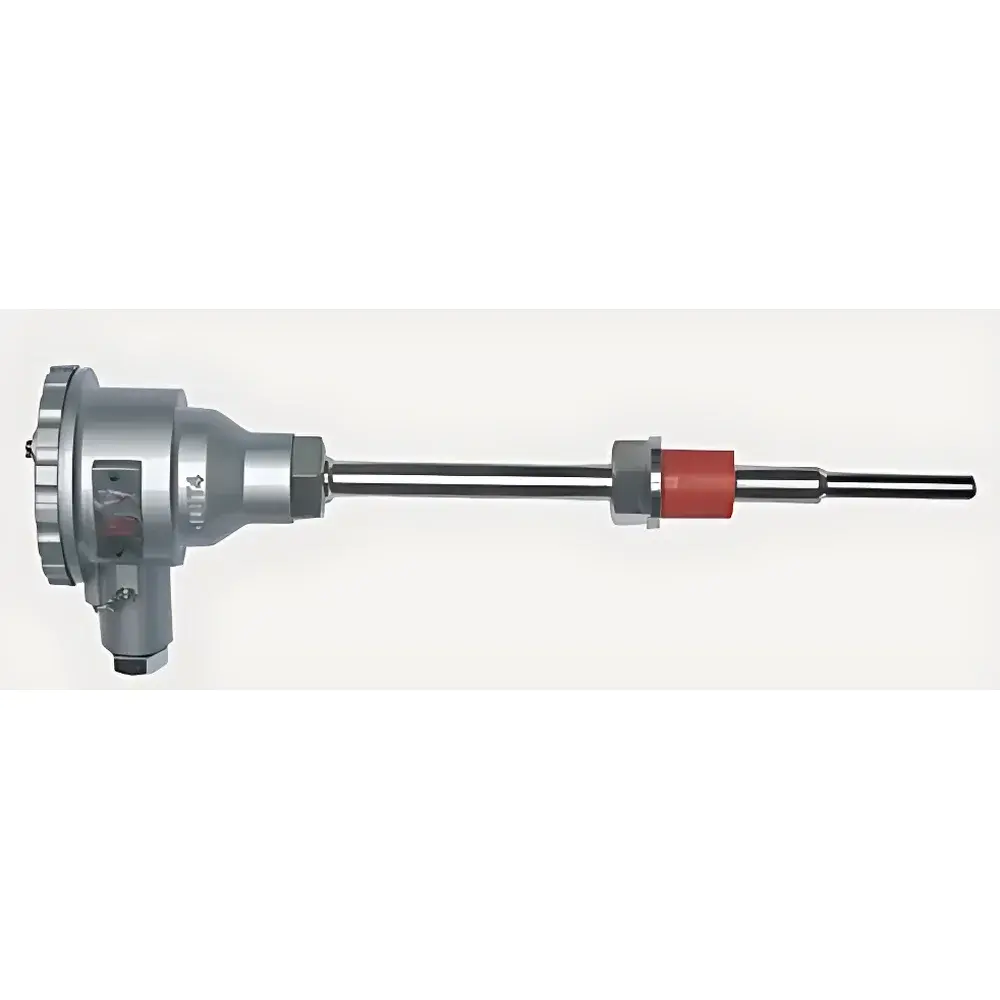
Xiatech T6WZP02 Explosion-Proof Platinum Resistance Thermometer
| Brand | Xiatech |
|---|---|
| Origin | Shaanxi, China |
| Model | T6WZP02 |
| Explosion Protection Rating | Ex d IIC T6 Gb / Ex tb IIIC T80°C Db |
| Temperature Range | 0–800 °C |
| Sensor Element | Pt100 (IEC 60751 Class A) |
| Pressure Rating | ≤2.4 MPa |
| Output Signal | 2-wire / 3-wire / 4-wire RTD configuration |
| Enclosure Material | Cast stainless steel (316L) |
| IP Rating | IP66/IP68 |
| Certifications | CNEx, NEPSI, GB 3836.1–2021, GB 3836.2–2021 |
Overview
The Xiatech T6WZP02 Explosion-Proof Platinum Resistance Thermometer is an intrinsically robust industrial temperature sensing solution engineered for continuous, high-fidelity measurement in hazardous environments where flammable gases, vapors, or combustible dusts may be present. Based on the fundamental principle of platinum resistance thermometry—where resistivity changes predictably and reproducibly with temperature—the T6WZP02 employs a precision Pt100 sensing element compliant with IEC 60751 Class A tolerance (±(0.15 + 0.002|t|) °C). Its flameproof enclosure conforms to Ex d IIC T6 Gb (gas) and Ex tb IIIC T80°C Db (dust) protection levels per GB 3836.1–2021 and GB 3836.2–2021, enabling safe deployment in Zone 1 (gas) and Zone 21 (dust) classified areas. Designed for static and moderate-flow process conditions, it delivers stable, drift-resistant output under thermal cycling and mechanical vibration—critical for long-term reliability in petrochemical reactors, natural gas compression stations, solvent recovery units, and bulk powder handling systems operating up to 2.4 MPa pressure and 800 °C surface temperature.
Key Features
- Flameproof enclosure certified to GB 3836.2–2021 (equivalent to IEC 60079-1), rated Ex d IIC T6 Gb / Ex tb IIIC T80°C Db for dual-gas-and-dust hazard mitigation
- Pt100 sensing element manufactured to IEC 60751 Class A accuracy specification, ensuring traceable calibration and low measurement uncertainty over extended service life
- High-strength 316L stainless steel housing with optimized thermal mass and low thermal lag—enabling response time (t₀.₅) < 30 s in still air and < 5 s in flowing media (per DIN EN 60751 Annex D)
- Configurable lead wiring: 2-wire (for short-distance fixed installations), 3-wire (standard for industrial PLC/DCS integration), or 4-wire (high-precision laboratory-grade compensation)
- Hermetically sealed ceramic-to-metal feedthrough and welded junction construction—resisting moisture ingress, chemical corrosion, and thermal shock
- IP66/IP68-rated environmental protection, supporting outdoor mounting and washdown-capable operation in food & pharma auxiliary utilities
Sample Compatibility & Compliance
The T6WZP02 is not a sample-contacting analytical instrument but a process-integrated temperature transducer. It interfaces directly with metallic process piping, vessel walls, or immersion wells via standardized threaded connections (e.g., M27×2, G1/2″, or NPT 1/2″). No fluid compatibility limitations apply beyond those imposed by the 316L wetted parts—making it suitable for hydrocarbons, steam, compressed air, aqueous solutions, and inert process gases. Regulatory compliance includes mandatory Chinese national explosion protection standards (GB 3836 series), CNEx and NEPSI type examination certificates, and design alignment with ISO 8501-1 surface preparation guidelines for protective coating adhesion during field installation. While not FDA-regulated as a standalone device, its materials and construction support GMP-aligned validation protocols when integrated into pharmaceutical clean steam systems or bioreactor temperature loops.
Software & Data Management
As a passive two-/three-/four-wire RTD sensor, the T6WZP02 does not incorporate embedded firmware, onboard memory, or digital communication interfaces (e.g., HART, Foundation Fieldbus, or Modbus). Its analog resistance output (100 Ω at 0 °C, ~390 Ω at 800 °C) is conditioned externally via certified temperature transmitters (e.g., Rosemount 3144P, Endress+Hauser TC32x) or PLC analog input modules meeting IEC 61000-6-2/6-4 EMC requirements. When deployed in validated environments—such as API RP 14C safety instrumented systems or ISO/IEC 17025-accredited calibration labs—the sensor’s metrological behavior supports full audit trails, calibration certificate generation (per ISO/IEC 17025 Clause 7.7), and traceability to NIM (National Institute of Metrology, China) standards. Documentation packages include factory calibration reports with raw resistance vs. temperature data points at 0 °C, 100 °C, 300 °C, 500 °C, and 800 °C.
Applications
- Continuous temperature monitoring in refinery fractionation columns, catalytic cracker regenerators, and delayed coker drums
- Safety-critical interlocks for flare stack pilot flame detection and combustion chamber overtemperature shutdown
- Process control of ethylene oxide sterilization chambers and solvent-based paint drying ovens
- Temperature supervision in coal pulverizer outlets, biomass boiler superheaters, and cement kiln precalciner ducts
- Environmental monitoring of landfill gas extraction manifolds and anaerobic digester headspaces
- Backup sensing for SIL2-rated burner management systems (BMS) per IEC 61511
FAQ
What explosion protection standards does the T6WZP02 meet?
It complies with GB 3836.1–2021 (general requirements) and GB 3836.2–2021 (flameproof enclosures “d”), certified by CNEx and NEPSI for Ex d IIC T6 Gb and Ex tb IIIC T80°C Db.
Is the Pt100 element calibrated individually before shipment?
Yes—each unit undergoes point-by-point resistance verification at five reference temperatures; a traceable calibration report is supplied with serial-number-matched data.
Can the T6WZP02 be used in steam service above 300 °C?
Yes—its 316L construction and optimized sheath design are qualified for saturated and superheated steam applications up to 800 °C, provided pressure remains ≤2.4 MPa and thermal cycling is within design limits.
Does it support intrinsic safety (Ex i) barriers?
No—the T6WZP02 is flameproof (Ex d), not intrinsically safe. For Ex i applications, a separate certified IS barrier must be used upstream of the transmitter, not the sensor itself.
What is the recommended recalibration interval?
Per ISO/IEC 17025 and industry best practice, annual calibration is advised for critical safety loops; for non-safety process control, intervals may extend to 2–3 years based on historical stability data and risk assessment (e.g., IEC 61511 Layer of Protection Analysis).