
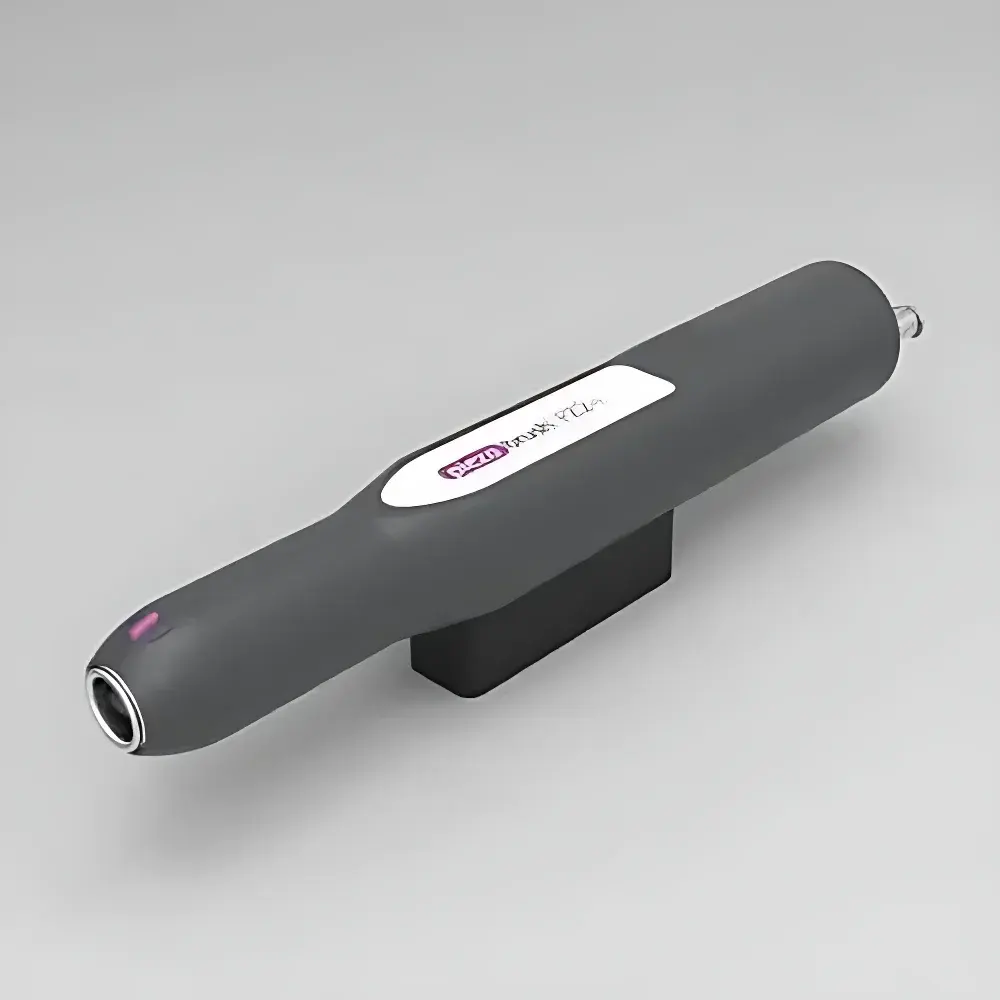
Relyon Piezobrush® PZ2-i Portable Atmospheric-Pressure Plasma Surface Treater
| Brand | Relyon |
|---|---|
| Origin | Germany |
| Model | PZ2-i |
| RF Frequency | 80 kHz |
| Power Output | 30 W |
| Dimensions | 4 × 20 × 3 cm |
| Weight | 180 g |
| Operating Gas | Single-channel (compressed air or N₂) |
| Plasma Temperature | ≤50 °C |
| Optimal Working Distance | 2–10 mm |
| Effective Treatment Width | 5–20 mm |
| Power Supply | 110–240 V AC / 50–60 Hz or 15 V DC |
| Control Interface | External TTL/0–10 V trigger-compatible |
| Compliance | CE, RoHS, IEC 61000-6-3/6-4 |
Overview
The Relyon Piezobrush® PZ2-i is a compact, handheld atmospheric-pressure plasma (APP) surface treatment system engineered for precision surface activation, cleaning, and functionalization under ambient conditions. Unlike low-pressure plasma systems requiring vacuum chambers, the PZ2-i generates cold, non-thermal plasma directly at atmospheric pressure using piezoelectric-driven dielectric barrier discharge (DBD) technology. Its 80 kHz RF excitation enables stable, uniform plasma plume generation with minimal thermal load—ensuring substrate temperatures remain below 50 °C. This makes it uniquely suitable for temperature-sensitive materials including polymers, thin films, biological substrates, and flexible electronics. Designed for both laboratory research and industrial integration, the PZ2-i delivers reproducible surface modification without consumables or hazardous gases, supporting applications from adhesion promotion to microbial decontamination.
Key Features
- True handheld architecture: Weighing only 180 g and measuring just 4 × 20 × 3 cm, the PZ2-i enables ergonomic, localized surface treatment without fixed mounting or infrastructure.
- Low-power, high-efficiency DBD plasma source: 30 W nominal power draw ensures compatibility with standard lab power supplies and mobile platforms while maintaining consistent plasma density and chemical reactivity.
- Dual power input flexibility: Operates on universal 110–240 V AC or optional 15 V DC input—ideal for integration into automated stages, robotic arms, or portable diagnostic workstations.
- Gas-flexible operation: Compatible with compressed air (standard configuration) or nitrogen; no gas cylinders or mass flow controllers required—enabling rapid deployment and field use.
- Interchangeable nozzle modules: Multiple nozzle geometries (e.g., linear, focused, wide-angle) allow optimization of treatment width (5–20 mm) and standoff distance (2–10 mm) for diverse sample topographies and material classes.
- External process synchronization: Equipped with TTL and 0–10 V analog input ports for precise timing control in synchronized manufacturing environments (e.g., inline printing, adhesive dispensing, or microfluidic assembly).
Sample Compatibility & Compliance
The PZ2-i treats a broad spectrum of substrates—including polyolefins (PP, PE), PET, PI, glass, silicon wafers, metal foils, and hydrogels—without surface ablation or thermal degradation. Its cold plasma chemistry primarily generates reactive oxygen and nitrogen species (RONS), enabling surface oxidation, amine grafting, and hydrophilicity enhancement. The device complies with CE marking requirements per Directive 2014/30/EU (EMC) and 2014/35/EU (LVD), conforms to RoHS 2011/65/EU restrictions on hazardous substances, and meets IEC 61000-6-3 (emission) and IEC 61000-6-4 (immunity) standards. While not certified for medical device manufacturing under ISO 13485, its repeatable output supports GLP-aligned surface preparation protocols in regulated R&D settings.
Software & Data Management
The PZ2-i operates as a hardware-controlled module without embedded firmware or proprietary software stack. All operational parameters—including trigger timing, duty cycle, and duration—are managed externally via programmable logic controllers (PLCs), motion controllers, or LabVIEW/Python-based automation frameworks. Built-in status LEDs provide real-time feedback on plasma ignition, power delivery, and thermal safety thresholds. For auditability in quality-critical workflows, external logging systems can record trigger events alongside environmental sensor data (e.g., humidity, ambient temperature), satisfying basic traceability needs aligned with FDA 21 CFR Part 11 principles when deployed within validated instrument networks.
Applications
- Surface activation prior to inkjet printing, screen printing, or UV-curable coating—improving ink adhesion and reducing delamination in flexible packaging and OLED display fabrication.
- Pretreatment of polymer substrates (e.g., PDMS, PMMA) for microfluidic device bonding, ensuring leak-free, plasma-assisted irreversible sealing.
- Enhancement of epoxy and cyanoacrylate bond strength on low-surface-energy plastics used in medical device assembly.
- Rapid, non-contact sterilization of surgical tools, endoscope components, and labware surfaces—validated against ISO 14937 and ASTM E2197 for microbial reduction efficacy.
- Functionalization of biosensor electrodes and electrodeposited nanomaterials to increase protein binding capacity and electrochemical signal stability.
- In-line pretreatment in roll-to-roll (R2R) processes for solar cell encapsulation films and battery separator membranes.
FAQ
Does the PZ2-i require vacuum or special gas supply systems?
No—it operates at ambient pressure using standard shop air or bottled nitrogen; no vacuum pump, gas cabinet, or mass flow controller is needed.
Can the PZ2-i be integrated into a robotic arm or CNC stage?
Yes—its lightweight form factor, DC power option, and TTL/0–10 V trigger interface support seamless integration with industrial motion control systems.
What is the expected lifetime of the piezoelectric transducer and electrode assembly?
Under continuous operation at rated power, the core plasma module demonstrates >10,000 hours MTBF, validated per IEC 61508 SIL-2 functional safety guidelines for industrial equipment.
Is ozone generation a concern during operation?
Ozone concentrations remain below 0.05 ppm at 30 cm distance per EN 60335-1 testing—well under OSHA and EU occupational exposure limits; no additional ventilation is required in typical lab environments.
How does treatment uniformity compare between handheld and fixed-position use?
Consistent results require controlled traverse speed (<50 mm/s) and stable standoff distance; for highest repeatability, pairing with motorized Z-stage or linear actuator is recommended.



