
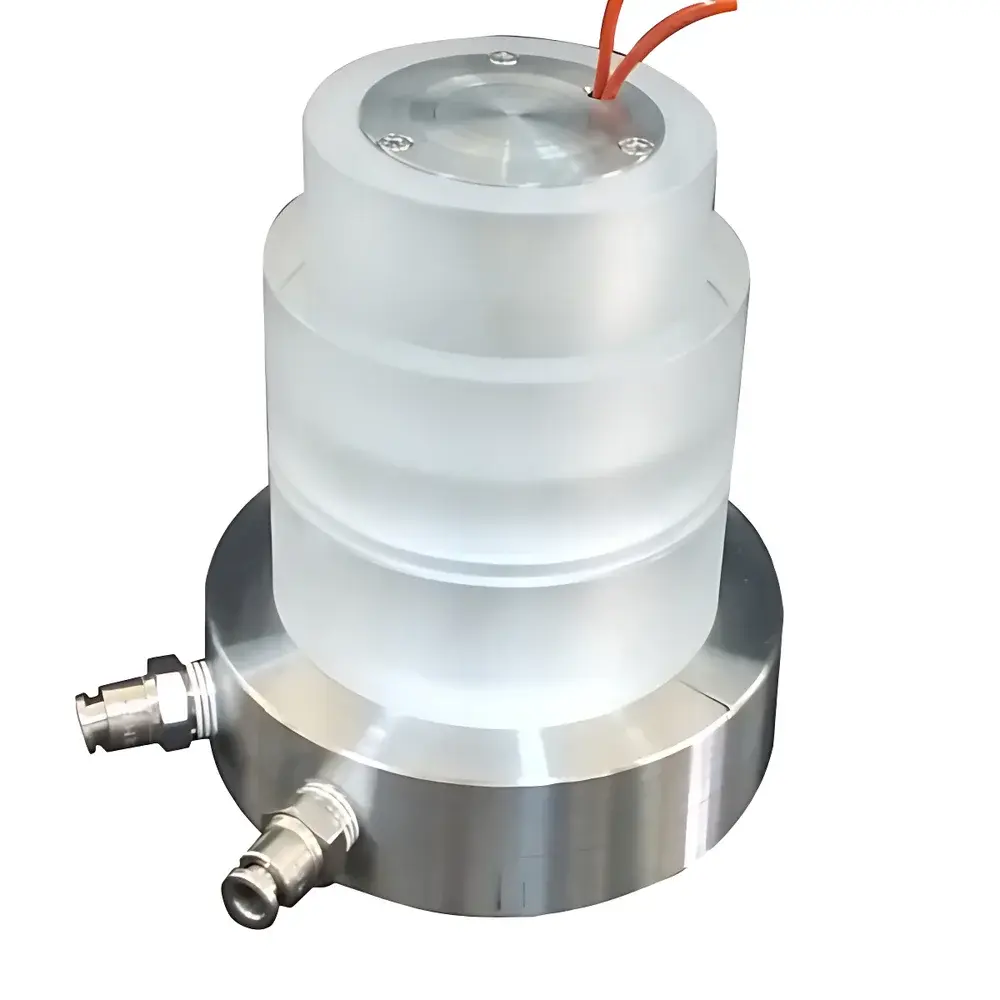
Xiatech TC2000 Heat Flow Method Thermal Conductivity Analyzer
| Brand | Xiatech |
|---|---|
| Origin | Shaanxi, China |
| Model | TC2000 |
| Measurement Principle | Heat Flow Method (Guarded Hot Plate Variant) |
| Thermal Conductivity Range | 0.1–30 W/(m·K) |
| Accuracy | ±3–5 % |
| Repeatability | ±2 % |
| Sample Form | Solid (including powders, pastes, and rigid/flexible solids) |
| Sample Dimensions | Ø50 mm, thickness 0.5–30 mm (customizable) |
| Test Atmosphere | Ambient air |
| Operating Temperature | Room temperature (RT) |
| Applied Pressure | 0–0.28 MPa |
| Thickness Resolution | 0.001 mm (via integrated displacement sensor) |
| Thermal Resistance Range | 0.001–0.05 (m²·K)/W |
| Data Interface | USB |
| Power Supply | 220 V, 50 Hz |
| Compliance | ASTM E1530 |
Overview
The Xiatech TC2000 is a precision-engineered heat flow method thermal conductivity analyzer designed for reliable, steady-state measurement of solid materials—including polymers, composites, ceramics, foams, aerogels, pastes, and powders—under ambient atmospheric conditions. Based on the one-dimensional steady-state Fourier conduction law, the TC2000 implements a guarded heat flow configuration that minimizes lateral heat loss and contact resistance effects through active pressure control and integrated thermal guarding. Unlike transient methods (e.g., laser flash), the TC2000 delivers inherently stable, absolute thermal conductivity values without requiring calibration standards for routine operation—making it particularly suitable for QC labs, R&D centers, and material certification workflows where traceability to ASTM E1530 is required. Its compact footprint, minimal sample volume requirement (single specimen per test), and robust mechanical architecture support high-throughput screening while maintaining metrological integrity across diverse industrial material classes.
Key Features
- Automated contact pressure control (0–0.28 MPa): Ensures consistent interfacial contact while preventing sample deformation or damage—critical for low-modulus polymers, soft foams, and fragile aerogel monoliths.
- Integrated high-resolution displacement sensor (0.001 mm resolution): Enables real-time, non-contact thickness measurement during thermal equilibration, eliminating manual micrometer errors and improving overall uncertainty budget.
- Single-specimen testing protocol: Supports direct measurement of bulk solids, layered assemblies, granular powders (compacted), and viscoelastic pastes—no reference standard or comparative calibration needed.
- Full automation via embedded Windows-based software: Controls temperature stabilization, pressure application, data acquisition, curve fitting, and report generation—including ASTM E1530-compliant uncertainty statements.
- Modular sample stage with customizable geometry: Standard Ø50 mm aperture accommodates thicknesses from 0.5 mm to 30 mm; optional fixtures available for non-circular or anisotropic specimens.
Sample Compatibility & Compliance
The TC2000 is validated for heterogeneous and anisotropic solid-phase materials commonly encountered in thermal management, building insulation, aerospace composites, and electronic packaging applications. Compatible forms include rigid plates (e.g., ceramic substrates, metal matrix composites), flexible sheets (e.g., graphite films, phase change interface pads), porous media (e.g., silica aerogel blankets, mineral wool), and compressible dispersions (e.g., thermal greases, conductive pastes). All measurements are performed under ambient air atmosphere at room temperature, eliminating need for purge gas or vacuum systems. The instrument fully conforms to ASTM E1530 (“Standard Test Method for Evaluating Materials Used in Thermal Insulation Systems for Spacecraft”)—a specification widely adopted in defense, aerospace, and high-reliability electronics sectors for its rigorous treatment of contact resistance, edge losses, and thermal gradient linearity. While not GLP/GMP-certified out-of-box, the system supports audit-ready data logging (timestamped raw voltage/temperature/pressure streams) and user-defined metadata tagging—enabling integration into ISO/IEC 17025-accredited laboratories when paired with documented SOPs.
Software & Data Management
The TC2000 operates with proprietary Xiatech ThermalStudio™ software, a deterministic, event-driven application built on .NET Framework for deterministic real-time control. It provides synchronized acquisition of thermocouple voltages (cold/hot plate surfaces), displacement transducer output, and load cell feedback at 10 Hz sampling rate. Post-acquisition, the software applies iterative linear regression to steady-state temperature profiles, computes thermal resistance and conductivity using ASTM E1530 Annex A equations, and propagates uncertainties based on instrument-specific calibration certificates (provided with each unit). Reports are exportable in PDF, CSV, and XML formats—with embedded digital signatures and revision-controlled templates compliant with internal QA requirements. USB 2.0 interface ensures compatibility with modern Windows workstations; no proprietary drivers or dongles required.
Applications
- Building science: Quantification of λ-values for insulation boards (PU, XPS, phenolic foam), aerogel composites, and multilayer reflective barriers per EN 12664 and ISO 8301.
- Electronics thermal design: Characterization of TIMs (thermal interface materials), PCB substrates (AlN, SiC, FR-4), and heat spreader films used in EV battery modules and 5G RF packages.
- Automotive lightweighting: Validation of thermal performance in carbon fiber reinforced polymer (CFRP) body panels, engine bay insulators, and battery pack encapsulants.
- Advanced manufacturing: In-process verification of sintered ceramics, additive-manufactured metal lattices, and cold-sprayed coatings where directional conductivity impacts service life.
- Academic research: Fundamental studies of phonon transport mechanisms in nanostructured polymers, phase-change composites, and bio-based insulators under controlled compressive loading.
FAQ
Does the TC2000 require calibration standards for daily use?
No—its heat flow method relies on absolute measurement of temperature gradient and heat flux via calibrated thermopiles and RTD arrays. However, annual verification against NIST-traceable reference materials (e.g., SRM 1450c Fibrous Glass) is recommended for ISO/IEC 17025 compliance.
Can the TC2000 measure anisotropic materials such as graphite sheets?
Yes—by orienting the sample so the primary heat flow direction aligns with the desired thermal axis (in-plane or through-plane), provided thickness uniformity meets ASTM E1530’s ≤2% variation criterion.
Is vacuum or inert gas purging supported?
Not natively—the TC2000 is optimized for ambient air testing per ASTM E1530. Optional environmental enclosures (sold separately) enable low-humidity or nitrogen-purged operation for hygroscopic samples.
What sample preparation is required for powder testing?
Powders must be uniformly compacted into the Ø50 mm cavity using the integrated pneumatic press; density and compaction pressure are recorded and reported alongside conductivity results to ensure reproducibility.
How is data integrity ensured for regulatory submissions?
ThermalStudio™ logs all raw sensor outputs with UTC timestamps, supports electronic signatures, and generates audit trails meeting FDA 21 CFR Part 11 requirements when deployed on domain-joined Windows systems with appropriate IT governance.



